Europe’s refugee crisis and the Horn of Africa
Martin Plaut[1]
This paper is a brief summary of the some of the key issues facing EU decision makers as they prepare for Wednesday’s African Union – EU summit on migration in Valletta.
I will attempt to answer three issues:
- Which states in the Horn of Africa are driving migration?
- What marks out the Eritrean government?
- What is the evidence of Eritrea’s response to EU initiatives to date?
Finally I will provide some lessons learnt from past engagements with Eritrea.
Which states are driving migration?
Let me begin with a simple point: human rights abusers rule all the major nations in the Horn: Ethiopia, Eritrea, Somalia and Sudan. Their people live under dictatorships of one kind or another.
- Sudan is led by a president who is wanted by the International Criminal Court for war crimes relating to the conflicts in Darfur.
- Ethiopia has this year held elections which were clearly rigged; freedom of the press is strictly limited and terrible human rights abuses continue in its eastern Somali region, almost unobserved by the outside world.
- Somalia has had no effective central government since the fall of Siad Barre in 1991 and is at war with al-Shabaab.
- Eritrea has few human rights of any kind.
In this context one might assume that any or all of these states would be major ‘drivers of migration’. This is not the case. Consider the diagram below – from the latest Frontex report.[2]
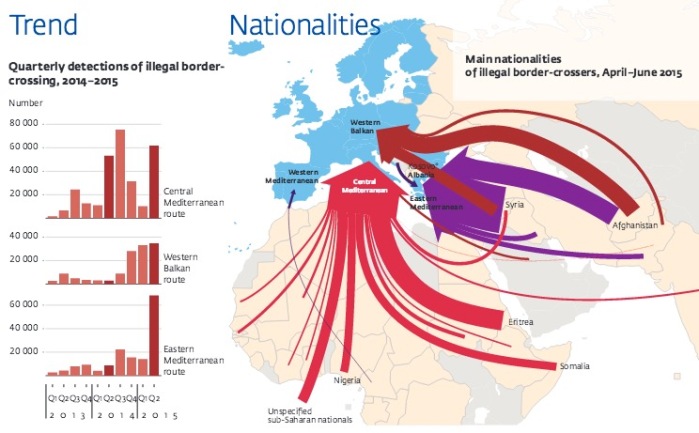
Look at the red outflows from the Horn. One fact is obvious: Eritrea is the main driver of refugees. Even Somalia does not come close.
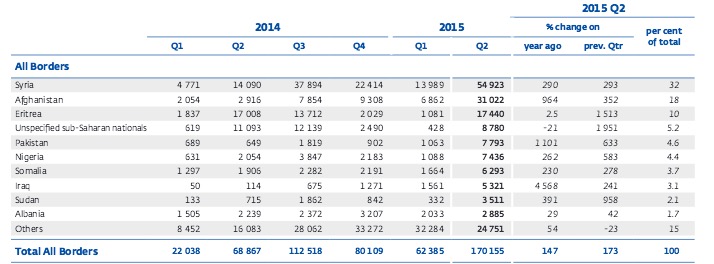
The statistics bear this out – they come from the same Frontex publication.
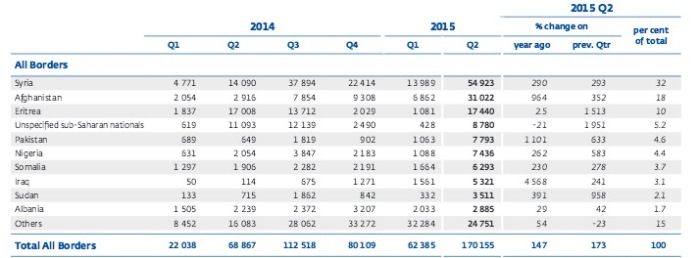
Eritrea is responsible for the third largest exodus of refugees (10% of the total) behind Syria and Afghanistan. By comparison just 2.1% of illegal entries into the EU are from Sudan.
If one looks at the per capita statistics the result is even more striking. Eritrea has a population of 5.1 million, while Sudan has a population of 39.4 million.[3] Yet of every 100,000 Eritreans 340 sought sanctuary in the EU in the second quarter of 2015. By comparison for every 100,000 Sudanese just 8.9 took the same route.[4]
Yet Eritrea is – at least on the surface – at peace and is currently not suffering from a natural disaster. The only logical conclusion is that there is something particularly noxious about the Eritrean regime that is driving so many of its citizens to take this difficult and frequently fatal step.
The Eritrean situation is not just bad; it is uniquely bad.
The Eritrean government says that it wishes to halt this exodus. It has been co-operating with the EU in what has been termed the ‘Khartoum Process’.[5]
Officially known as the EU-Horn of Africa Migration Route Initiative, the November 2014 conference was attended by the Eritrean government. Eritrea’s Minister of Foreign Affairs, Osman Saleh, who told the gathering that:[6]
Eritrea values its partnership with the European Union and is determined to work with the EU and all European countries to tackle irregular migration and human trafficking and to address their root causes. We call for an urgent review of European migration policies towards Eritreans, as they are, to say the least, based on incorrect information, something that is being increasingly acknowledged. [emphasis in the original]
Yet since then the Eritrean regime has taken no steps to end the causes of migration and flight, which are driven by human rights abuses. The Eritrean government would welcome co-operation with Interpol, Europol, Frontex and other security agencies to prevent its citizens from escaping from the country. Offering support, training and intelligence sharing with a regime that is accused of such gross human rights abuses would be a violation of the EU’s most fundamental values.
What marks out the Eritrean government?
The UN Security Council has concluded that the Eritrean regime remains a serious threat to peace in the Horn of Africa and the region as a whole. In June 2015 the Council expressed its concern at the evidence provided by UN experts that President Isaias Afewerki was responsible for “ongoing Eritrean support for certain regional armed groups.”[7] As a result the Security Council went on to re-affirm its arms embargo against the Eritrean government.
Behind these bland phrases lies a catalogue of evidence carefully assembled by experts from the UN Monitoring Group.[8] This laid out in graphic detail just how the regime operates. It supports rebel movements in neighbouring Ethiopia and Djibouti. Eritrea is now also cynically participating in the Yemeni civil war in return for the Saudi and UAE financial support.
The UN monitors report they have: “received credible and persuasive testimony from multiple sources and independent reports indicating that Saudi Arabia and the United Arab Emirates have established a military presence in Eritrea as part of the military campaign against the Houthi rebels in Yemen and may be offering Eritrea compensation for allowing its territory and possibly its troops to be used as part of the Arab coalition-led war effort.”
The experts say that this deal was done after Djibouti rejected a similar deal with the Saudis and their allies in the UAE. The UAE are said to have struck a separate deal to use the Eritrean port of Assab for the next 30 years. Situated just 60 km from the Yemeni coast, it has lain idle since Eritrea’s war with Ethiopia (May 1998 to June 2000) – a conflict that sealed the borders between the two countries.
It is not hard to imagine what Eritrea might do with the funds from its new Arab allies, since the regime has been keen to purchase weapons. The UN monitors report that a ship – the Shaker 1 – secretly docked at the Eritrean port of Massawa in January 2015. On board were Sudanese heavy weapons, apparently en route to an armaments fair in Abu Dhabi.
Whether they ever reached their destination is a moot point. What were described as eight ‘empty containers’ were offloaded at Massawa. The monitors say they have evidence that the containers were full, not empty, as claimed. It is likely that the howitzers and rocket launchers provided by the Military Industry Corporation of the Sudan were offloaded at this time. If so, this was in clear violation of the UN’s arms embargo against Eritrea.
Serious as these violations are, they pale into insignificance beside the evidence of the ongoing Eritrean backing of armed groups attempting to overthrow neighboring governments. These operations are co-ordinated by the head of Eritrean intelligence, Brigadier General Abraha Kassa, “a long-time associate of the President” – as the UN report puts it.
These movements include a newly formed front of Ethiopian rebel organisations, whose unity was “facilitated” by the Eritrean government. The Eritreans are also said to provide support to Afar rebels operating in Djibouti. This allegation, from Djibouti itself, was put to Eritrean officials, but they failed to respond. These are exactly the kind of operations the Security Council has repeatedly demanded that Eritrea brings to an end.
One of the roles of the monitors is to try to ensure that finances are not diverted by the regime to destabilise the region. This has been difficult to achieve, since the Eritrean government refused all access to the country by the experts.
Even when senior Eritrean officials, including the senior political adviser to the President of Eritrea, Yemane Gebreab, meet with the UN’s appointed monitors, their promises of assistance have proved to be worthless. The report notes that they have yet to receive the government accounts for the past three years, promised at a meeting in Cairo in February 2014.
Given what they termed this “lack of financial transparency” the UN experts explained their concerns about reports that the European Union is considering substantially increasing aid to Eritrea. The monitors call for “due diligence, monitoring and full oversight of the dispersal of large amounts of aid to Eritrea” since there is otherwise every risk that they will be used to fund rebellions across the region.
What is the evidence of Eritrea’s response to EU initiatives to date?
The European response to Eritrea has developed over many years. It should not be forgotten that Europe supported the Eritrean people even before the de-facto independence of the country in 1991: especially during the 1984 – 85 famine, when European countries were major donors. Cross-border operations fed millions who would otherwise have starved.
Since de-jure independence in 1993 was ratified by the United Nations, Europe has attempted to build a relationship with the Eritrean government. This has not proved easy. Under President Isaias Afewerki, Eritrea has become one of the most inward looking, repressive of states. The EU has attempted to build a relationship with the Eritrean regime, but this has proved next to impossible.
Mishandling the 2001 government crackdown
In 2001 there was a generalised clampdown on all forms of opposition. Independent media were closed and senior government officials and journalists – the “G-15” – were arrested and disappeared from public view. They have never been formally charged, much less tried, and have been held inceeommunicado. Among those in detention is Dawit Isaak, a Swedish-Eritrean journalist, arrested in the 2001 round-up. The EU has repeatedly called for his release and for EU representatives to actively take up his case.[9]
When the arrests took place the Italian Ambassador to Eritrea, Antonio Bandini, presented a letter of protest to the authorities. He was promptly expelled and other European ambassadors were withdrawn in response. The EU presidency said relations between the EU and Eritrea had been “seriously undermined” by the government’s action.[10]
An internal EU document explained just how poorly the EU responded to the situation.[11] The report said that it had been decided at the time that European ambassadors would be: “conditioning their return on the willingness of President Isaias to engage on human rights dialogue. This request was never satisfied, but EU Ambassadors nevertheless returned to Eritrea, in a non-coordinated way.”
Even when it is not beset by these problems, providing aid to Eritrea has proved notoriously difficult. Most aid agencies were forced to leave after a law was enacted by the regime to control their activities in May 2005. [12] This required NGO’s to pay taxes on all goods imported into the country and prohibited international agencies from engaging in ‘development,’ surely among their core activities.
As time passed the EU re-assessed its relations with Asmara.[13] Although there had been no sign of movement on human rights by the regime it was decided to attempt to try to have a ‘new beginning’ with Eritrea. In May 2007 President Isaias visited Brussels and was “warmly welcomed” by the Development Commissioner, Louis Michel.[14] In the light of the talks that were held the European Commission altered its stance towards Eritrea, as the internal report made clear.
“In June 2007 the European Commission changed its strategy and initiated a process of political re-engagement with Eritrea. The main reason for Commissioner Louis Michel’s change of approach was his determination to ignite a positive regional agenda for the Horn of Africa, where Eritrea has a major role to play in view of its presence in the conflicts in Sudan and Somalia.”
The document concluded that for this “political re-engagement” to work both sides would be required to show that they were serious about it. Concrete evidence was required:
“Both sides need political dialogue to bring some results: the European Commission needs a visible sign of cooperation from Eritrea in order to continue to justify its soft diplomacy, while the increasingly isolated Eritrean regime might need to keep a credible interlocutor and a generous donor. The liberation of Dawit Isaak based on humanitarian grounds could be such a sign but, although welcome, it would only be a drop in the ocean.”
Instead of the making improvements to human rights, the Eritrean government ensured that Dawit Isaak remained in jail, as did the other political prisoners. There was no softening in President Isaias’s stance, despite the aid that the EU was delivering. Despite this the EU pressed ahead with its ‘renewed engagement’ strategy. Brussels had learnt nothing from the mistakes made following the 2001 withdrawal of its ambassadors. Asmara, on the other hand, believes that if it remains obdurate European politicians and civil servants will, in time, give in to its demands. President Isaias determines the agenda and has no intention of softening his stance on his people’s democratic rights.
On 2nd September 2009 the EU and Eritrea signed a Country Strategy for 2009 – 2013.[15] This acknowledged the impact of Eritrea’s 2001 crackdown on dissent, albeit in diplomatic language. “From 2001 to 2003, there was a slowdown in EU-Eritrea development cooperation, and the Political Dialogue process witnessed the emergence of substantially divergent views on developments in Eritrea and the Region.” The report talked about “limited” political dialogue, but said that regular meetings were planned.
A mission by the Development Committee of the European Parliament in late 2008 painted a more gloomy, but more accurate, picture.[16] The fact-finding mission by a delegation from the EU Development Committee to the Horn found that:
“Since the interruption of the democratisation process in 2001, EC cooperation with Eritrea has been confronted with major political and technical difficulties. Cooperation was frozen for several years in reaction to the expulsion of the Italian Ambassador, which led to a certain backlog with the 9th EDF funds.”
At the same time the delegation was able to report that relations had improved in recent years and funds had begun to flow once more.
Buoyed up by an apparently more positive situation the EU Development Commissioner, Louis Michel, re-opened talks with Eritrea. By August 2009 he was sufficiently encouraged by his discussions to visit Asmara, after receiving assurances from an Eritrean diplomat that Dawit Isaak, would be released into his care.[17] Having booked a ticket for Dawit to return with him to Europe, Louis Michel left for Asmara. But once he met President Isaias it became immediately apparent that the President had no intention of allowing Dawit to go free. Indeed, Mr Michel was not even permitted to visit the prisoner, and had to return to Europe without Dawit – a humiliation for such a senior EU representative.
A ‘useless’ engagement
Despite these setbacks the EU has remained wedded to attempting to secure its relationship with Eritrea. It is noteworthy that in October 2009, despite the fiasco surrounding the Louis Michel visit, European foreign ministries were prepared to take a considerably softer line towards Eritrea than their American counterparts. A US diplomatic cable, released by Wikileaks, reported how one European representative after another called for restraint, while opposing extending sanctions against the Afeworki regime.[18]
“Italy described Eritrea as governed by a ‘brutal dictator,’ and noted that Italy had not gotten results from its efforts at engagement. He cautioned, however, against ‘creating another Afghanistan’ by applying Eritrea-focused sanctions. The Italian representative questioned whether the sanctions should be focused on spoilers in general and include others beyond Eritrea. The French said that while engagement was ‘useless,’ France would continue on this track as there was no other option.”
Speaking at the same day-long meeting the British official, Jonathan Allen, said: “London has already made clear to Asmara that the UK was aware Eritrea was supporting anti-Western groups that threatened British security.” In reply the American senior representative, the Deputy Assistant Secretary for African Affairs, Karl Wycoff pointed out what were described as: “the inconsistency between the private acknowledgement that Asmara was not only playing a spoiler role with regard to Somalia but also supporting violent, anti-West elements and the provision by some countries provided assistance packages to Asmara. He also noted that strong actions, including sanctions, were needed to have a chance of changing Isaias’s behaviour.”
Despite the American concerns the EU pressed ahead with its strategy: a strategy in which it had little faith and which its representatives described as ‘useless’. It remains a strategy that has seldom been publicly acknowledged or openly discussed.
The situation was reviewed once more in 2011, when the EU drew up a ‘Strategic Framework for the Horn of Africa.[19] This laid out Europe’s relationship with the region as a whole: “The EU is heavily engaged in the region, with involvement focused around five main areas: the development partnership, the political dialogue, the response to crises, the management of crises and the trade relationship.”
The document then elaborates on how this would be achieved.
“The development of democratic processes and institutions that contribute to human security and empowerment will be supported through:
- promoting respect for constitutional norms, the rule of law, human rights, and gender equality through cooperation and dialogue with Horn partners;
- support to security sector reform and the establishment of civilian oversight bodies for accountable security institutions in the Horn countries;
- implementing the EU human rights policy in the region;”
The Framework also declared that it was committed to involving what it describes as the “large Horn diaspora living in Europe” in the achievement of these goals. In line with these policies it was decided to provide Eritrea with aid worth €122 million between 2009 and 2013.[20]
Since the Strategic Framework was drawn up the situation inside Eritrea has gone from bad to worse. This has driven Eritreans into exile in record numbers. Although the EU continued to raise the human rights situation in Eritrea under its Article 8 dialogue, there has been no progress on the release of political prisoners, the implementation of the Constitution or on freedom of expression.[21] The country remains a one-party state, locked into permanent repression.
The United Nations Human Rights Council’s rapporteur on human rights in Eritrea, Sheila Keetharuth, made it clear in her 2014 report that there was no improvement in the situation and that: “The violations described in the present report are committed with impunity.” As Ms Keetharuth made plain, she received no co-operation from the Eritrean authorities in carrying out her mission and was repeatedly denied access to the country.[22]
So concerned has the international community become at the situation inside Eritrea that in June 2014 it took the rare step of establishing a Commission of Inquiry into the country’s human rights.[23] This initiative received the support of all EU member states.[24]
The Commission published its report in June 2015. Its key finding was that: “The Government of Eritrea is responsible for systematic, widespread and gross human rights violations that have created a climate of fear in which dissent is stifled, a large proportion of the population is subjected to forced labour and imprisonment, and hundreds of thousands of refugees have fled the country, according to a UN report released Monday. Some of these violations may constitute crimes against humanity.”[25]
Lessons learnt
Federica Mogherini, the EU’s senior diplomat, warned Eritrea recently that it had to respect human rights and urged the country to engage in deep reforms.[26] This is the background against which any consideration of a “re-engagement” with Eritrea must be judged. The following lessons can be drawn from the EU’s previous attempts to build a relationship with the regime.
- There is no evidence that President Isaias and his government has any intention of moving away from its current policies, which involve the systematic denial of human rights. As the EU representatives acknowledged privately in 2009, attempts at engagement are ‘useless.’[27] It would be a grave error to believe the vague promises of powerless ministers and diplomats.
- Repeated attempts to win over the regime have ended in failure. Past promises of reform, made by Eritrean diplomats, carry no weight. The political prisoners remain in detention, democratic rights are denied and there is no freedom of conscience or religious expression. Rather, as the EU’s experiences in 2001 and 2009 indicate, any softening of pressure is regarded by President Isaias as a sign of the weakness of international resolve. The regime believes it can out-last any external criticism.
- Promises of aid and international assistance have not resulted in any softening of this stance. Attempting to establish a ‘new engagement’ with Eritrea without seeing concrete, verifiable changes in the policies and practices of the regime would require abandoning the human rights agenda that is an integral part of European development policy.
- The EU’s initiative termed “the Khartoum process” aims to identify sources of economic support in order to stem migration. Treating the problem as economic misses the point in relation to Eritrea. As Baroness Kinnock has said: ‘The regime in Eritrea is, in short, a secretive, reclusive, authoritarian tyranny which is ruthlessly controlled by President Afewerki.’ The root cause of the Eritrean refugee crisis is the absence of the rule of law and the repression of its citizens; unless these underlying causes are addressed nothing else will work.
- From the above it is clear that the Eritrean government cannot be regarded as a suitable partner for the EU: its repression is worse than almost any other in Africa, its word cannot be trusted and any concessions will be regarded as signs of weakness. There is every likelihood that aid will be diverted (directly or indirectly) into the Eritrea’s military, thereby further destabilising the Horn of Africa. Given the lack of transparency of Eritrean public finances the EU will not be in a position to prevent this diversion from taking place.[28]
- Any proposals for co-operation between EU and international security forces and their Eritrean counterparts must be resisted. To assist the Eritrean regime in its stated goal of halting the flight of its citizens under the guise of curtailing the activities of people smugglers and traffickers would be unconscionable.
- In the light of the above, and given the EU’s public commitment to human rights as an integral part of the development process, Eritrea cannot be regarded as a suitable or legitimate partner in the forthcoming Africa – EU summit in Valletta.[29]
[1] Senior Research Fellow, Institute of Commonwealth Studies, University of London and former Africa Editor, BBC World Service News
[2] Frontex report, Fran Quarterly, April-June 2015
http://frontex.europa.eu/assets/Publications/Risk_Analysis/FRAN_Q2_2015_final.pdf
[3] World Bank data
[4] Put another way, in this quarter 0.34% of Eritreans arrived in Europe, 0.0089% Sudanese arrived in Europe
[5] http://ecre.org/component/content/article/70-weekly-bulletin-articles/911-khartoum-process-eu-and-african-union-launch-initiative-against-smuggling-of-migrants.html
[6] Official Eritrean government website.
http://www.tesfanews.net/eritrea-denounces-human-trafficking-urges-eu-review-of-migration-policy/#pc6Afk5gbaDFBFb6.99
[7] http://www.un.org/press/en/2015/sc12094.doc.htm
[8] http://www.un.org/ga/search/view_doc.asp?symbol=S/2015/802
[9] http://www.europarl.europa.eu/document/activities/cont/201109/20110920ATT27041/20110920ATT27041EN.pdf
[10] http://www.europeanvoice.com/article/eu-protests-after-eritrea-expels-envoy-bandini/
[11] Background Note on Eritrea, October 2008, Directorate-General for external policies of the Union, Directorate B, Policy Department.
http://eu-information-service.rs-consulting.com/Policy%20Department%20for%20External%20Relations/Countries%20and%20Regions/ACP%20Countires%20%28African,%20Caribbean,%20Pacific%29/2.%20Country%20Notes/Eritrea/Eritrea%20country%20note%202008.pdf
[12] Dan Connell and Tom Killion, Historical Directory of Eritrea, Second Edition, Scarecrow Press, Toronto, 2011, p. 399
[13] Background Note on Eritrea, October 2008, Directorate-General for external policies of the Union, Directorate B, Policy Department.
http://eu-information-service.rs-consulting.com/Policy%20Department%20for%20External%20Relations/Countries%20and%20Regions/ACP%20Countires%20%28African,%20Caribbean,%20Pacific%29/2.%20Country%20Notes/Eritrea/Eritrea%20country%20note%202008.pdf
[14] http://www.eepa.be/wcm/dmdocuments/2010-07-16_Eritrea_and_Isaias_Afewerki_a_cold_logic.pdf
[15] http://ec.europa.eu/development/icenter/repository/scanned_er_csp10NEW_en.pdf
[16] Report of the fact-finding mission of a Delegation of the Development Committee of the European Parliament to the Horn of Africa (Eritrea, Djibouti, Ethiopia) (25 October-2 November 2008)
[17] http://www.asmarino.com/news/435-an-afternoon-with-louis-michel-in-the-european-parliament
[18] http://www.telegraph.co.uk/news/wikileaks-files/somalia-wikileaks/8302251/EUROPEANS-TRACK-U.S.-ON-EAST-AFRICA-BUT-REMAIN-RELUCTANT-TO-SANCTION-ERITREA.html
[19] A Strategic Framework for the Horn of Africa, EU 14 November 2011
http://www.consilium.europa.eu/uedocs/cms_data/docs/pressdata/en/foraff/126052.pdf
[20] http://www.eeas.europa.eu/delegations/eritrea/eu_eritrea/political_relations/index_en.htm
[21] https://www.gov.uk/government/publications/eritrea-country-of-concern/eritrea-country-of-concern-latest-update-31-march-2014
[22] Report of the Special Rapporteur on the situation of human rights in Eritrea, Sheila B. Keetharuth, 13 May 2014, A/HRC/26/45
[23] http://daccess-dds-ny.un.org/doc/UNDOC/LTD/G14/062/46/PDF/G1406246.pdf?OpenElement
[24] http://www.hrw.org/news/2014/09/26/eritrea-un-names-commission-inquiry
[25] http://www.ohchr.org/EN/NewsEvents/Pages/DisplayNews.aspx?NewsID=16054&LangID=E
[emphasis added]
[26] http://diplomat.so/2015/10/21/federica-mogherini-urges-eritrea-to-respect-human-rights/
[27] http://www.telegraph.co.uk/news/wikileaks-files/somalia-wikileaks/8302251/EUROPEANS-TRACK-U.S.-ON-EAST-AFRICA-BUT-REMAIN-RELUCTANT-TO-SANCTION-ERITREA.html
[28] The UN has repeatedly made this clear, and it is important that this lesson is not ignored. This is what the UN Monitors had to say about this: http://www.un.org/ga/search/view_doc.asp?symbol=S/2015/802
“During its mandate, the Monitoring Group has received consistent information from several former government officials and independent sources with direct knowledge of Eritrean finances that the Government of Eritrea continues to maintain a PFDJ-controlled informal economy involving hard currency transactions through a non-transparent network of business entities incorporated in several jurisdictions.[28] The complete lack of financial transparency by the Government of Eritrea enables it to maintain a PFDJ-controlled informal economy. Senior officials within the Government and PFDJ continue to exert full economic control over revenue through a clandestine network of State-owned companies.33 The Group has documented extensively in its previous reports (S/2014/727 and S/2011/433) how Eritrea manages an offshore financial system controlled by elements of the Government and PFDJ to generate revenue streams.
As the Monitoring Group has repeatedly concluded, most companies in Eritrea are owned by the State and managed by senior officials of the Government, PFDJ and the military. The network of companies linked to PFDJ continues to be the driving force of the economy. The Government, through PFDJ and the military, has exclusive control of all economic activity, including the agriculture, trade and production sectors. In 2006, the Government passed Proclamation No. 159/2007 (Foreign Financed Special Investments Proclamation), which specifically limits foreign investment in financial services such as national wholesale trade, national retail trade and commission of agencies, but permits investment in other sectors.[28] Meanwhile, in 2005, the Government suspended all private enterprises from conducting construction in the country and effectively awarded all public contracts to businesses controlled by PFDJ.”
[29] http://www.consilium.europa.eu/en/meetings/international-summit/2015/11/11-12/








 .
.