Main_stream_ray

John Ray Africa Correspondent

A large proportion of the migrants arriving in Europe from Africa have come from the small, secretive nation of Eritrea.

Thousands of Eritreans readily risk death trekking across the gruelling Sahara and take the desperate gamble of a sea crossing to flee one of the world’s harshest regimes.

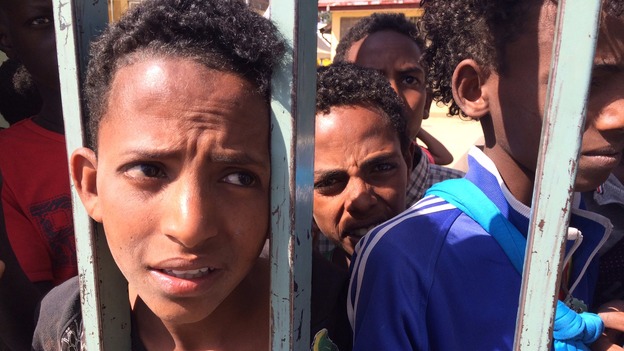
A newly arrived child at a reception centre of Eritrean refugees in the north of Ethiopia

A newly arrived child at a reception centre of Eritrean refugees in the north of Ethiopia Credit: ITV News


In the sleepy streets of the border town not long after dawn it is a startling sight.

Hundreds upon hundreds of men and women marching in neat ranks towards us.

They are the latest escapees from Eritrea; one of the world’s most forbidding regimes.

They’ve been picked up close to the border by Ethiopian patrols and brought to one of several reception centres.

This is the everyday routine, says a senior official from the United Nations.

refugee campA refugee camp in northern Ethiopia that's home to many thousands of Eritrean refugees. Some stay for years, but for many it's a stop off only on their journey to Europe. Credit: ITV News


By one UN estimate, 9% of Eritrea’s population of 4.5 million has fled the country.

One in fifty has sought a new home in Europe.

Eritrea is known as African’s North Korea. A small, secretive state that has lived under emergency rule for 18 years.

No elections, no opposition parties, no free media.

The UN has accused its leaders of crimes against humanity.

Accusations of mass surveillance, arbitrary detention and torture feature strongly in the reports of human rights organisations.

Almost every male refugee we spoke to at the Mai Ani camp tells the same story; how they wanted to avoid compulsory military service, a form of forced labour that can last indefinitely.

Robel Habtie is a slender, gentle young man. He told me how he and his friends slept for three nights in the mountains to avoid the call up.

Robel Habtie Robel Habtie has fled Eritrea, which has earned a reputation as Africa’s North Korea Credit: ITV News


In the end, he decided to run for the border.

"How can I live there?’" he asks. "There is no work, no money, no chance."

The journey to Europe, across the desert and the Mediterranean is notoriously dangerous.

But until 2014, most Eritreans could at least expect to be welcomed as genuine refugees.

But that’s changing; as the well of sympathy dries up in the face of the larger Syrian crisis.

According to Amnesty International, the refusal rate for Eritrean applicants for asylum has jumped from 14% to 66%.

But that doesn’t deter Robel, and many like him.

He has a just few dollars in his pocket, only the clothes he stands up in, but he has his heart set on Britain.

"If I have a chance to get to Europe, then I will try," he tells me.

"I can think of how my family live in Eritrea. I want better."

Last updated Tue 23 Feb 2016
 

The Peace and Security Council of the African Union (AU), at its 576th meeting, held on 16 February 2016, in Addis Ababa, dedicated an open session to the theme: migration, peace and security in Africa.

Council took note of the presentations on migration, peace and security in Africa by the Head of the European Union Delegation to the African Union and by the Representative of the International Organization for Migration (IOM) to the African Union. Council also took note of the statements made by representatives of some AU Member States, international partners, specialized institutions, think tanks and civil society organizations.

Council recalled that the 2006 African Common Position on Migration and Development, as well as the Migration Policy Framework for Africa provide a sound basis from which to address some of the challenges linked to illegal migration, which include violent conflicts, bad governance, human rights violations, environmental factors, social exclusion, marginalization, poverty, inequality and underdevelopment, as well as lack of opportunities, particularly for the youth. Therefore, Council urged Member States to take urgent steps to effectively address these push factors for illegal and forced migration, stressing, in particular, the need for availing opportunities for the youth, as well as the need to promote stable, secure, prosperous and inclusive societies.

Council reaffirmed the recognition, in the African Common Position on Migration and Development, that illegal migration is currently taking serious dimensions and alarming proportions that threaten peace, security and stability of the continent. In this context, Council reaffirmed the AU commitment, among others, to strengthen efforts to combat human trafficking and smuggling of migrants, through the implementation of the provisions of the United Nations Convention on Transnational Organized Crime and its Protocols against Trafficking in Persons and Smuggling of Migrants.

Council, while noting that properly managed legal and regular migration within Africa can be a very significant catalyst for promoting the integration of the African continent and that, beyond Africa, migration is an ever-present and growing phenomenon, underscored the need for ensuring the effective protection of economic, social and cultural rights of migrants, including the right to development, in line with the relevant human rights instruments. In the same vein, Council emphasized the need for developing frameworks and agreements on the return, readmission/ re-integration of Illegal and forced migrants.

Council emphasized the need for comprehensive gender-sensitive migration policies, which can ensure that women and girls fleeing violent conflicts and other push factors in their countries of origin are not subjected to exploitation, including human trafficking.

While acknowledging that Africa and the international community have adequate policy instruments for addressing the issue of illegal and forced migration, Council underscored the need for Member States to sign, ratify and fully implement legal instruments on migration, including the African Common Position on Migration and Development, as well as the Migration Framework for Africa, with a view to reverse the persistent trend of illegal and forced migration on the continent.

Council noted the potential link between illegal migration and transnational organized crime, including terrorist and violent extremist groups. In this connection, Council emphasized the need to put in place effective mechanisms for combating corruption and organized crime, including human trafficking and smuggling.

Council also noted that no country is immune to the issue of illegal and forced migration, which is a multidimensional and complex challenge.  In this respect, Council underscored the need for effective border management, within the context of strict observance of human rights, as well as for cooperation and information sharing among the countries of origin, transit and destination of illegal migrants. Council also emphasized the need for the AU and its partners, as well as the larger international community to enhance cooperation in addressing the root causes of illegal and forced migration, particularly, in the countries of origin.   

Council agreed to remain seized of the matter,

Source=http://www.peaceau.org/en/article/press-statement-of-the-peace-and-security-council-of-the-african-union-au-at-its-576th-meeting-on-migration-peace-and-security-in-africa#


A new report prepared by the Security Sector Program (ISSP) of the Intergovernmental Authority on Development (IGAD) and the Nairobi-based SAHAN Foundation has revealed that Eritrean diplomats and prominent nationalities of the Red Sea state are massively involved in human trafficking and smuggling activities in the Horn of Africa region.

The report was prepared upon the request of the governments of Ethiopia and Sudan and describes the illegal activities that are taking place from the Horn of Africa via Libya to Europe as a “dangerous and organized illicit trade”.

The 39-page report entitled, “Human Smuggling and Trafficking on the Horn of Africa-Central Mediterranean Route” was made public February 19, 2016 during a consultation meeting organized by the new ISSP office, which was opened in Addis Ababa.

The new report was summarized and presented to the Addis Ababa-based diplomats and the press by Matt Bryden, chairman of SAHAN. Bryden indicated the different human trafficking routes, mainly the Northern and Southern route, to Europe.

Accordingly, human trafficking between the Horn of Africa and Europe is run by a “sophisticated and integrated international networks that derive massive profits from the mass movement of thousands of migrants and refugees”.

“The principal smugglers and trafficking kingpins who dominate the central Mediterranean Route are predominantly Eritrean in nationality who reportedly collaborate with ethnic Somalis, Ethiopians and Sudanese to eases border crossings,” the report read.

The study claimed that there are two groups of migrants from Eritrea; those who fled Eritrea on their own and those who claim to have been assisted. Those travelers said that they have contacted facilitators in and outside Eritrea for a safe passage out of the country. Others allegedly said to have contacted smugglers over the internet who provided local contacts usually in Asmara.

“These facilitators – alleged to be government facilitators – would typically arrange for transportation to Sudan or Ethiopia without any immigration procedure…Some prominent Eritrean human smugglers appear to rely upon the services of Eritrean diplomats abroad,” the report stated.

Some migrants are also reported to have obtained Eritrean ID cards and passports at the Eritrean embassy in Khartoum.

Some well-connected Eritrean smugglers operating from Khartoum are said to have organized flights to remote international destinations from where European visas are obtained for their passengers.

The report identifies some of the key Eritrean nationals involved in smuggling and trafficking.

Among them is an Eritrean individual known as John Habtu a.k.a. Obama. He is mentioned and profiled in the report. Another pioneer smuggler was Habtom Merhay, who is indicted in the US in 2010 and pleaded guilty to having smuggled several “first-class” migrants from Eritrea.

The other smuggler is a man by the name Efrem Misgna, who according the the report has been arrested in Italy, routinely serves as an escort for Eritrean government and party officials when they visit Europe. The report also published a picture of Efrem along with Yemane Gebreab, senior government official, during the latter's visit to Stockholm in 2012.

“Human trafficking is an issue related to security that demands concerted efforts from members of the IGAD region and the international community” Commander Abebe Muluneh, Director of ISSP, who chaired the meeting, said.

It was also reported that migrants risk abandonment in the desert, kidnapping for ransom by criminal gangs and abduction or execution by militants affiliated with the Islamic State (IS).

The attendees expressed the urgency and need for international collaboration to respond to the problem. Some even demanded the Security Council to pass a resolution against the officials and criminals involved in the smuggling.

It is reported that there is a sharp increase in the arrival of Eritrean refugees in Ethiopia, with a record of 34,451 new arrivals into Ethiopian camps between January 1 and August 31 in the year 2015.

Back in 2015, the United Nations High Commissioner for Refugees (UNHCR) in Ethiopia has reported the total number of Eritrean refugees and asylum seekers is well over 140,000.

This new report indicated that – in the same year – 154,000 migrants entered Europe via the Central Median Route. Out of this 39,000 migrants are from Eritrea, which is the second smallest country in Africa.

The study, which was conducted between June and September of 2015 worked in close consultation with government officials from Ethiopia and Sudan and reportedly received excellent support from European countries, notably the UK and Italy. Researchers also stated that they have visited Egypt, France, Kenya, Sudan, Switzerland, Tunisia and the UK to meet with government and NGO officials and migrants from the Horn of Africa, mainly from Eritrea. The team also said that it interviewed over 200 fresh migrants, some during first arrival and others in the country of destination.

Source=http://www.thereporterethiopia.com/content/report-reveals-eritrean-diplomats-prominent-nationals-involvement-human-smuggling#.VsmgOzcH3Us.mailto

Mohammed Ali Ibrahim, Central Council member of the Eritrean People's Democratic Party (EPDP), is marking this week his 4th year since he disappeared in Kassala, Sudan, on 14 February 2012. His comrades-in-struggle, Woldemariam Bahlbi and Teklebrahan Ghebre-Tsadiq (Wedi Bashay), who were Executive Committee members of the ELF-RC, will mark their 24th year of disappearance in April this year. The three of them were reportedly seen in some of the prisons of PFDJ's Eritrea, a country for whose sake they spent everything in life.

MAIWBTG

The list of disappeared Eritreans is growing by the say. Hundreds 'disappeared' in the Sudan in the last 25 years of Eritrea's territorial 'independence'. Observers and most Eritreans believe that the unmistakable culprit is the criminal regime in Asmara.


During the 2015 submissions to the UN Commission of Inquiry, many Eritreans identified their own long list of 'disappeared' Eritrean freedom fighters and submitted them o the UN COI on Eritrea. The writing below is a submission of a single person who knew closely these 20 in this list.

Mohammed Ali Ibrahim

  • He left his house in the outskirts of Kassala on bicycle in the morning hours of 14 February 2012 towards downtown Kassala and he was never seen again. His bicycle was found in the city.
  • That morning a vehicle without a plate number and with darkened windows, which made people raise eyebrows in Kassala, was seen driving to the direction from where Mohammed Ali was coming to the city centre.
  • His telephone call responded after four days of his disappearance. The responder, talking in perfect Sudanese Arabic, said: “You will never get Mohammed Ali easily” and he bunged the phone.
  • Several months later, his wife, Fatima, and his two sons, Majid and Nassir, heard rumours that Mohammed Ali "is" in a prison not far from the town of Hagaz in western Eritrea.
  • Mohammed Ali Ibrahim joined the Eritrean Liberation Front at the age of 17 in 1967 and was in continued struggle until his arrest.
  • At the time of his arrest, he was member of the Central Council of the Eritrean People’s Democratic Party (EPDP)....

Woldemariam Bahlbi and Teklebrahan Ghebre-Tsadik (Wedi-Bashai)


  • Both were Executive Committee members in charge of military

and security affairs of the then Eritrean Liberation Front – Revolutionary Council (ELF-RC). They were kidnapped on 26 April 1992 by agents of the then new Eritrean government in collaboration with Sudanese security.

  • The day was an Eritrean Easter Holiday and they were invited for morning breakfast by a certain Tesfazion Gebre-Yesus, a government supporter whose wife was a relative of Woldemariam. He came from Saudi Arabia to visit his family in Kassala. When they wanted to leave after the food, he used many reasons to delay them (eg he asked his son to go on errand by using one of the bicycles of the two ELF-RC members.
  • When they left his house, persons in Sudanese security uniforms told them that they were needed at the Kassala Security Office, which they accepted as normal because they were used to such duty invitations related to Eritrean citizens in the city.
  • Eyewitnesses saw them being taken to the Kassala security office. Later in the day, they were seen riding in a fast moving Toyota car which was heading towards the border to Eritrea.
  • Tesfazion Gebre-Yesus, the collaborator who invited them to his house, was heard saying about them:       “Don’t worry, they have gone to their home country”.
  • Their colleagues in Kassala on 10.05.1992 notified to the Sudanese authorities accusing Tesfazion Gebre-Yesus as an accomplice. The Sudanese authorities reportedly decided that he should be searched - but the person was already out of the country.  
  • That was their end of their story although rumours persisted that they were being moved from prison to prison in Eritrea.

From Among Those Who Disappeared in the 1990s:

  1. Memher Ghirmai Gebrehawariat, a former ELF-RC member was arrested in Asmara in 1994 and disappeared without trace.
  2. In 1996, Mohammed Muftah and
  3. Mohammed Bani were arrested in the town of Adi Kayih, Akele-Guzai. They were former fighters of the ELF who returned home after liberation.
  4. Embaye Hidru (original of Liban Habela, Hamassien province) arrested in Barentu in 1996. He lived in Wad-Sherifey, Sudan before returning home after independence.
  1. 5.Woldeselassie Chanchu,
  2. Gherebrahan Zere, was kidnapped from the Eritrea-Ethiopia border town of Humera on 4 February 1997 and his whereabouts are not yet known.

Ten former freedom Strugglers Who Disappeared in a Single Day, 16.12. 2002

The three below were taken prisoners after an attack of the government army in February 1992 against ELF-RC units in the Gash. They were freed in 2000 and started civilian life as workers and students till a surprise action that took in the morning hours of 16 December 2002. No family member or friend saw them after the arrest.

  1. Ghebre-Luul Amdezion (original of the village of Adi Yacob, Hamassien province), a father of one child, arrested while going to work;
  2. Habtemichael Berhe (original of the village of Korbaria, Akele-Guzai province) arrested while walking towards the Asmara University to attend classes. He was freedom fighter in the ELF since 1975 until his return to Eritrea after independence;
  3. Andebrahan Kidane (from the village of Ahsia, Serae province).

Disappeared 1                        Ghebre-Luul Amdezion             Habtemichael Berhe                         Andebrahan Kidane


The first two of the followings three compatriots returned to Asmara to lead civilian life in independent Eritrea. They were law-abiding citizens until the surprise arrest of 16 Decembers:

  1. Memhir (teacher) Haile Selassie Ghebre-Kristos (originally from the village of Hadish Adi, Akele-Guzai) arrested while going to the school where he taught. His bicycle was found thrown down in a street in Asmara;
  2. Amanizgi Tekeste (original of Adi Naamin, Hamassien) was arrested and taken away in a taxi-like vehicle. His bicycle was left in the street.

Disappeared 2                                                  Haile S Ghebrekristos                                    Amanezghi Tekeste

  1. Ghebrehiwet Keleta was first kidnapped from the Sudan after independence and was released in December 2000 after 8 years in prison and started work in one of the private papers. H was arrested in 2001 and disappeared for good.

The list below shows five civilian members of the ELF till liberation who were giving information and succor to fighters against the Ethiopian occupation army. After independence, they were conducting normal life until the PFDJ agents arrested them on that fateful 16 December 2002. They disappeared without trace.   

  1. Memhir (teach) Hailemelekot Mehari, arrested in Asmara (his village of origin is Tera-Imni, Serae province and his family phone number in Asmara was.....
  2. Memhir (teacher) Debessai Mehari, arrested in Keren.Prisoners who were released later reported having seen him at one time in an Asmara prison called Track B. That was the last news about him.
  3. Memhir (teacher) Yohannes Naizgi, arrested in Asmara (originally from Akele Guzai province. His family phone number in 2002 was....
  4. Memhir (teacher) Hadgu Tekle, arrested in Agordat (originally from Hassien province. His family number was ........
  5. Woldeab Andemariam, a commercial bank manager, was arrested in    Asmara (originally from the village of Adi-Yacob, Hamassien province).


Mirjam van Reisen | Credit. Philips FoundationAMSTERDAM (IDN) - A Court in Amsterdam struck down Meseret Bahlbi lawsuit against Mirjam van Reisen, Dutch professor and human rights advocate. The judge found that she was not guilty of libel and slander and that the youth party of the Eritrean regime can be seen as a means of collecting intelligence abroad. The decision comes as a huge relief not only for the Dutch professor, but also for the Eritrean diaspora across Europe.

When the case was heard on January 27, 2016 in Amsterdam the focus was more about the nature of the regime in Eritrea, and the role played by its supporters in Europe. The court room was packed to overflowing, mostly by Eritreans from the diaspora in Europe. The majority came to support Mirjam van Reisen. She was being sued for libel and slander by Bahlbi, an Eritrean residing in the Netherlands.

Although the legal action centred on remarks made by the professor on Dutch radio, it quickly became apparent that this case was about more than the comments. On February 10, 2016, the judge ruled that van Reisen had no case to answer and awarded damages against Bahlbi in her favour. The ruling ensured that opinions based on research and evidence would not be muted, and should not be silenced by those who disagree.

Although certainly not the crux of the matter, it is important to understand the background of the case. On May 21, 2015 van Reisen expressed concern that two interpreters for the Dutch Immigration Office were siblings of the “centre of the Eritrean intelligence in the Netherlands”.

Bahlbi’s name was not mentioned during the interview for BNR Nieuwsradio, but he felt it was clear that the statemented referred to him. This is because Bahlbi is the former head of the Young People's Front for Democracy and Justice (YPFDJ) in the Netherlands, a nationalist Eritrean Diaspora youth organisation connected to the Eritrean ruling party, the People's Front for Democracy and Justice (PFDJ).

Following van Reisen’s comments, Bahlbi filed a legal action for libel and slander. In the judgement, the judge declared that van Reisen’s statements were warranted and that she had provided sufficient evidence of the facts.

In the Amsterdam court room, both the prosecution and the defence spent little time debating the facts of what was said. Instead, arguments centred on the relationship between the YPFDJ and the PFDJ, conditions in Eritrea, why so many Eritreans were fleeing their country and the existence of the Eritrean secret services in the Netherlands.

Van Reisen’s lawyer strove to show that the YPFDJ was the “eyes and ears” of the Eritrean regime. The court’s decision accepts this to be the reality. A common headline across Dutch newspapers was De lange arm van Eritrea, or the ‘long arm of Eritrea’. The arm not only refers to intelligence gathering, but also to intimidation. UN personnel, journalists and van Reisen herself have all been subjected to intimidation from members of the YPFDJ because they have drawn attention to the human rights abuses perpetrated by the regime and its supporters.

Interpreters are a crucial part of the Dutch immigration service, and yet their direct access to political refugees makes them a valuable asset for a repressive and secretive Eritrean state. Information given to interpreters during the asylum process can prove costly for relatives and friends back home. Such interpreters are also in a position to twist the meaning of what is being said. Regulations are in place to ensure that the integrity of interpreters is beyond doubt. They are screened to check that they and their family members are not connected to the Eritrean regime. Questions remain regarding how interpreters with clear connections to the Eritrean regime were employed in the first place.

Professor van Reisen has expressed her relief that the judge ruled in her favour, but also expressed concern and continued to advocate for those fleeing from and suffering in Eritrea. She told the Dutch press “I now know what it feels like to be Eritrean” having witnessed the legal and less than legal attempts to silence her. Overjoyed with the news of her judgement, van Reisen posted on Facebook: “victory to all justice seekers. Together we will continue to pursue the truth.”

The court’s decision sends a strong message – the Netherlands is an open democracy where evidence based criticism is legitimate. The rule of law, democracy and freedom of speech, values that the EU and the Netherlands stand for, have been defended. Values which Eritreans do not enjoy in their own country. [IDN-InDepthNews – 10 February 2016]

Related article: Dutch Court Examines Alleged Eritrean Surveillance & Intimidation

IDN is flagship of the International Press Syndicate.

Photo: Mirjam van Reisen | Credit. Philips Foundation

2016 IDN-InDepthNews | Analysis That Matters

This e-mail address is being protected from spambots. You need JavaScript enabled to view it. | This e-mail address is being protected from spambots. You need JavaScript enabled to view it.

Follow us on Twitter and Facebook:
http://twitter.com/InDepthNews
http://www.facebook.com/IDN.GoingDeeper


Source=http://www.indepthnews.info/index.php/global-issues/2732-court-rules-in-favour-of-dutch-human-rights-advocate


Court Rules in Favour of Dutch Human Rights Advocate

AddThis Social Bookmark Button

By Reinhardt Jacobsen | IDN-InDepthNews Report

Mirjam van Reisen | Credit. Philips FoundationAMSTERDAM (IDN) - A Court in Amsterdam struck down Meseret Bahlbi lawsuit against Mirjam van Reisen, Dutch professor and human rights advocate. The judge found that she was not guilty of libel and slander and that the youth party of the Eritrean regime can be seen as a means of collecting intelligence abroad. The decision comes as a huge relief not only for the Dutch professor, but also for the Eritrean diaspora across Europe.

When the case was heard on January 27, 2016 in Amsterdam the focus was more about the nature of the regime in Eritrea, and the role played by its supporters in Europe. The court room was packed to overflowing, mostly by Eritreans from the diaspora in Europe. The majority came to support Mirjam van Reisen. She was being sued for libel and slander by Bahlbi, an Eritrean residing in the Netherlands.

Although the legal action centred on remarks made by the professor on Dutch radio, it quickly became apparent that this case was about more than the comments. On February 10, 2016, the judge ruled that van Reisen had no case to answer and awarded damages against Bahlbi in her favour. The ruling ensured that opinions based on research and evidence would not be muted, and should not be silenced by those who disagree.

Although certainly not the crux of the matter, it is important to understand the background of the case. On May 21, 2015 van Reisen expressed concern that two interpreters for the Dutch Immigration Office were siblings of the “centre of the Eritrean intelligence in the Netherlands”.

Bahlbi’s name was not mentioned during the interview for BNR Nieuwsradio, but he felt it was clear that the statemented referred to him. This is because Bahlbi is the former head of the Young People's Front for Democracy and Justice (YPFDJ) in the Netherlands, a nationalist Eritrean Diaspora youth organisation connected to the Eritrean ruling party, the People's Front for Democracy and Justice (PFDJ).

Following van Reisen’s comments, Bahlbi filed a legal action for libel and slander. In the judgement, the judge declared that van Reisen’s statements were warranted and that she had provided sufficient evidence of the facts.

In the Amsterdam court room, both the prosecution and the defence spent little time debating the facts of what was said. Instead, arguments centred on the relationship between the YPFDJ and the PFDJ, conditions in Eritrea, why so many Eritreans were fleeing their country and the existence of the Eritrean secret services in the Netherlands.

Van Reisen’s lawyer strove to show that the YPFDJ was the “eyes and ears” of the Eritrean regime. The court’s decision accepts this to be the reality. A common headline across Dutch newspapers was De lange arm van Eritrea, or the ‘long arm of Eritrea’. The arm not only refers to intelligence gathering, but also to intimidation. UN personnel, journalists and van Reisen herself have all been subjected to intimidation from members of the YPFDJ because they have drawn attention to the human rights abuses perpetrated by the regime and its supporters.

Interpreters are a crucial part of the Dutch immigration service, and yet their direct access to political refugees makes them a valuable asset for a repressive and secretive Eritrean state. Information given to interpreters during the asylum process can prove costly for relatives and friends back home. Such interpreters are also in a position to twist the meaning of what is being said. Regulations are in place to ensure that the integrity of interpreters is beyond doubt. They are screened to check that they and their family members are not connected to the Eritrean regime. Questions remain regarding how interpreters with clear connections to the Eritrean regime were employed in the first place.

Professor van Reisen has expressed her relief that the judge ruled in her favour, but also expressed concern and continued to advocate for those fleeing from and suffering in Eritrea. She told the Dutch press “I now know what it feels like to be Eritrean” having witnessed the legal and less than legal attempts to silence her. Overjoyed with the news of her judgement, van Reisen posted on Facebook: “victory to all justice seekers. Together we will continue to pursue the truth.”

The court’s decision sends a strong message – the Netherlands is an open democracy where evidence based criticism is legitimate. The rule of law, democracy and freedom of speech, values that the EU and the Netherlands stand for, have been defended. Values which Eritreans do not enjoy in their own country. [IDN-InDepthNews – 10 February 2016]

Related article: Dutch Court Examines Alleged Eritrean Surveillance & Intimidation

IDN is flagship of the International Press Syndicate.

Photo: Mirjam van Reisen | Credit. Philips Foundation

2016 IDN-InDepthNews | Analysis That Matters

Send your comment This e-mail address is being protected from spambots. You need JavaScript enabled to view it. | Subscribe to IDN newsletter This e-mail address is being protected from spambots. You need JavaScript enabled to view it.

Follow us on Twitter and Facebook:
http://twitter.com/InDepthNews
http://www.facebook.com/IDN.GoingDeeper

Eritrea Events of 2015

Tuesday, 09 February 2016 23:26 Written by

Two key developments in 2015 highlighted the consequences of President Isaias Afwerki’s authoritarian rule: the continuing flow of Eritreans escaping the country, and the publication of a scathing 453-page report by a United Nations commission of inquiry describing the serious human rights violations prompting thousands to seek refuge outside Eritrea.

The United Nations High Commission for Refugees reported at the end of 2014 that 416,857 Eritreans have lodged asylum claims or are registered as refugees, over 9 percent of the country’s population. UNHCR released no comprehensive figures for 2015 but reported about 39,000 Eritreans had applied for asylum by October in 44 industrialized countries alone. In October, 10 members of Eritrea’s national soccer team sought asylum in Botswana.

The commission of inquiry concluded that grave human rights violations “incite an ever-increasing number of Eritreans to leave their country.” Based on over 500 interviews, the UN commission found that the Eritrean government engages in “systemic, widespread and gross human rights violations,” and that the abuses occur in the “context of a total lack of rule of law” with the result that it “is not the law that rules Eritreans, but fear.” 

After refusing the commission entry into the country, the government protested its findings as not based on first-hand in-country observations. The government has never allowed any UN special mechanism investigators into the country.

In June, the UN Human Rights Council extended the commission’s mandate until mid-2016, instructing it to further investigate whether some abuses constitute crimes against humanity.

Indefinite Military Service and Forced Labor

By law, each Eritrean is compelled to serve 18 months in national service starting at 18. In practice, conscripts serve indefinitely, many for over a decade. One escapee, echoing many others, told Human Rights Watch, “I don’t mind military service but in Eritrea it never ends and you have no rights.” Most Eritreans begin military training as part of the last year of high school, but children as young as 15 are sometimes conscripted. Assignments include forced labor for government-owned construction firms, farms, or manufacturers.

Conscripts receive inadequate pay to support themselves, much less a family. They are subject to military discipline and are harshly treated throughout their long service.  Perceived infractions result in incarceration and physical abuse often amounting to torture. Military commanders and jailers have absolute discretion to determine the length of incarceration and the severity of physical abuse. Female conscripts are often sexually abused by commanders. There is no mechanism for redressing abuses; protest can result in more severe punishment. 

Senior government officials told foreign visitors and diplomats in 2015 that the government intended to release the current and future classes of conscripts after they serve 18 months, but President Isaias made no public announcement of a change in policy, nor was there any other independent corroboration of the claim. Yemane Gebreab, the president’s political adviser, admitted to a foreign reporter that demobilization hinged on whether the economy could absorb those released.

When conscripts have been “released” from national service, some have been forced to work for the government, rather than being allowed to choose their own careers and jobs, although at somewhat higher pay than conscripts. Older former conscripts are compelled to participate in the “People’s Army,” including periodic military training and weekly participation in public works projects, guard duty, or security patrols, all without pay. 

Arbitrary Arrest, Prolonged Detention, and Inhumane Conditions

Arbitrary arrests are the norm. A prisoner is rarely told the reason for the arrest; often prison authorities are not informed. Detainees are held indefinitely. Releases are as arbitrary as arrests. Few detainees are brought to trial. 

Prisoners are held in vastly overcrowded cells, underground dungeons, or shipping containers, with no space to lie down, little or no light, oppressive heat or cold, and vermin. Food, water, and sanitation are inadequate.

Beatings and other physical abuse in detention have frequently been reported, sometimes resulting in deaths. The commission of inquiry concluded that the prevalence of torture is a “clear indicator of a deliberate policy” to “instill fear among the population and silence opposition.” Many prisoners simply disappear.

Freedom of Speech and Association

President Isaias rules without institutional restraint. A constitution adopted in 1997 remains unimplemented. No national elections have been held since independence.  Eritrea has had no legislature since 2002. The court system is subject to executive control and interference. Nongovernmental organizations are not permitted. 

The commission of inquiry noted the government’s rampant use of spies through a “complex and militarized system of surveillance.” Family members are often punished for the actions of close relatives, usually by having coupons and licenses necessary to receive government services cancelled; sometimes family members are fined or jailed.

The government owns all media. The Committee to Protect Journalists identified Eritrea as the most censored country in the world. Sixteen journalists remain imprisoned without trial, some since 2001. Six government journalists were granted bail in 2015, almost six years after being jailed without trial. No reason was given for their arrests or provisional releases.

In March, authorities in Adi Keyh, a town southeast of Asmara, bulldozed a number of “unauthorized” houses. When townspeople and students at the nearby College of Arts and Sciences protested, some with sticks and stones, security forces fired at them. Two people were killed and others injured. According to the UN’s special rapporteur on Eritrea, houses were also destroyed near the capital, Asmara, rendering about 3,000 people homeless.

Freedom of Religion

The government persecutes citizens who practice religions other than the four it recognizes —Sunni Islam, Eritrean Orthodox, Roman Catholic, and Lutheran churches. Prayer meetings of unrecognized religions are disrupted and participants are arrested. A condition for release is usually a signed statement by the prisoner recanting his religious affiliation.

Jehovah’s Witnesses are especially persecuted. Three arrested in 1994 for refusing to serve in the military remain imprisoned 21 years later. As of mid-2015, they were among 56 jailed Jehovah’s Witnesses. 

The government also interferes with the practices of the four religions it recognizes. The government appointed the Sunni imam in 1996, deposed the patriarch of the Eritrean Orthodox Church in 2005, and appointed his successor. The deposed patriarch remains under house arrest 10 years later. 

Refugee Policy

In 2014, the Danish Immigration Service issued a report suggesting that human rights conditions in Eritrea were better than reported and that no harm would come to Eritreans who were returned from countries where they sought asylum. In 2015, the report was repudiated by two of its three authors amid growing questions about the credibility of the report’s methodology. One of the report authors contended that quotations in the report were taken out of context by his superiors to achieve a political goal of discouraging Eritrean asylum seekers.

Despite widespread criticism of the Danish report, the United Kingdom’s Home Office changed its guidance about Eritrea in early 2015 to assert that asylum-seekers “who left [Eritrea] illegally are no longer considered per se to be at risk of harm or mistreatment amounting to persecution on return.” 

Key International Actors

Eritrea’s relations with neighboring Ethiopia and Djibouti remain severely strained. Fifteen years after a bloody border war, Ethiopia occupies slivers of territory identified by a boundary commission as Eritrean, including the town of Badme where the war began. President Isaias uses the pretext of “no-war, no-peace” to keep his countrymen under totalitarian control. 

In September, Molla Asghedom, head of an armed Ethiopian opposition group, the Tigray People’s Democratic Movement (TPDM), long given sanctuary in Eritrea and reportedly used to round up draft evaders and to protect President Isaias, fled to Ethiopia via Sudan, accompanied by several hundred followers. Eritrea continues to host other armed Ethiopian opposition groups.

The UN Security Council maintained an arms embargo on Eritrea for another year after receiving a report from its Monitoring Group on Somalia and Eritrea that found no evidence Eritrea was still supporting Al-Shabaab rebels in Somalia, but complained Eritrea had not cooperated in Monitoring Group investigations and had not provided information about Djiboutian prisoners of war captured in border clashes in 2008.

Much of Eritrea’s foreign exchange income comes from foreign gold/copper mining company projects in which the Eritrean government holds a 40 percent stake. In 2015, a mine, majority-owned by China’s Shanghai Corporation for Foreign Economic and Technological Cooperation (SFECO), began operations, joining the Bisha mine, majority- owned by Canada’s Nevsun Resources. A third mine, bought in late 2015 by Chinese state-owned Sichuan Road & Bridge Mining Investment Development Corp. (SRBM) from a Canadian majority-owner is expected to begin operations in late 2016. Based on Nevsun’s experience, there are concerns that new mining projects will be compelled to use government-owned construction firms for infrastructure development and thereby indirectly use conscript labor.

China is Eritrea’s largest trading partner, investor, and contractor. One company, China Harbor Engineering Co., is engaged in a US$400 million project to modernize Eritrea’s primary port, Massawa. 

At time of writing, the European Union was reportedly considering a five-year €200 (US$216) million aid package designed to address “the root causes of migration.”

Source=https://www.hrw.org/world-report/2016/country-chapters/eritrea


At a press briefing held at Latvia's only asylum seeker center, at Mucenieki on the outskirts of Riga, Interior Ministry official Ilze Petersone-Godmane said the two families consisting of two adults and one young child in each case, had freely chosen to seek refuge in Latvia . 

"All the adults have higher education... and have expressed willingness to learn Latvian and integrate into Latvian society," Petersone-Godmane said.

Their skills included hotel management, hairdressing and fashion design and had genuine reasons to leave their homelands in fear of their lives, she added.

Moreover, the new arrivals - who speak English as well as their native tongues - had read up on Latvia via the internet and with information supplied by officials.

"They knew about and chose to come to Latvia, not just to any destination... We have of course warned them that there will be huge media interest in them, but during these first days we ask that you allow them to settle in," Petersone-Godmane asked the media.

"The stories they will tell you about themselves are much more emotional and personal than I could tell you about them," she added.

Their backgrounds were extensively checked before embarking on their journey northward from Greece  and upon arrival in Latvia, according to internationally agreed procedures and the Asylum Law, they submitted applications for asylum seeker status, were fingerprinted and issued with suitable documents, border guard official Marks Honavko explained.

"The children were of course a little scared, but they got to sleep last night," he said.

Latvia has agreed to take in a total of 531 refugees from Italy and Greece, with the possibility that number could rise to a maximum of 776 if agreement can be reached with other EU member states.

However, all political parties are against the introduction of any form of compulsory quotas by the EU. 

The news from Latvia contrasted with elsewhere in Europe where anti-immigrant demonstrations are being staged in several countries, led by Germany's Pegida movement.

But Riga also witnessed a demonstration with Latvian Radio reporting that around 200 people gathered at the Freedom Monument to protest against migrants.

Source=http://www.lsm.lv/en/article/societ/society/first-refugees-arrive-from-syria-eritrea.a167832/

Why Paradigmatic Shift ?

Sunday, 07 February 2016 23:34 Written by

A paradigm is a model where a certain problem is solved. It is the collection of conscious and unconscious rules or norms dominating it, and which control both the large and small scale individual and group thoughts and actions. Why paradigm shift at this time in the struggle from dictatorship to democracy is because the old norms and rules that we have during the past does not solve our current problems. More problems are arising every time in the Eritrean Opposition forces for democratic change and still we don't have clear methods to solve them. We all want to solve them, but we lack the skills and knowledge. Problems are shelved but this shelving of our problems is now ripe for paradigm shift. The unresolved problems may thus engender a new era and the organization which gets there takes the first lead of leading the struggle. What the Eritrean Opposition need is identifying and defining constraints to our thoughts and consequently our actions, and indicating how to act within these constraints to attain success and solve the challenges and problems. In this article, I will deal with the constraints and our actions to attain success and solve the challenges and problems. I will classify the constraints six parts:


1. Political

2. Working relations

3. Internal problems

4. Organisational capacities

5.Sources of knowledge and skills of the organization

6. The role and quality of media


1. Political constraint

The Eritrean forces for democratic change are facing structural constraints in their internal and external environment. In their internal environment they failed to establish a mutual accommodation and a wilful cooperation. The norm today in the camp of the opposition is marginalizing one another and acquiring hegemony and self-aggrandizement ( in ruthless manner) in your cleavages under certain identities that you never respect them. There is misconception of the democratic values. There is a serious gap between the rhetoric and practicing. Adhesion to such structure is creating confusion and blaming each other accompanied by a litany of attacking others and making yourself free. The external environment was not also conductive in the past to own your case and make your own policies and this has been evidenced in all the meetings of the opposition. What we need is to openly discuss these political constraints internally and externally that weakens our partnerships and co-operations dysfunctional. The demands of this time differ from the demands of the liberation period, therefore, we must search find a political structure where the demand and supply curves meet or are in equilibrium.


2. Poor working relations

I am not sure what does the tigrinya, " Smret, Hadnet" mean. In every speech or meeting we all cry for Smret, Hadnet but these has been our daily explanation but we don' t practice it. I think let us get rid of repetitive mantra of Smere or Hadnet and change it to how can we build working sustainable relations  in order to achieve a peaceful and democratic Eritrea respecting our diversities. The most constraining factor that hamper to develop a good and sustainable working relationship is the unclear or conflicting objectives of the various organizations struggling for democratic change. The trend we have cannot help us to establish working relations based on common interests but domination and power. We must change this trend of domination and inequality a trend of attacks and counter-attacks. Working relations is the way you act and react building a culture and process of work that promotes the common objectives. With the word , " culture" I mean the values and attitudes that we all share in Eritrea. We need a paradigm shift change the culture of negation and hate politics inside the opposition and build a culture of mutual respect and co-operation.


3. Internal problems/ hampering attitudes

The main problem of the Eritrean opposition forces for democratic change is the lack of a political clout/ courage that can strike hard the dictatorship and gain legitimacy from both the Eritrean people and international community. Lack of good communication between the various leaders of organizations.  One of the most characteristics of leadership is how the leader communicate with people and issues. But the Eritrean political or civic has been and are still sharp antagonistic with each other, instead of attacking the problems they attack each other. Such culture of  communication never lead to succeed and work together in harmony. One of the internal problems is our way of communication with each other. We must change our way of communication being soft with partners and hard with the issues. What I see and experience in the my resident country is fear of one another with suspicion and the desire to eliminate his/ her presence  in the participation for democratic change. Let us improve the climate of  mutual respect and reception and thus learn the art of negotiation.


4. Organisational capacities

Thanks to the western democracy and the freedom to organize any movement, today there are hundreds civic organizations of Eritrean origin in each resident cities of the western countries. Most of the civic organizations are composed of 5 or 6 persons with statute but have no members or administrative bodies, program, resources and finances. Any organization strength or weakness is characterized by the following checkpoints:

- Organizational structure

- Organizational administration

- Membership

- Youth and women participation

- Organizational program

- Democracy

- Financial and human resources

- Public relations

- Relations with media


Any organization has level of action. The actions and responsibilities can be divided into three levels. They are the Strategic level, Managerial level and Operative level. These three levels function the same as our bodily blood circulation system. The Strategic level is responsible to plan the vision, mission, program and position of the organization, while the Managerial level is responsible for resources allocation and performance monitoring, and the Operative level's responsibility is following up day today activities and organizational process of development.


If we see the various opposition political or civic organizations they all lack the above mentioned criteria in order to be functioning organizations.


5. Sources of knowledge and skills of the organization

The opposition in Diaspora lack the sources of knowledge and skills to challenge the supporters of the dictatorship. This was one the most factor that we still couldn't give attention. It has been difficult to compete with the dictator's supporters in the foreign countries while we have more opportunities than the dictator's supporters. The quality of knowledge and skills is how to gain the public opinion and get more legitimacy and support from your own people and the international community. The opposition must search skills and knowledge that can win the support of the Eritrean people instead of demonizing each other.

6. The role and quality of media

Media is the main weapon to mobilize and make aware the public on their human and fundamental democratic rights. The role of media in the opposition has been a campaign against each other instead of warring the oppressive regime and its supporters. The media in the opposition has been a main factor of not promoting democracy but in contrary hindering the opposition from coming together.


The quality of the media of the opposition did not facilitate learning, therefore, the opposition must evaluate and change this trend of retardation to a new trend of promoting democracy and human development.

In sum, it is difficult, but not impossible task to paradigm shift but let us look forward and overcome the problems facing us fight the dictatorship in Eritrea.

Zenobia Bel

Do Not Risk Your Lives, Filippo Grandi Tells Eritrean Refugees in Ethiopia

Filippo Grandi

 Shire, Ethiopia (UNHCR)―Improving conditions for refugees in camps and expanding programs for legal pathways outside Ethiopia were both key to reducing the numbers who attempt perilous journeys to reach safety, Filippo Grandi, the UN High Commissioner for Refugees, said as he met Eritreans who fled to Ethiopia.

After Syrians, Afghans, and Iraqis, Eritreans were the fourth most common group of refugees trying to cross the Mediterranean to Europe in 2015. On his first trip to Africa as High Commissioner, Grandi visited Hitsats camp, one of four hosting Eritreans in Ethiopia’s northern highlands.

The refugees there told Filippo Grandi that their mostly young population would not fall prey to smugglers and human traffickers if, after fleeing from their homes, they found more reasons beyond simple security to stay in the refugee settlements in Ethiopia. Education and promises of productive life elsewhere were the priorities, they said.

Their experience is matched by millions of other people fleeing conflict and persecution who find themselves initially sheltered in locations where the lack of opportunity often drives them to leave again in search of a future.

“We will do our best to create opportunities here and to improve resettlement placements and other legal ways of migration so that refugees will not expose themselves to danger,” Grandi said during his visit to Hitsats.

“Your points are well taken and please rest assured that I will do my best to call attention to your situation so we can mobilize more resources and improve the living conditions in the camps.”

Ethiopia looks after 734,000 mostly South Sudanese, Somali, and Eritrean refugees, more than any other country in Africa. Some 155,000 of them are Eritrean, and many report fleeing home out of fear.

Hagos*, who is 26 and arrived in Hitsats in 2014, said he was forced to serve in the Eritrean army for seven years, much longer than the national service to which he initially thought he was committed.

“I would not object to the mandatory national service if the government respected the 18-month term limit,” said Hagos. Instead, he was paid a pittance, could not leave, and added: “As if this was not injustice enough, the commanders violate our rights every day, hence my decision to flee.”

Hagos said he hid during the day and walked only under cover of darkness during the 10 days it took him to reach Ethiopia. He found safety at Hitsats, but said life still carried challenges. “I completed 12th grade at school before joining the army and here there is no way I could continue my education,” he said, adding a plea for better opportunities for continued education, or vocational training, at the camp.

He is not alone in requesting the chance to continue schooling. Of the nearly 38,000 refugees living in the four camps near the town of Shire here, three quarters are aged under 25, and many of those are teenagers and children.

One 16-year-old, Kidan*, described how she fled on her own from Eritrea in 2014 but decided after only a few months in Ethiopia to find a smuggler – called a ‘pilot’ here – to take her to Europe.

“Frustrated by the difficulties of life in Hitsats, I contacted a pilot and traveled on foot for many days and nights before we got to the border with Sudan, hungry and thirsty,” she said.

After crossing through her homeland and making it close to its border with Sudan, Eritrean guards caught and detained her for several days. The authorities eventually released her, but made her mother sign a guarantee that she would pay 90,000 nakfa, the equivalent of several thousand dollars, if her daughter fled again.

Nonetheless, life at home was so difficult that Kidan again made the journey to Ethiopia, with her mother and siblings soon following her out of fear that the authorities would track them down, demand the money, and likely imprison them when they could not pay.

Recent surveys in the six refugee camps hosting Eritreans in Ethiopia found that 82,000 were no longer present in the camps and were so far unaccounted for. It is expected that few would have tried voluntarily to return to Eritrea. Some may be in other parts of Ethiopia, while the rest may have joined the ranks of those trying to reach Europe. UNHCR is working with the Ethiopian government’s refugee agency, the Administration for Refugee and Returnee Affairs, or ARRA, to track down these individuals.

Better schooling, more vocational training, and the promise of resettlement would stop those refugees and others like Kidan and Hagos from attempting these dangerous journeys, Grandi was told during his visit. He was accompanied by Ayalew Aweke, the Deputy Director of ARRA, Valentin Tapsoba, the Director of UNHCR’s Africa Bureau, and Clementine Nkweta-Salami, the UNHCR Representative in Ethiopia.

Filippo Grandi‘s visit to Ethiopia was his first to Africa since taking office as High Commissioner at the start of 2016. Earlier, he attended the 26th African Union Summit in the capital, Addis Ababa, and met with Ethiopia’s Prime Minister, Hailemariam Desalegn, whom he thanked for the country’s ongoing welcome to people fleeing hardship across the region.

“Notwithstanding its current challenges related to the severe drought affecting certain parts of the country, Ethiopia continues to maintain an open door policy and is hosting the largest refugee population in Africa today,” Grandi said.

Source=http://www.ethiogrio.com/news/40579-do-not-risk-your-lives-filippo-grandi-tells-eritrean-refugees-in-ethiopia.html


EPDP Magazines