Fresh chaos as Italian border town sees new migrant influx

The Italian border town of Ventimiglia has seen more than 300 migrants arrive in the last week. Photo: Valerie Hache/AFP


The Local · 6 Jun 2016, 14:20

 Published: 06 Jun 2016 14:20 GMT+02:00
 

More than 300 people arrived in the Ligurian town after making their way up from southern Italy after a week that saw 13,000 rescued at sea.

The spike comes a year after Italy and France became embroiled in a standoff after hundreds of migrants were stranded in Ventimiglia because they were refused entry into France.

With the border still being stringently monitored, just 20 of the 300 migrants who arrived in Ventimiglia have attempted to cross, with the majority now housed in the town’s main refugee centre, run by the parish church of San Antonio, where numbers have swelled to over 600.

“The situation has become unsustainable,” parish priest Father Rito Alvarez told San Remo news.

Volunteers at the centre are now preparing 700 meals a day.

“We're trying to welcome everyone, but there are so many and the number keeps growing,” Maurizio Marma, a volunteer from Caritias, the church-run charity, told Ansa.

“Many of them are now sleeping on the floor outside; we are looking for another solution.”

The problems are not just logistical. The spike in arrivals is also creating a headache for guards at the French border.

Although the majority of the arrivals have been identified in Italy and therefore must stay, some have been caught trying to cross the border into France, with a reported 20 migrants being removed from France-bound trains on Monday morning alone.

The sudden influx has also caused sanitation problems inside the refugee centre.

An outbreak of chickenpox last week saw four refugees hospitalized and a further 80 given vaccinations against the disease.

Ventimiglia Mayor Enrico Ioculano is set to meet with religious leaders on Monday in the hope that more Church structures can be freed up for use as welcome centres.

In June last year around 250 migrants camped out in Ventimiglia for four days, protesting that they should be allowed to enter France on their way to their desired destinations in northern Europe.

Italy’s Interior Minister Angelino Alfano described the dramatic scenes as “a punch in the face of all European countries that want to close their eyes”. The migrants were eventually forcibly moved.

Migrants in Ventimiglia last June. Photo: Valery Hache/AFP 

Source=http://www.thelocal.it/20160606/fresh-chaos-as-italian-border-town-sees-spike-in-migrant-arrivals

Proposal intended to stop refugees reaching southern Europe, according to draft document seen by the Guardian

 
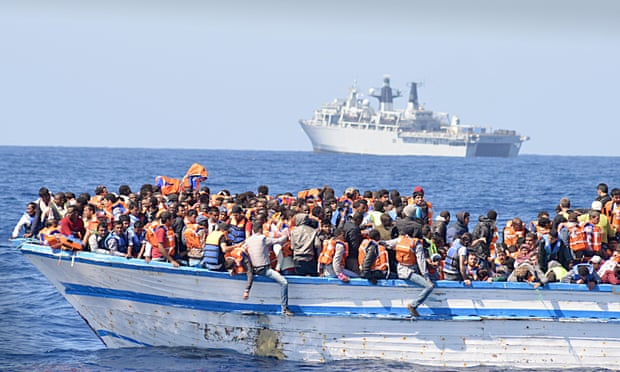
369 migrants crammed into a heavily overcrowded wooden hulled boat which was located in the waters just north of Libya.                                                                                               
 369 migrants crammed into a heavily overcrowded wooden hulled boat which was located in the waters just north of Libya. Photograph: MOD/REX Shutterstock


Jennifer Rankin in Brussels, and Patrick Kingsley in Istanbul

Monday 6 June 2016 20.36 BST  Last modified on Monday 6 June 2016 21.00 BST

Europe is considering whether to forge ahead with a plan to work with repressive African regimes in an attempt to stem migration flows, according to the draft version of a policy expected to be finalised by European officials on Tuesday.

To stop refugees reaching southern Europe from Africa, Europe is mulling whether to partner with Sudan, whose president is wanted for war crimes, and Eritrea, whose government is accused of crimes against humanity by the UN.

Both countries are a significant source of refugees in Europe, while Sudan is also a major migration thoroughfare for people moving between east Africa and the Libyan coast, the springboard for most people-smuggling missions to Italy. Over 150,000 people reached Europe from Libya in 2015 – only slightly fewer than the record of 170,000 in 2014.

In a draft document seen by the Guardian ahead of its official release by European civil servants on Tuesday, the EU has pledged to go ahead with a project that could see Europe provide Sudan’s security services with more equipment and funds to stop refugees, as well as assisting Eritrea’s judiciary.

The text has yet to be finalised, and EU sources could not confirm that the sections concerned would be kept in the text when it is officially published on Tuesday. The plans are only the latest iteration of a new EU migration strategy still being fleshed out by European leaders.

The proposed strategy also includes sending more aid and technical assistance to about 20 countries including Jordan, Lebanon, Niger, Libya and Ethiopia, in a bid to persuade their governments to do more to curb irregular migration.

Following a fall in the number of people reaching Europe from Turkey, European leaders are now trying to curb migration from elsewhere in the region. Favourable trade deals and visa liberalisation programmes are among the suggested ways of winning the acquiescence of target countries. Vague reference to legal pathways for refugees to Europe, as well as increased job opportunities for refugees left behind in Africa and the Middle East, are also included among the so-called “country packages”.

But buried deep within the draft document, the most eye-catching announcement concerns the EU’s “Better Migration Management” project, which the draft suggests “will start this summer”.

The project was first floated publicly in December, and according to documents released at the time could involve the provision of cars, equipment and possibly aircraft to the Sudanese government – as well as “capacity-building” for Eritrean judges, whom the UN accuses of aiding and abetting President Isaias Afwerki’s despotic regime in Asmara.

The proposals have been met with fury by some rights campaigners and leftwing MEPs. Barbara Spinelli, an Italian MEP from GUE/NGL, a leftwing coalition in the European parliament, said: “These ‘country packages’ would make us complicit with dictatorships and deny basic fundamental rights to people fleeing wars, famine and extreme poverty … The commission should be ashamed of this proposal.”

Sara Tesorieri, a policy adviser at Oxfam, accused EU leaders of compromising European values, should the proposals come to pass on Tuesday. She said: “The EU needs to reconsider very carefully exactly how much it is willing to sacrifice on the altar of migration, because right now, they are headed down a road where they will have a foreign policy that consists of a single objective. And they will be bargaining with regimes that they have held at arm’s length.”

She added the EU “should be rethinking its approach. It needs to return to reframing migration as an opportunity. The reality is that migration is increasing globally and Europe is going to be part of that.”

A spokesperson for the European commission said: “There are also no [concrete] plans at this stage to provide equipment to the Sudanese government. Any decision to provide civilian equipment will be taken on the basis of a forthcoming appraisal mission to Sudan from the EU and the consortium of EU member states.”

The German development minister, Gerd Müller, last week told the Guardian that Germany had no plans to send money to Sudan, contrary to reports in Der Spiegel and statements within EU policy documents, including the draft seen by the Guardian.

The Guardian view on Eritrea: a regime of terror

Editorial: The EU may be saving lives in the Mediterranean but it is turning a blind eye to the political repression in Africa’s worst dictatorship

Tuesday’s policy paper is only the latest attempt by the EU to stem the flow of people arriving on Europe’s shores. At a summit in Valletta last November, the EU promised to give 23 African nations a share in a €1.8bn (£1.4bn) “trust fund”, money for employment projects and border controls to dissuade people from travelling to Europe.

Some countries would like to see the EU go further, with a tougher approach to refugees. Austria’s foreign minister, Sebastian Kurz, has called for asylum seekers to be kept on islands rather than having direct access to the continent. In an interview with Die Presse on Sunday, he urged the EU to follow the Australian model, where migrants and refugees are sent to Pacific island detention centres, where they are held indefinitely, while their asylum applications are processed.

Hungary, a staunch opponent of plans to redistribute refugees around the bloc, had already proposed that refugees be restricted to “closed and protected” centres beyond the EU’s borders.

Source=http://www.theguardian.com/world/2016/jun/06/eu-sudan-eritrea-migration

June 3, 2016 (ADDIS ABEBA) - The UN refugee agency on Thursday urged Sudan, to stop forcibly deporting hundreds of Eritrean back to their country saying it is unlawful and contrary to international laws on refugees.
 
JPEG - 21.8 kb
Eritrean migrants wait aboard a navy ship in the Sicilian harbour of Augusta, March 4, 2015 (Photo Reuters/Antonio Parrinello)

In a short statement it issued and extended to Sudan Tribune, UNHCR said the Eritrean refugees could be subjected to prosecution and risk detention and abuse at the hands of the “brutal” regime in Asmera.

The UN refugee agency’s concerns over “collective expulsions” of Eritreans comes one day after Human Rights Watch revealed that Sudanese authorities has deported at least 442 Eritreans, including six registered refugees, to Eritrea in May 2016.

According to UNHCR, on May 6 the Sudanese authorities arrested 377 people in the Sudanese border town of Dongola as they tried to cross to Libya.

Among them were the 313 Eritreans, including six who had already registered as refugees in Sudan, and 64 Ethiopians, none of whom were registered refugees.

All were tried and convicted of “illegal entry” into Sudan. Sudan deported the Eritreans, including 14 children, on May 22, and continues to detain the Ethiopians.

UNHCR also confirmed that a few days earlier, the Sudanese authorities deported 129 Eritreans to their country.

Many of those Eritreans deported were those arrested as they tried to enter Libya from Sudan.

“They were tried and convicted of illegal entry into Sudan ... and were forcibly returned to Eritrea on 22 May” The refugee UN agency said.

The latest expulsion included six Eritreans who were registered refugees. Others had not applied for asylum but it remains unclear if they had been given the opportunity to do so. Individuals have the right to apply for asylum at any time and to be offered access to a fair and efficient asylum procedure.

UNHCR said the forcible return of refugees, asylum-seekers, or others who may be in need of international protection to their country of origin may amount to refoulement as prohibited by Sudanese domestic law, as well as the 1951 Refugee Convention, the 1969 OAU Convention, international human rights law, and customary international law.

UNHCR called on the Sudanese government to respect its obligations under international and Sudanese law further urged the Sudanese government to refrain from forcible return of Eritreans back to their country of origin.

Sudan is being a key transit route for African migrants hoping to cross the Mediterranean from Libya to finally reach Europe.

The latest deportations came as EU reportedly reached a deal with Khartoum to stem migrant flow towards Europe.

European Union is trying to work to manage the flow of migrants to flow with at least 8 African countries.

According to reports Sudan will tighten its border control and intercept refugees who use its soil as a transit to illegally cross to Europe.

Sudan will in return be provided with a total of £40 million along with seven other African countries within three years.

Following the secret deal, Sudan has reportedly rounded up some 900 Eritreans Khartoum last week.

Eritreans are fleeing to one of world’s most repressive regime.

Hundreds of Eritreans risk their life to sneak out the heavily guarder Eritrean borders where there exists a shoot to kill policy against any citizen trying to cross the border.

Families of an Asylum seeker who manage to make it to a neighbouring country will be fined or could be imprisoned.

(ST)

Source=http://www.sudantribune.com/spip.php?page=imprimable&id_article=59178

World | Mon May 30, 2016 8:33am EDT


ROME A photograph of a drowned migrant baby in the arms of a German rescuer was distributed on Monday by a humanitarian organization aiming to persuade European authorities to ensure safe passage to migrants, after hundreds are feared to have drowned in the Mediterranean last week.

The baby, who appears to be no more than a year old, was pulled from the sea on Friday after the capsizing of a wooden boat. Forty-five bodies arrived in the southern Italian port of Reggio Calabria on Sunday aboard an Italian navy ship, which picked up 135 survivors from the same incident.

German humanitarian organization Sea-Watch, operating a rescue boat in the sea between Libya and Italy, distributed the picture taken by a media production company on board and which showed a rescuer cradling the child like a sleeping baby.

In an email, the rescuer, who gave his name as Martin but did not want his family name published, said he had spotted the baby in the water "like a doll, arms outstretched".

"I took hold of the forearm of the baby and pulled the light body protectively into my arms at once, as if it were still alive ... It held out its arms with tiny fingers into the air, the sun shone into its bright, friendly but motionless eyes."

The rescuer, a father of three and by profession a music therapist, added: "I began to sing to comfort myself and to give some kind of expression to this incomprehensible, heart-rending moment. Just six hours ago this child was alive."

Like the photograph of the three-year-old Syrian boy Aylan lying lifeless on a Turkish beach last year, the image puts a human face on the more than 8,000 people who have died in the Mediterranean since the start of 2014.

Little is known about the child, who according to Sea-Watch was immediately handed over to the Italian navy. Rescuers could not confirm whether the partially clothed infant was a boy or a girl and it is not known whether the child's mother or father are among the survivors.

Sea-Watch collected about 25 other bodies, including another child, according to testimony from the crew seen by Reuters. The Sea-Watch team said it unanimously decided to publish the photo.

"In the wake of the disastrous events it becomes obvious to the organizations on the ground that the calls by EU politicians to avoid further death at sea sum up to nothing more than lip service," Sea-Watch said in a statement in English distributed along with the photograph.

"If we do not want to see such pictures we have to stop producing them," Sea-Watch said, calling for Europe to allow migrants safe and legal passage as a way of shutting down people smuggling and further tragedies.

At least 700 migrants may have died at sea this past week in the busiest week of migrant crossings from Libya towards Italy this year, the UN Refugee agency said on Sunday.

The boat carrying the baby left the shores of Libya near Sabratha late on Thursday, and then began to take on water, according to accounts by survivors collected by Save the Children on Sunday. Hundreds were on board when it capsized, the survivors said.

(Editing and additional reporting by Mark John in London)

MA

In an email, the rescuer, who gave his name as Martin but did not want his family name published, said he had spotted the baby in the water "like a doll, arms outstretched".

"I took hold of the forearm of the baby and pulled the light body protectively into my arms at once, as if it were still alive ... It held out its arms with tiny fingers into the air, the sun shone into its bright, friendly but motionless eyes."

The rescuer, a father of three and by profession a music therapist, added: "I began to sing to comfort myself and to give some kind of expression to this incomprehensible, heart-rending moment. Just six hours ago this child was alive."

Like the photograph of the three-year-old Syrian boy Aylan lying lifeless on a Turkish beach last year, the image puts a human face on the more than 8,000 people who have died in the Mediterranean since the start of 2014.

Little is known about the child, who according to Sea-Watch was immediately handed over to the Italian navy. Rescuers could not confirm whether the partially clothed infant was a boy or a girl and it is not known whether the child's mother or father are among the survivors.

Sea-Watch collected about 25 other bodies, including another child, according to testimony from the crew seen by Reuters. The Sea-Watch team said it unanimously decided to publish the photo.

"In the wake of the disastrous events it becomes obvious to the organizations on the ground that the calls by EU politicians to avoid further death at sea sum up to nothing more than lip service," Sea-Watch said in a statement in English distributed along with the photograph.

"If we do not want to see such pictures we have to stop producing them," Sea-Watch said, calling for Europe to allow migrants safe and legal passage as a way of shutting down people smuggling and further tragedies.

At least 700 migrants may have died at sea this past week in the busiest week of migrant crossings from Libya towards Italy this year, the UN Refugee agency said on Sunday.

The boat carrying the baby left the shores of Libya near Sabratha late on Thursday, and then began to take on water, according to accounts by survivors collected by Save the Children on Sunday. Hundreds were on board when it capsized, the survivors said.

(Editing and additional reporting by Mark John in London)

'20 to 30' people dead in new migrant shipwreck

The latest disaster comes two days after five people died while trying to make the crossing to Italy. Photo: Marinare Militare


AFP · 26 May 2016, 13:42


Published: 26 May 2016 13:42 GMT+02:00

"We estimate the dead to be between 20 and 30 people," captain Antonello de Renzis Sonnino, spokesman for the EU's Sophia military operation to combat people smugglers in the Mediterranean, told AFP.

"A Luxembourg reconnaissance plane spotted a capsized boat around 35 nautical miles off the Libyan coast with about 100 migrants in the water or clinging to the sinking vessel," he said.
   
The Spanish frigate Reina Sofia and Italian coast guard raced to the scene and threw life-floats and jackets to those in the water.
   
"Unfortunately there were bodies too," de Renzis Sonnino said, adding that the rescue operation was still ongoing.
   
In photographs released by EUNAVFOR MED on Twitter, migrants could be seen waving their arms for help as they balance perilously on the deck of the boat, already underwater but clearly visible in the limpid aquamarine sea.
   
The shipwreck followed sharply on the heels of a disaster Wednesday when a migrant boat overturned leaving five people dead, and another sinking on Tuesday which left a baby girl orphaned after both her parents died.
   
A bout of good weather as summer arrives has kicked off a fresh stream of boats attempting to cross from Libya to Italy.
   
The survivors will be added to the list of nearly 40,000 migrants to arrive in the country's southern ports so far this year.

Sourec=http://www.thelocal.it/20160526/up-to-30-people-dead-in-new-migrant-boat-disaster-reports


This combination of handout pictures released on May 25, 2016 by the Italian Navy (Marina Militare) shows the shipwreck of an overcrowded boat of migrants off the Libyan coast
This combination of handout pictures released on May 25, 2016 by the Italian Navy (Marina Militare) shows the shipwreck of an overcrowded boat of migrants off the Libyan coast (AFP Photo/) 
 
Rome (AFP) - Dramatic images released by the Italian navy Wednesday captured the moment a heavily overcrowded boat overturned in a shipwreck off Libya which left at least five people dead.
 
The blue fishing vessel, its deck heaving with people, tipped over after the migrants rushed to one side on spotting a rescue ship -- an all too frequent mistake which has led to many disasters in the Mediterranean.
 
The migrants, many of them men, some already wearing orange lifejackets as a precaution, were captured in rare photographs as they clung to the boat's rails or each other, or dropped like stones into the sea.
 
Some are seen hanging on to the starboard edge by their fingertips as the trawler rolls, while others try to balance on the rim.
 
Pictures taken seconds later show the churning waters around the boat peppered with people trying to get away from the vessel which, now overturned, begins to sink, with four people still perched on its upturned hull.
 
The navy said its Bettica patrol boat had spotted "a boat in precarious conditions off the coast of Libya with numerous migrants aboard" but the trawler overturned shortly afterwards "due to overcrowding".
 
The Bettica threw life-rafts and jackets to those in the water, while another navy ship in the area sent a helicopter and rescue boats.
 
- Sounding the alarm -
 
Survivors can be seen in the photographs wearing life-rings, some swimming towards the Bettica as the helicopter whirrs overhead. The navy said 562 people had been pulled to safety.
 
The operation wound up late Wednesday without finding any further survivors or victims.
 
The migrants had sounded the alarm by calling for help using a satellite phone some 18 nautical miles off Libya.
 
The Bettica went on to pluck another 108 migrants from their dilapidated vessel in a second rescue operation on Wednesday.
 
It is not the first time a boat making the perilous journey across the Mediterranean has overturned because of sudden movement onboard when help is in sight.
 
In August last year, a Palestinian survivor of just such a shipwreck described the moment the boat rolled as "like being flung from a catapult. I could only see heads, all around, amid the waves, everyone pushing down on everyone else to try and stay afloat".
 
According to the International Organization for Migration, over 1,370 migrants have lost their lives so far this year as they attempt the perilous crossing to Europe.
 
The latest arrivals bring the number of people rescued and transferred to Italy since the start of the year to nearly 40,000 following the rescue of more than 6,000 since Monday, according to figures collated by the UN's refugee agency (UNHCR) and the coastguard.
 
The overwhelming majority of those arriving in Italy so far this year have been from sub-Saharan Africa.
 
Italian media reports warned the number of minors arriving was on the rise. A nine-month old baby girl whose mother died during a crossing this week was being looked after by cultural mediators in the reception centre on Lampedusa island, La Repubblica said.
 
The UNHCR, aid organisations and the Italian government say there is no sign yet of Middle Eastern refugees switching to the Libyan route to Europe following moves to restrict access from Turkey via the Greek islands.


TesfaNews | 316 | http://www.tesfanews.net/?p=45730">2 Comments |

eritrean migrants in sudanThe UNHCR spokesperson said none of those intercepted in northern Sudan while heading towards the Libyan border to reach Europe are asylum seekers and Sudan may be within its legal right to pursue deportation of these Eritrean migrants from its territory. (Photo: Maram Mazen IRIN)

By Kristy Siegfried | for IRIN,

Authorities in Sudan have launched a crackdown on Eritrean migrants – arresting those living in the capital, Khartoum, and intercepting hundreds travelling north through the country towards Libya, the launching point for smugglers’ boats heading for Europe.


Reports that 900 Eritreans were rounded up in Khartoum on Monday and that a further 400 arrested en route to Libya have been deported to Eritrea, come amid recent revelations in the British and German media that the EU is planning to deepen its cooperation with a number of African countries, including Sudan and Eritrea, to stem migration towards Europe.

Kibrom (not his real name), a 16-year-old Eritrean refugee who used the route through Sudan and Libya to reach Europe in 2015, told IRIN that his twin sister was among a group of 130 Eritreans captured by Sudanese soldiers in the town of Dongola, about halfway between Khartoum and the Libyan border, earlier this month.

“I passed the same way. When we were travelling, we had to bribe the police. My sister used the same smuggler, but when he tried to bribe the police, it didn’t work,” he said.

Kibrom’s sister, along with the rest of the group, were taken to a prison in Khartoum where they spent three days. Kibrom said he tried to alert the UN’s refugee agency, UNHCR, but failed to make contact.

“Only the Eritrean Embassy was informed. They took them in an open truck at night time to the Eritrean border,” he said. “From there they were taken to a prison located in my city – Tesseney.”

Leaving Eritrea without permission is a criminal offense and Kibrom is extremely concerned about his sister, who was trying to evade military conscription, as well as his mother and two younger brothers who are still living in Tesseney.

“My mother can’t even try to see my sister or she will be arrested as well,” he told IRIN over the phone from Sweden where he has applied for asylum. “I’m so worried what’s going to happen to them.”

A spokesperson with UNHCR’s office in Khartoum confirmed that a number of migrants, including Eritreans, had been intercepted in northern Sudan heading towards the Libyan border. Of those being held at the Aliens Detention Centre in Khartoum, UNHCR had only identified six individuals who had previously sought asylum and been recognized as refugees.

None of those six had been deported and the spokesperson did not comment on the other deportations but said:

“If an individual does not apply for asylum through the channels provided and subsequently does not express a wish to seek asylum, Sudan may be within its legal right to pursue deportation of irregular migrants from its territory.

“For UNHCR, the principle prohibiting forcible returns or non-refoulement only takes centre stage when the affected individuals are persons of concern to UNHCR, which does not appear to be the case in this particular instance.”

It is unclear whether UNHCR had access to all of the Eritreans detained in Khartoum prior to their deportation. Meron Estefanos, an Eritrean activist based in Sweden who has been in touch with the relatives of some of the deportees, told IRIN that another group of around 300 Eritreans arrested while making their way to Libya were deported last Friday.

Sudan has a prior record of deporting Eritreans without allowing them access to asylum procedures, a practice that UNHCR has condemned in the past as amounting to refoulement.

Increased Border Controls

In addition to the arrests of migrants in Sudan, Estefanos said there has also been a noticeable increase in controls on the Eritrean side of the Sudan-Eritrea border in the last two months. “Leaving Eritrea to Sudan is becoming hard now,” she told IRIN. “People are being intercepted and sent back.”

Last year, a UN inquiry found evidence that Eritrea is a totalitarian state responsible for “systemic, widespread and gross human rights violations” including a system of indefinite national service that amounts to forced labour.

Eritrean soldiers are instructed to shoot at anyone they discover trying to leave the country illegally, a policy that hasn’t prevented thousands from fleeing across the border every month. While the majority of Eritreans remain in camps in Sudan and Ethiopia, over 70,000 applied for asylum in Europe during 2014 and 2015, according to EuroStat figures.

Source=http://www.tesfanews.net/sudan-and-eritrea-crackdown-on-illegal-migrants/


GENEVA (23 May 2016) – Ahead of the celebration of the 25th Anniversary of the Independence of Eritrea on Tuesday 24 May, the United Nations expert Sheila B. Keetharuth, urges the Eritrean Government to implement the 1997 Constitution.

The UN Special Rapporteur on the situation of human rights in Eritrea also calls on all Eritreans to fully embrace democracy and the rule of law to achieve the vision established on 24 May 1991.

“The 25th Independence Anniversary celebration provides Eritreans with an opportunity to reflect on the aspirations and dreams of those who fought for independence.

The 1997 Constitution sets out the vision of what Eritrea wanted to be as a country and yet it remains unimplemented to date. As the country reaches 25 years, this constitutional vacuum provides room for arbitrariness in managing the affairs of the State and engaging with its citizens. 

The independence of the country, that is, the national independence should match with individual independence and freedoms: freedom of conscience, thought, mind and expression; freedom to engage in employment and education of one’s own choice.

At 25, Eritrea needs to take decisive steps to embed democracy and the rule of law in the country. Such a move would advance respect for human rights, while further empowering the people and bridging the gaps between aspirations and reality. I call on the Government to do more to respect, protect and fulfil human rights and to establish the rule of law.

I salute the heroism and courage of all those women and men who struggled for their freedom and fought for their country’s independence. I also acknowledge the determination of those who are still engaged in preserving such hard-won freedom.”

Ms. Sheila B. Keetharuth was appointed as the Special Rapporteur on the human rights situation in Eritrea during the 21st Session of the UN Human Rights Council in September 2012.  She took her functions on 1 November 2012.  As Special Rapporteur, she is independent from any government or organization and serves in her individual capacity.  A lawyer from Mauritius, she has extensive experience in monitoring and documenting human rights violations, advocacy, training and litigation in human rights in Africa. Learn more, log on to: http://www.ohchr.org/EN/HRBodies/SP/CountriesMandates/ER/Pages/SREritrea.aspx

The Special Rapporteurs are part of what is known as the Special Procedures of the Human Rights Council. Special Procedures, the largest body of independent experts in the UN Human Rights system, is the general name of the Council’s independent fact-finding and monitoring mechanisms that address either specific country situations or thematic issues in all parts of the world. Special Procedures’ experts work on a voluntary basis; they are not UN staff and do not receive a salary for their work. They are independent from any government or organization and serve in their individual capacity.

UN Human Rights, country page – Eritrea: http://www.ohchr.org/EN/Countries/AfricaRegion/Pages/ERIndex.aspx

For press inquiries and additional information, please contact Ms. Françoise Mianda (+41 22 917 92 50 / ) or write to

For media inquiries related to other UN mandates:
Xabier Celaya, UN Human Rights – Media Unit (+ 41 22 917 9383 / )

For your news websites and social media: Multimedia content & key messages relating to our news releases are available on UN Human Rights social media channels, listed below. Please tag us using the proper handles:
Twitter: @UNHumanRights
Facebook: unitednationshumanrights
Instagram: unitednationshumanrights
Google+: unitednationshumanrights
Youtube: unohchr

- See more at: http://www.ohchr.org/EN/NewsEvents/Pages/DisplayNews.aspx?NewsID=20001&LangID=E#sthash.IHr2wlfh.dpuf

Source=http://www.ohchr.org/EN/NewsEvents/Pages/DisplayNews.aspx?NewsID=20001&LangID=E

GenevaConferencepic 4

Over the past two days, Thursday and Friday, a small group of activists and researchers on Eritrean studies gathered in Geneva with the aim of stocktaking on the post-independence experience of Eritrea (on the occasion of the country’s 25th year of independence). A conference like this should have ideally taken place in Eritrea. As is known to many, due to the sad political reality in Eritrea, this was not possible; thus, the conference had to take place in exile. The conference featured a very proactive engagement, lively discussions, and most of all civilized discourse among participants. Given Eritrea’s highly polarized political landscape, and the fact that some of the speakers at the conference subscribe to fundamentally divergent views with those of others, did not come as an obstacle for a civilized discourse (as some observers may have anticipated).

In the afternoon hours of Thursday, the 19th of May, we had an Opening Speech by Mr. Manuel Tornare, Member of the Swiss Parliament (National Council) and former Major of Geneva, among other things. This was followed by a Panel Discussion with Tanja Müller, Selam Kidane and Salih Nur (with Daniel R. Mekonnen as moderator and discussant). In the evening hours, there was a Welcoming Dinner for presenters, speakers and invited guests.

GenevaConferencepic 2

On Friday, the 20th of May, we had the following presentations:

Mother Tongue versus Arabic: The Post-Independence Eritrean Language Policy Debate, by Abdulkader Saleh M Ohammad
Eritrea’s Wrong Start in 1991: How It Contributed to Where and What It is Today, by
Wolde Ammar
Authoritarian Resilience in Eritrea: The Dual Role of Nationalism, by
Goitom Gebreluel & Daniel R. Mekonnen (presented by Daniel)
Dynamics of Post-liberation Politics – Interrogating Aspirations and Political Space in Eritrea, by Tanja R. Müller
Making Sense of Post-independence Eritrea: A Late African Postcolonial State or a Misunderstood African Exceptionalism?, by
Salih Nur
Civil Society Space in Post-Independence Eritrea, by
Wegahtabrhan Sereke
By Way of Patriotism, Coercion or Instrumentalisation: How the Eritrean Regime Makes Use of the Diaspora to Stabilise its Rule, by
Nicole Hirt & Abdulkader Saleh Mohammad
Collective Trauma: A Major Component of the Eritrean Refugee Crisis, by
Selam Kidane
Legal Battles in Eritrean Transnational Communities, by
Tricia Redeker Hepner & Daniel R. Mekonnen (presented by Daniel)
Leaving Eritrea and Looking for a Safe Haven: Reflections from the Experiences of Eritrean Refugees in Selected Eritrean Diaspora Communities, by
Sadia Hassanen & Beyan Negash (partly presented in the form of a video presentation of Sadia)

The above contributions will make part of a forthcoming conference proceeding (edited volume) that will be refined in the coming months. Other contributors who showed initial interest in participating at the conference but were not able to make it to Geneva have also submitted full version papers that shall make part of the forthcoming edited volume. These include Gaim Kibreab’s “The Military in Post-Independence Eritrea” and Joseph Venosa’s “Liberating Eritrea from Abroad: Diaspora Activism on the eve of Eritrea’s War of Independence, 1958-62.”

GenevaConferencepic 3

The successful finalization of the conference would not have materialized without the active participation and involvement of everyone who played a role in different ways, and in particular the presenters, speakers, commentators and funders. As Convener of the Conference, I am deeply indebted to all of these stakeholders. While the conference may have had its own limitations in some ways, on balance, I am glad to see it coming to fruition the way it did. My effort of the last several months (starting from October 2015) has paid off satisfactorily, thanks to all who have helped in many ways, some of whom are already tagged in this posting; others are unfortunately not on Facebook. Some more colleagues, whose names I see on Facebook, and who deserve a word of thanks include the following: Michael Guggenheimer, Veronica Almedom, and Awet Kidane.

GenevaConferencepic 1

Den 24 maj 1991 är mycket speciell dag för Eritreaner. När vi firar/minns denna dag, så tänker vi på många saker. En del av tankarna och verkligheten som vi kommer att tänka är följande:

-          24:e maj förverkligade drömmen om fritt Eritrea, och slutade den långa lidande av beväpnadekampen för friheten.

-          24 maj var starten för nytt dröm liv för Eritreaner.

-          24 maj var starten för de lidande som eritreanska befolkningen befinner sig i.

-          Om 24:e maj 1991 inte hade hänt med alla dessa händelser, vad skulle vi ha gjort det?

Med utgångspunkten som ovan nämnda och mycket annat tankar, så ska vi tillsammans fira, minnas och blicka fram och tillbaka med vad det innebär den 24 maj 1991 för oss Eritreaner, i Eggebygård (Tensta) i Järvafältet – Järva folkets Park den 28 maj 2016 KL. 19:00 - .

Här med skickar vi Eritreanska Socialdemokrater (Eritreanska S-föreningen) inbjudan till Er alla som vill fira tillsammans, 25 års Eritreas självständighet.

Program

  1. Sport aktiviteter/fotboll match mellan ungdoms klubbar i Rinkeby idrotts Plats (Mellan kl. 10:00 – 16:00).
  2. Information/pratstund om självständighet, vad måste göras för att komma ut ur stagnationen med de eritreanska politiska frågor och annat som hör hemma till dagensagenda.
  3. Att välkomna de nyanlända eritreanska flyktingar det senaste året. Information om integration i Sverige - från Socialdemokratiska politiker.
  4. Kultur utbytte/kultur kväll – Musik.
  5. Mat och dryck finns.

De som vill ha mera information så kan ni kontakta följande telefon nummer. Eritreanska S-Föreningen, Tel: 070-7223287 - 073-5515638 – 070-4306169

Email: This email address is being protected from spambots. You need JavaScript enabled to view it..

Med vänliga hälsningar,

Eritreanska S-Föreningen,

Obs: Vi kommer att skicka mera Information fram över: via sms, publicmedia och annat.