Why people are leaving Eritrea

Friday, 15 April 2016 21:11 Written by

Eritrea

Every month as many as 5,000 people flee Eritrea, a country ruled by an authoritarian regime in which human rights violations are widespread. Oliver Ramme has just returned from a rare visit to the African nation.

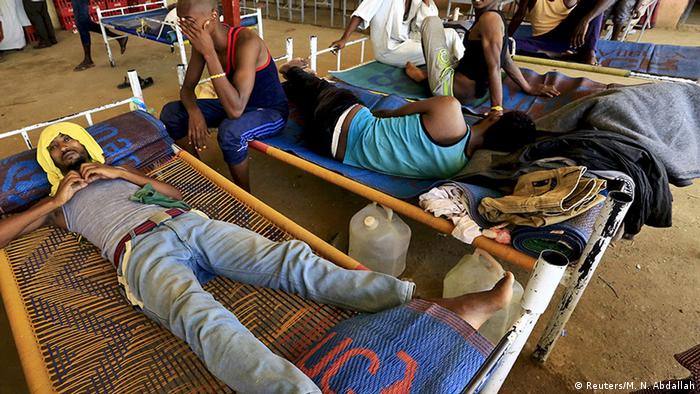
Sudan: Kassala refugee camp

Eritrean asylum seekers at a refugee camp in Kassala State, eastern Sudan


Tokombia is a village lying some 200 kilometers (124 miles) from the Eritrean capital, Asmara. Dogs bark as the scorching sun beats down on the mud huts. The soil is arid, almost desert-like. The village is underdeveloped, like many places in Eritrea. The Ethiopian border is not that far away.

"It is quiet along the border. Not much happens. We don't want any trouble with the Ethiopians," says Tesfalem Andom, the village elder. He is a member of the ruling party, the People's Front for Democracy and Justice (PFDJ). It is the only party in Eritrea and is neither democratic, nor does it uphold justice. The PFDJ has ruled the country since it gained independence from Ethiopia in 1993. Eritrea does not have a constitution, or a free press.

But Eritrea owes its notoriety largely to its national service, nominally 18 months of compulsory military service for young men which is often extended indefinitely at the whim of military commanders. National service is the main reason why young Eritreans flee their country. When asked about their fate, Tesfalem Andom replies evasively:

"It's normal for people to come and go. They go in groups to Ethiopia only to discover that life isn't that easy in a refugee camp. Running away seems to be some sort of 'kick' for young people, a 'craze' of sorts," he said.

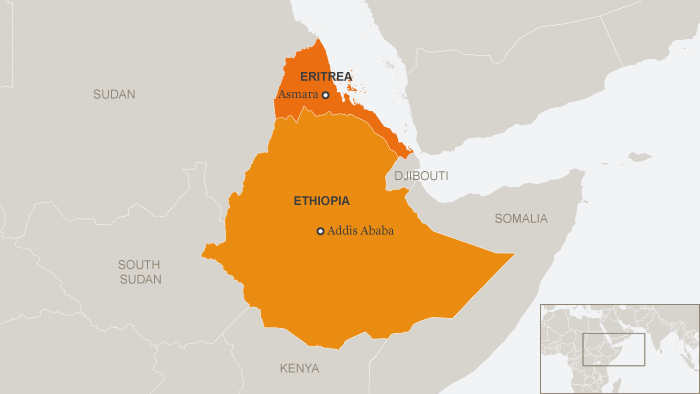
DW map show Ethiopia and neighboring Eritrea

Eritrea separated from Ethiopia in 1991 after a 20-year independence war. Their common border remains tense

Thousands succumb to the supposed 'craze' every month, leaving Eritrea by crossing the border into Ethiopia or Sudan. Fleeing Eritrea is dangerous, because a border conflict with Ethiopia is still smoldering.

In Asmara, Abraham and John agree to talk in a car. Those are not their real names as it is forbidden to criticize the government in Eritrea. With loud music in the background, they tell their stories. "I am not proud of working in an illegal occupation," says John. "I would prefer to have a normal job in which I receive some sort of recognition, but I have to have something to live on." John deals in foreign currency, illegally. Such trading is prohibited in Ethiopia. If he were to be caught, he would land in jail.

No future for the youth

Abraham and John have both been to university. But there are hardly any jobs in Eritrea's tiny private sector and wages and salaries in the numerous state-owned enterprises are low. "Twenty five years after independence, the country is moving backwards," says Abraham, "in healthcare, education and production."

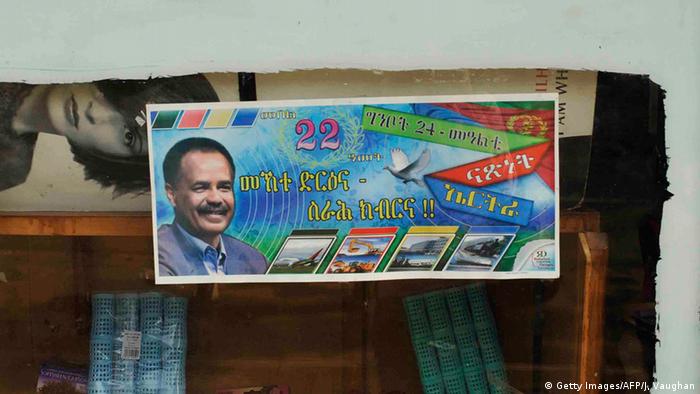
Eritrea Asmara Poster Präsident Afewerki

The face of Eritrean President Issaias Afewerki looks down from a shop window in Asmara.

The cost of living is high in Eritrea. A liter of sunflower oil costs 5 euros ($ 5.60). A pound (half a kilo) of noodles costs about the same. A liter of petrol costs about 3 euros. The monthly wages paid to the hundreds of thousands of conscripts range between 50 and 100 euros.

The frustration this economic deprivation causes as well as the fear of the state and its prisons can be sensed wherever you go in Eritrea.

Help from outside

Yemane Gebreab is the personal advisor to President Isaias Afwerki and is regarded as the second most powerful person in the country. Gebreab speaks precisely and softly, in a manner slightly reminiscent of an old-fashioned accountant. Eritrea, he maintains, is simply misunderstood by the international community.

"I go all over the world and people who don't know what Eritrea is, where Eritrea is, the first thing they ask you is national service. I say how can national service in a very small country become a topic of global conversation?," he said. Gebreab blames the United States for Eritrea's political isolation.

Peter Schwidtal runs a small German NGO, Archemed, dedicated to improving the healthcare infrastructure in Eritrea. It is one of the few aid projects in Eritrea. Despite all his idealism, the German medical practitioner admits that he is forced to face up to the reality of life in Eritrea. That includes the exodus of the young and the skilled.

"It can be very hard when after having trained up a surgeon or a pediatrician, you suddenly discover that person is no longer there. It's huge loss because there are so few trained medical personnel in the country."

He also said that when they take ambitious, young colleagues to Germany for training, there is the risk that they will not return to Eritrea.

John and Abraham are also thinking about escaping. They are undeterred by television footage showing European nations erecting border fences.

Source=http://www.dw.com/en/why-people-are-leaving-eritrea/a-19190853

NO: 000102

The Ad Hoc Contact Organ of the Nairobi’s National Consultative Conference held its meeting in Addis Ababa from April 1-3, 2016. The Chairman and the members of the committee presented their reports for the last three months, and then embarked on an objective assessment of their performance. The chairman concluded that the overall work of the committee was productive, and attributed its success to the strong support it gained from the organizations that participated in the Nairobi meeting and the Eritrean public in general. In its evaluation of the phase that followed the Nairobi meeting, the Contact Organ noted some confusion in the understanding of the aims and objectives of the Forum For National Dialogue (Medrekh) by some sides, perhaps, because of the seemingly similar path the National Council, like the Forum, is making preparations for its second Conference, or other reasons. Accordingly, the Contact Organ deemed it necessary to reassure the following:

  1. The National Consultative Conference of Nairobi was a consultative meeting of the various political organizations and parties to reach a common political understanding on the present Eritrean affairs and a vision for the future.
  2. The mission of the Ad Hoc Contact Organ, in accordance with the tasks it was entrusted, is to strive in involving all political forces, those who participated, as well as those who did not participate in the Nairobi Consultative Meeting, in the upcoming second consultative meeting, and not a replacement (displacement) of the Eritrean National Council for Democratic Change or the Democratic Alliance or any other political arrangement. Therefore, the Nairobi Forum does not interfere or contradict with the preparation of the second National Conference of the National Council of Eritrea.

Based on its unanimous assessment, the Ad Hoc Contact Organ put forward its provisional programme of work that covers the period from the end of the meeting (April 3) and the second half of the month of August, when the second consultation meeting will be held. Towards this, it has decided, to initiate the preparation of working papers, which will set the agenda for discussion of the next consultative meeting, namely: a unifying strategic vision for the opposition, an agreement on the means to topple the dictatorial regime, drafting a vision for the transitional period utilizing all existing documents of the Eritrean National Council for Democratic Change, the Eritrean Democratic Alliance, Eritrean Peoples’ Democratic Party and other opposition forces, as well as the findings of a committee of Eritrean experts who will conduct Root Cause Analysis of the Eritrean opposition by taking into account all previous experiences.

During the time of its meeting, the Ad Hoc Contact Organ held important meetings with the different political forces, in order to update relevant parties of the activities it has undertaken since its formation, pursuant to the responsibilities it was entrusted by the National Consultative Meeting held in Nairobi. The first meeting was to brief the representatives of the organizations, which participated in the Nairobi Forum, of the achievements that have been made and the circumstances in which the overall activities were put into effect. The representatives of the organizations have reconfirmed their support for the mission of the Ad Hoc Contact Organ. Medrekh and members of the Contact Organ also met with representatives of the six organizations and the Democratic Organization of the Afar Red Sea, which, for various reasons, did not participate in the Nairobi forum, but after a fruitful engagement in which they stressed the importance of inclusiveness, they have decided to welcome the initiative and participate in the upcoming meeting.  

At the end of the meeting the Ad Hoc Contact Organ expressed its thanks and appreciation to everyone who supported and contributed, in thought and wishes, in furthering the objectives of the consultative forum among all the political forces, and especially thanked those who contributed to the success of this meeting.

The Ad Hoc Contact Organ

National Consultative Conference--Nairobi Declaration

April 4, 2016

On April 10, 2016 North America (USA & Canada) EPDP Zoba Leadership hosted all–members teleconference meeting. This is the first conference of this magnitude after its election in December 2015.

The meeting was attended by overwhelming majority of members. The Zoba chairman haw Kalaab Kifleghiorghis lead the meeting and the main agendas were the following:

·         Zoba leadership’s progress report

·         Zoba’s departments responsibilities and tasks

·         Branch responsibilities and activities

·         Members expectation and suggestions to zoba

The Chairman discussed the agenda points in depth and detail. Each zoba office leaders also briefly present their tasks and responsibilities. Lengthy questions and answers session was given and covered all topics. Zoba members expressed their satisfaction with the performance of Zoba Leadership and pledge to collaborate to their ability to achieve the objectives. 

Since its election, the Zoba Leadership have engaged in meetings with branch leadership and outlined action plan for the next six months which includes zoba congress. The meeting ended with high spirit of respect and civility.

As the Commission of Inquiry on Human Rights in Eritrea continue to research and work diligently in regards to the Human Rights issues in Eritrea; we Eritreans residing in North America, will continue to support the Commission of Inquiry on Human Rights in Eritrea in 2016, just as we successfully did last year in October 2015. In order to continue to support all efforts made by the Commission of Inquiry on Human Rights in Eritrea. It is important for all political and civic organizations in North America to play a role in mobilizing for COIE 2016. We are calling for all political and civic organizations in North America, to elect representatives, to assist in mobilizing and organizing, all efforts for the Commission of Inquiry on Human Rights in Eritrea 2016. The united effort created and executed "FOR THE PEOPLE, BY THE PEOPLE" for the Commission of Inquiry on Human Rights in Eritrea 2015, will be equally needed to ensure the success and final outcome for the Commission of Inquiry on Human Rights in Eritrea in 2016. 


To forward representatives and for all questions and concerns please email 

Sincerly; ENA4COI


Eritreans in North America for Commission of Inquiry on Human Rights in Eritrea


Best Regards,

~*~*~*~*~*~*~*~*~*~*~*~*~*~*~*~*~*~~*~*~*~*~*~

Eritreans in North America United

in Support of the United Nations Commission of Inquiry

(ENA/US/COI)

Any situation in which some individuals prevent others from engaging in the process of inquiry is one of violence. The means used are not important; to alienate human beings from their own decision-making is to change them into objects.[1]

Recently I had a chance to read Paulo Freire's classical work, Pedagogy of the Oppressed, which mainly deals with Oppressor-Oppressed relationship. To larger extent, I found Freire’s work mirrored in present day Eritrea. In his work, Freire addressed the engagement between the oppressor and the oppressed and the means used to that end. Here I have tried to relate a fraction of his work to the Eritrean context.

While reading Pedagogy of the Oppressed I was contemplating on the difficulty through which the Eritrean people are passing through. We all are aware that in their struggle to become free subjects and build a democratic country, Eritreans fought long and hard. Their long suffering came to an end when the protracted and bitter thirty years of armed struggle concluded in triumph, independence of Eritrea. Never in their dreams would Eritreans imagined that a government in an independent Eritrea will be so oppressive like the one that we are witnessing at the moment. A quarter a century after independence they have to accept the bitter truth that their once hailed revolutionary leaders, on whom they have full trust, failed them and turned to be their oppressors.

Changing Poles

According to Freire it is habitual for the oppressed to wage a struggle to resolve the contradiction in which they are caught. The Oppressor-Oppressed contradiction will be resolved by the emergence of a new man: neither oppressor nor oppressed but man in the process of liberation.[2] Likewise, while under Ethiopian occupation and domination, Eritreans felt oppressed and opted to struggle to restore their freedom. The Eritrean struggle for independence was a palpable expression of this phenomenon. The aim of independence should not be replicating former oppressors; rather it ought be redressing past wounds and building a democratic country. In Eritrean case we missed the emergence of the new man.

Freire insisted that if the aim of the oppressed is to become fully human, they will not achieve their goal by merely reversing the terms of the contradiction, by simply changing poles. …the moment the new regime hardens into a dominating 'bureaucracy' the humanist dimension of the struggle is lost and it is no longer possible to speak of liberation. The authentic solution of the oppressor-oppressed contradiction does not lie in a mere reversal of position, in moving from one pole to the other. Nor does it lie in the replacement of the former oppressors with new ones who continue to subjugate the oppressed - all in the name of their liberation.[3] This is what the Eritrean experience demonstrates, a situation in which former leaders of liberation struggle – side-lining promises of the revolution - turned into current oppressors. They simply, as Freire put it, change poles - from being formerly oppressed into current oppressors. Hence the humanist dimension of the Eritrean struggle is completely lost.

It is habitual that in their unrestrained eagerness to dominate and control the people, oppressors become anti-dialogical and developed the conviction that it is possible for them to transform the society into obedient citizens or objects. In doing so they have to conquer and manipulate them. Let’s briefly look how Conquest and Manipulation employed in Eritrea to the end of controlling people.

Conquest

One of the attribute of anti-dialogical action is the necessity for conquest. Freire highlighted that, in dealing with the people, the anti-dialogical oppressor endeavours at conquering them by every means, from the toughest to the most refined, from the most repressive to the most solicitous. The conqueror imposes his objectives on the vanquished, and makes of them his possession. Anti-dialogue is necessary to the oppressor as a means of further oppression - not only economic, but cultural: the vanquished are dispossessed of their word, their expressiveness, their culture. Further, once a situation of oppression has been initiated, anti-dialogue becomes indispensable to its preservation.[4] This is the main characteristics of the Eritrean government, headed by the People’s Front for Democracy and Justice (PFDJ) – the sole legal party in Eritrea. Since its inception, it is anti-dialogical and used whatsoever method suitable to it to subjugate the people. Today, Eritrea is a country with no constitution, no parliament, no independent judicial system; and Eritreans have no right to express themselves, no right to vote, and no right to live a peaceful life in their own country. Every aspect of their life is under the strict scrutiny of the government. As key part of its conquest, the government monopolized the economy and created total dependency of the people on the regime. It is ironic Eritreans cannot get basic needs such as food and shelter and work freely if they are reluctant to abide by the oppressive rules of the government. The infamous and abusive National Service also used to control and dominate the Eritrean youth. Further showing its anti-dialogical nature the government always insists to the people - through its monopolized "mass media" - that all they have to do is carefully listen to the 'wise' guidelines of their 'visionary' government and act accordingly, making them mere objects, dispossessing their expressiveness and denying their own decision making.

This total conquest approach of the government serves the ends of control and obedience. In this phenomenon, the government imposed its own view of the world upon the people by curbing their expression and denying the right to have a say in their day-to-day life. It made every effort to mould the society to immerse the government's view point. As it is anti-dialogical the government always made a choice and the people are always expected to follow that choice.

In its conquest the government used every means, but habitually coercion. Hence, throughout the independence years many are arbitrarily killed, thousands are jailed, and hundreds of thousands fled the country. In such a way the government compelled Eritreans to develop a culture of silence and total obedience. Eritreans, as the UN commission of inquiry put it, are ruled by fear not by law. This was a direct result of the whole situation of economic, social and political dominance and conquest by the regime.

Manipulation

Manipulation, as another dimension of the theory of anti-dialogical action, is an instrument of conquest. Freire explains that by means of manipulation, the dominant elites try to conform the masses to their objectives. And the greater the political immaturity of these people (rural or urban) the more easily they can be manipulated by those who do not wish to lose their power. Furthermore, the oppressed are manipulated by series of myths.[5]

Alongside coercion, manipulation is one way of controlling mechanism in Eritrea. Eritreans are frequently advised that they are under constant attack from the ‘unjust’ world and should remain resolute and be vigilant to Western ‘conspiracy’ against their country. The government’s monotonous rhetoric is that the country is continually in danger and the people have always to endure their suffering which, according to it, is emanated from the ‘hostile’ neighbouring countries and international community. The people are told that their suffering and predicament is not the direct result of local oppression and failed government policies but effect of Western plotting against their nation. It is the habit of the Eritrean government that for every failure, it has to blame neighbouring countries and the United States.

Moreover, Eritreans are softened by dreamy promises that their country's economy is boosting with the mining boom and the country have promising economic prospects. All they have expected to do is just believe. Year in year out they are tired of listening to the government’s intangible and broken promises.

Freire further elaborates: manipulation, like the conquest whose objectives it serves, also attempts to anesthetize the people so they will not think. For if the people engaged in a process of critical thinking they become aware of things and that is considered by oppressive elites as a real threat to their dominance. The dominant elites are so well aware of this fact that they instinctively use all means, including physical violence, to keep the people from thinking.[6] Through its coercive measures, the Eritrean regime made critical awareness and response to government policies and actions an impossible. This is done in Eritrea in several ways, from closing the country's sole university [which was accused of producing ‘non-obedient’ and ‘sub nationalist’ students] to jailing senior leaders, journalists and critical citizens; to banning free press and freedom of expression; to imposing tight restriction on access to internet; to jamming opposition parties’ media outlets and other methods alike. According to the Eritrean government Eritreans need not to think but listen to the ‘noble’ words of their 'provident' government.

It is therefore evident to conclude that Conquest and Manipulation, as key components of an anti-dialogical action, are well exhibited in Eritrea and effectively utilized by the Eritrean regime as mechanisms of oppression.

Finally, it is worthy to remember that the aim of our struggle for independence was neither for conquest nor for manipulation. A liberation that lacks our reflective participation is turning us into objects, dehumanizes us and hindered our just cause of becoming free citizens. As individuals and as people, we need to strive for the restoration of our humanity and the restoration of our freedom. In our quarter a century suffering under PFDJ’s authoritarian rule, we have enough experience to understand the effects of oppression and the need for a genuine freedom. But we will not gain this freedom by chance but through our quest for it, through our recognition of the necessity to fight for it. We must also believe that freedom is acquired by conquest and not by gift. Hence, we should pursue it relentlessly, responsibly and win it back from the regime that conquered our lives and threatened our existence as a nation. It only by doing so we restore to our oppressors the humanity they had lost in oppressing us. As an oppressive group they can free neither us nor themselves.


[1]Paulo Freire, Pedagogy of the Oppressed. Translated by Myra Bergman Ramos, (New York: The Continuum International Publishing Group Ltd, 2005), p. 85.

[2]Freire, p. 56.

[3]Freire, pp. 56-57.

[4]Freire, p. 138.

[5]Freire, p. 147.

[6]Freire, p. 149.

EMDHR Logo New

EMDHR Press Release


On 03 April 2016 about at least 11 Eritreans were massacred by the Eritrean regime in the capital Asmara. The Eritrean Movement for Democracy and Human Rights (EMDHR) condemns this yet another heinous act against defenceless children and their mothers. These innocent Eritreans have lost the most sacred right- the right to life. Indeed, this vicious act confirms the findings of the UN Human Rights Inquiry Commission findings of crimes against humanity committed by the ruling regime. The slaughter was committed in broad day light when truck loads of conscripts were being transported through the capital, Asmara, where some of them started to jump off their trucks when security forces began shooting live ammunition killing 11 people including women and children bystanders, and injuring over two dozens which may increase the death toll. The young conscripts were being taken from military training in the West of the country to forced labour camps in Eastern Eritrea. They were trying run away from the slavery like conditions which have become synonymous with Eritrea today. The Eritrean regime routinely executes military conscripts who either abscond or attempt to flee the country with impunity. What is different this time is that it happened in the capital and in public before the eyes of their loved ones who were waiting to see a glimpse of them and waive hello on the side of the streets before their little hopes turned into a nightmare. It is time for the international community to act in defence of the fundamental values enshrined in the Universal Declaration of Human Rights and hold the Eritrean regime accountable for the crimes against humanity it continues to commit.


Eritrea is a country ruled by fear and not by law, and is often referred as the ‘African North Korea’. It has no constitution, no parliament, no judiciary, and all forms of freedoms and rights are banned and denied. Citizens are often arbitrarily arrested, disappeared, tortured, and even extrajudicially executed. The UN Commission of Inquiry on Human Rights in Eritrea confirmed in 2015 the “systematic, widespread, and gross human rights violations” in the country. The Eritrean youth are at the receiving end of the regime’s ruthlessness and brutality. Today the youth are wasting their potential and talents in a forced and indefinite military conscription and doing forced labour under degrading conditions. Eritrea has become a country where even high school students are taken into a military training camp and forced labour programs. As a result these appalling conditions and denied of their rights in their own country, Eritrean youth are fleeing in mass risking their lives in search of refuge and hoping to reconstruct their lives in exile. 


EMDHR

09 April 2016

Pretoria, South Africa

www.emdhr.net


Asmara

General Filipos

General Filipos, Army chief of staff

/

I have received details of the tragic events of last Sunday, when National Service conscripts were shot in cold blood in Asmara. They were attempting to escape from trucks taking them to the port of Assab.

The information is from inside Eritrea

Martin

On 03 April 2016  conscripts who jumped from vehicles were shot at in cold blood in front of many people. As a result, some died, some were wounded from the shooting and others were injured when they jumped from the vehicles.

A total of 29 conscripts were killed or injured.

Six were killed on the spot and eighteen were taken to hospital. Five of those in Halibet hospital have since died of their injuries. The remainder are under under heavy guard.

Reliable sources reveal that some of those still in hospital are in a critical condition. The numbers of fatalities may rise.

These are the names of some of the 18 wounded in hostpital:
1) Dawit Mickael
2) Abraham Fessehaye
3) Habtom Girmay
4) Mehanie Gebremedhin
5) Biniyam Zeray
6) Yonas Teame
7) Seare Welday
8) Yonatan Andemeskel
9) Basiliyos Zemhiret
10) Samuel Tekie

The other names are presently unknown.

We have all the names of the dead, however since not all the families have been informed the names of most are being withheld. However we will disclose 2 of the youth who died in hospital as their families have been told and have begun mourning.

1) Che’ay Haabtesilasie Gebremeskel the son of Mr Habtesilasie Gebremeskel who resides in Adi Guadad and works in a textile factory.
2) Yafiet Fessehaye Mengesha the son of Mr Fessehaye Mengesha who is from Mai Temenai Asmara and works in the transport industry.

These two deceased that we have listed were not part of the group who were rounded and taken to Barka for military service. When the incident took place they were just at the wrong time and wrong place and due to their heavy wounds, they died in hospital.

Source=https://martinplaut.wordpress.com/2016/04/07/eritrea-naming-the-dead-and-injured-conscripts-in-asmara-shooting/

Eritrean army conscripts 'killed in Asmara escape bid'

Wednesday, 06 April 2016 22:15 Written by

From the section Africa

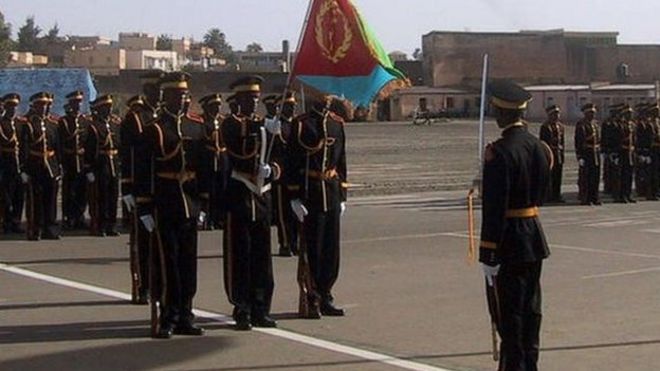
Eritrean Army parades during the country's independence anniversary celebrations attended by a 13,000-strong crowd 24 May 2003, at Asmara main squareImage copyright AFP Image caption Many Eritreans flee to avoid long-term conscription into the army


Security forces in Eritrea's capital Asmara have killed several young conscripts who tried to escape the convoy they were travelling in, according to opposition media outlets.

There were also civilian casualties after some of the recruits' friends and family used a bus to block the road to help them escape, according to the unconfirmed reports.

Conscription in Eritrea is compulsory.

The Eritrean authorities have not commented on the alleged incident.

Rights groups consider Eritrea to be one of the world's most repressive states.


In 2015, it ranked bottom of the World Press Freedom Index, published by media watchdog Reporters Without Borders (RSF).

Conscription in Eritrea can last for decades and is one of the main reasons tens of thousands flee the country every year.

Source=http://www.bbc.com/news/world-africa-35977605?SThisFB

Grey line

More about Eritrea:

Inside the secretive state of Eritrea

Eritrean life in pictures

The lone seven-year-olds leaving Eritrea

| BELGIUM

| 22 MARCH 2016 

The Socialist International condemns without reservation the cowardly and indiscriminate terrorist assault on innocent civilians in the heart of Brussels and at Zaventem airport, and expresses its deepest sympathy and solidarity with the victims of these despicable acts, the local emergency services, and all the people of Belgium. We extend our sincere condolences to the families and friends of those killed and to all those who have suffered trauma and injuries in the explosions that struck Belgium's capital today.
 
The SI equally stands in support of its socialist members in Belgium, the government of the country and all its institutions as they come to terms with this attack and take measures to catch the perpetrators and protect citizens. We look forward to the apprehension of all those responsible for the planning and execution of today's bombings and for justice to be carried out.  
 
Now is a time for all decent people around the world to unite in defence of the universal values of freedom, tolerance and peace, and reject the chaos, destruction and fear caused by terrorism. These acts are above all an attack on our way of life, and the number of major terrorist attacks in recent months in different locations around the world has demonstrated that this is a threat which requires a united global response.
 
The Socialist International once more calls on all its member parties and the entire international community to join in a comprehensive response to terrorism in order to eliminate this scourge without sacrificing the fundamental freedoms and rights that these attacks seek to undermine.

/

Israel May Be Trafficking Former Eritrean Slaves
 
This article, by Peter Dorrie suggests that Israel is trading Eritreans for weapons.
Martin
Source: Warisboring
 
 AfricaIsrael March 15, 2016 Peter Dörrie 1

Israel May Be Trafficking Former Eritrean Slaves

In Uganda’s capital Kampala, a sign in Eritrean script points the way to a back alley. There’s a small hotel here with only a few rooms, most of them empty. In room number eight an old man sits on a worn-out sofa. His trousers and shirt are stained and he wears flip-flops. His arms are covered in scars.

The old man’s lawyer sits next to him. Both have requested anonymity. “He has gone through a lot,” says the lawyer. He speaks to his client in Tigrinya, the official language of Eritrea.

The old man — we will call him Aman — describes how he wound up in this dingy hotel in Uganda. And he’s not alone. Aman’s tale is representative of thousands of Eritrean refugees who have been caught up in the deadly nexus of the illicit arms trade … and human trafficking.

Icono WIB

The pattern is often the same. Refugees fleeing one of the most repressive regimes in the world get stuck and eventually arrested in Israel, which bills itself as the only democracy in the Middle East.

Years later, Israel deports them to Rwanda, which passes them on to Uganda and sometimes South Sudan, where the refugees suffer harassment by agents of the regime they were trying to escape in the first place. Their only hope is to begin the dangerous journey through the Sahara again, paying thousands of dollars in fees and bribes to traffickers and border guards.

Many die along the way.

In exchange for helping Israel to get rid of its unwanted refugee population, East African military and intelligence officers travel to Israel to receive training and go on shopping sprees for high-tech military hardware. Refugees, especially from Eritrea, have become a kind of currency in arms deals between some of the world’s shadiest and most corrupt governments.

Eritrean refugees arrive in Romania. U.N. High Commissioner for Refugees photo

Eritreans have been fleeing their home country in droves for years now — and with good reason. The regime of the East African country on the Red Sea is second only to North Korea in its repressiveness. Many Eritrean refugees flee the country to escape compulsory military service. Officially instituted by Pres. Isaias Afewerki in 1995, conscription was supposed to provide the necessary manpower for Eritrea’s army. But it quickly devolved into an instrument of repression and exploitation.

For those who can’t afford to bribe officers or government officials, enlistment is essentially indefinite and targets both men and women up to the age of 50. Conscripts receive very little military training and are forced to work on infrastructure projects and in agriculture while receiving less than $30 per month in compensation. Female conscripts are frequently victims of sexual violence.

While some young adults manage to dodge the draft, they live in constant danger of being discovered and can’t access higher education or formal employment. Refugees interviewed for one 2013 study reported to have served an average of six years in the military prior to their escape, with some having served more than double that. For all intents and purposes, military service in Eritrea is a form of slavery.

Aman, the old man in the hotel, says he didn’t flee because of conscription, but the rest of his story is similar to those who do. A high-ranking officer in the Eritrean army, he had to flee the country in 2008 after refusing to carry out an order from Afewerki.

Passing through Sudan and Egypt, he tried to reach Israel by crossing the Sinai Peninsula. There he was abducted by local bedouins. His family had to pay them a $25,000 ransom. If he had refused or had been unable to pay, his abductors threatened to cut out his kidney and sell it on the black market.

Eritrean asylum-seekers wait to board a ferry in Greece. U.N. photo

Aman’s experience of abduction and ransom is the norm rather than the exception for Eritrean refugees who pass through the Sinai, says Mirjam van Reisen, a Dutch scholar and co-author of the 2014 report “The Human Trafficking Cycle: Sinai and Beyond.”

“Because of the long history of Eritreans fleeing their home country, they form a large, tightly-knit expatriate community abroad,” van Reisen tells War Is Boring. “Combined with the desperate need of people to escape the Eritrean regime, this makes them an attractive target for abductions and ransom demands.”

Van Reisen’s report details many cases of Eritreans who suffered tremendous abuse on their way from Eritrea to Israel and other destinations, at the hands of both criminals and government security agents.

Aman’s captors set him free on the Egyptian-Israeli border, from where he was able to cross into Israel.

In theory, his plight should have ended here. Under the 1951 Refugee Convention, to which Israel is a party, host countries are required to treat refugees fairly, give them access to the labor market and guarantee their freedom of movement. Importantly, host countries are explicitly forbidden to expel refugees, especially “in any manner whatsoever to the frontiers of territories where his life or freedom would be threatened.”

Migrants sneak into Hungary. Photo via Wikipedia

Unfortunately for Aman and thousands of other refugees from Eritrea and beyond, the Israeli government completely disregards its obligations under international law. Politicians refer to refugees as “infiltrators.” Current Minister of Culture and Sport Miri Regev called displaced people “a cancer in the body” of the nation.

For several years Aman was able to live and work in Israel, cleaning rooms to make a living and learning Hebrew. Every three months, he stood in line at the immigration authority to prolong his papers.

That changed suddenly in July 2014. “They took my papers and locked me up in Holot,” Aman says. Both Holot and nearby Saharonim are camps in the middle of the desert close to the Egyptian border. Around 50,000 refugees, most of them Africans, are housed at these facilities. While inmates of Holot are allowed to own mobile phones and keep in contact with the outside world, Saharonim is comparable to an actual prison.

Both facilities represent a clear breach of Israel’s obligations under international law, organizations such as Human Rights Watch and Amnesty International have said. Former interior minister Eli Yishai made clear their purpose. As long as Israel was unable to deport all asylum seekers, he said he would “lock them up to make their lives miserable.”

And in December 2012, Prime Minister Benjamin Netanyahu said that his party would move to the “second stage, that of repatriating the infiltrators who are already here.” Every month people would be repatriated “until the tens of thousands of people who are here illegally return to their countries of origin.”

Migrants arrive in Germany under heavy police security. Photo via Wikipedia

Officially, those refugees who leave do so “voluntarily,” but in reality they face either indefinite detention or simply have no choice at all, as was the case with Aman.

Eighteen days after his initial arrest, he says, he and five other Eritreans were escorted by uniformed security guards and two men in civilian clothes to the airport in Tel Aviv. He didn’t go through any passport or security checks and did not receive any documents. Instead, an official gave him $3,500 in cash, for which he had to sign a receipt, and then he got put on a plane.

Most refugees get deported on commercial airlines such as Turkish Airlines or Ethiopian Airways, but Aman says his plane “was small.” The other passengers were official-looking and wore passes on lanyards around their necks. Aman says he thinks they were diplomats. There were also bodyguards on board, complete with small Secret Service-style earpieces.

Nobody told him where the flight was going to. “Only when I saw the airport building, I knew — we are in Rwanda,” he says.

The official-looking passengers left the plane and were driven away in sedans with blue lights. “I was led away by Rwandan agents in civilian clothes,” Aman recalls. Again, he passed no official controls or checks. Nothing documents his entry into Rwanda. Together with the other Eritreans he was driven to a house in the capital Kigali. “The guy who set us up at the house introduced himself as John.”

Migrants arrive by boat in Greece. Photo via Wikipedia

Many Eritreans, even those who arrive in Rwanda on commercial airliners, confirm this chain of events. All describe the same house and the same “John,” who told them that the Israeli government would pick up the tab for three nights of lodging. John would return on the second day and tell them that a car would wait for them the next morning and would bring them to Uganda. The car ride would cost them each $250.

Aman was brought by said car to the hills on the Ugandan border, from where he was guided by a shepherd across the border, again without passing through an official crossing. At no point was he offered the opportunity to apply for asylum in Rwanda, as would be required by international law.

On the Ugandan side, a minibus awaited the Eritreans. The driver again demanded $250, this time to bring the group to Kampala. Just outside the city, the driver received a phone call and stopped. Shortly thereafter, an SUV pulled up and two Eritreans stepped out. They greeted the driver, demanded more money from the passengers and finally brought them to the dingy hotel in one of Kampala’s back alleys.

It is hard to overstate how irregular this procedure is. The techniques employed in the transfer of refugees such as Aman from Israel to Rwanda and onward to Uganda are comparable to those of sophisticated human-trafficking operations. But the details leave no doubt that all of this happens with government participation.

A Ugandan Su-30 fighter. Photo via Wikipedia

Both Rwanda and Uganda are tightly-run authoritarian states with incredibly well-resourced militaries and intelligence services. There is no conceivable way that the security establishments of both countries are not aware of the movements of refugees like Aman, and in Rwanda’s case the government seems to be actively participating.

But officially, all participating governments deny the existence of a deal to facilitate the deportation of refugees from Israel. “Israel is a good friend of Rwanda and we work together closely, especially in the fields of agriculture and technology,” Rwanda’s foreign minister Louise Mushikiwabo said. But there is “no special package” for the refugee question, she added.

While this “has been discussed” in earlier negotiations with Israel, “negotiations ultimately weren’t finalized.” Ugandan authorities also said that they were unaware of any deal.

So why is this trade in refugees conducted in secret when the Israeli public should be overwhelmingly in favor of it and African countries such as Rwanda could find ways to justify their actions? Maybe the reason for so much secrecy is not the government-sanctioned human trafficking, but what Rwanda, Uganda and other African countries get in return for taking refugees from Israel.

When the deal was first discussed around 2013, the Israeli government openly floated the idea of providing military hardware and training at heavily discounted prices, or even for free, to the participating African countries. The packages would also include agricultural and technological assistance.

Uganda has acquired Orbiter 2 drones. Aeronautics Systems photo

At the time, government officials said that they were “close” to finalizing these deals. And indeed, Rwanda entered into a partnership agreement with Israel in 2014, and Israeli businesses invested heavily in the Ugandan agricultural sector in the following years. Conspicuously absent from any official celebration of the agreements was any mention of either refugees or arms.

A Ugandan official even told Vice that “no such agreement is in place between Uganda and Israel” and that “Uganda fully respects and encourages state parties to respect rights of refugees, including the principle of ‘non-refoulement’ and burden sharing.”

Strangely, though, this was also the exact period when pro-refugee organizations began to report the first cases of “voluntary” deportations of African refugees to Rwanda and Uganda. And at the same time, Israel suddenly embarked on a program of close cooperation with African countries in the defense sector.

Traditionally, Uganda and Rwanda have been close military allies of the United States and the United Kingdom. America has spent billions of dollars on military training and equipment for East Africa. As a result, the Rwandan and Ugandan militaries are among the most capable and effective on the continent.

While Rwanda’s army primarily focuses on internal security and projecting the country’s influence into the volatile Democratic Republic of the Congo, as well as contributing substantial forces to U.N. peacekeeping operations, Uganda has taken on the role of a veritable regional military superpower.

11983305234_3c57363f95_kRwandan soldiers deploy to Central African Republic. Rwandan government photo

Ugandan soldiers are fighting Al Shabab in Somalia as part of an African Union mission and have, at one point or another, intervened militarily in the majority of countries across the region. Uganda’s military provides the forces that secure Pres. Salva Kiir’s position in the South Sudanese civil war, for example.

Rwanda and Uganda have foreign assistance to thank for these military capabilities. The regimes in both countries rely on a constant flow of modern hardware and training from international partners.

Rwanda is a military state with an all-mighty intelligence community that has virtually stamped out internal dissent. The Rwandan government’s main security challenge today emanates from hostile groups active in eastern Congo. To guard against incursions, the Rwandan military covets aerial surveillance equipment, among them modern long-endurance drones. It also requires training and equipment to guard against terror attacks and bombings inside its own borders.

Likewise, this type of high-tech military hardware and know-how is on the shopping list of the Ugandan military, together with other modern surveillance gear, multi-role fighters and air defenses. Pres. Yoweri Museveni, in power since 1986, recently faced a highly contested election that only served to underscore his reliance on the security services to guarantee his continued control of the state. For its international adventures, especially in Somalia, the Uganda People’s Defense Forces have to be equipped and trained in counterinsurgency and close-quarters urban combat.

There is a limited number of countries that offer this sophisticated technology and training and would be willing to provide it to Rwanda and Uganda at the prices that these developing countries can afford.

The U.S. and U.K. have pulled back their cooperation over Rwanda’s support for the M23 rebel group in eastern Congo in 2011, and since, Uganda’s Museveni made clear that he has no intentions of relinquishing power any time soon.

Fortunately for both regimes, a few years ago Israel was searching for a solution to its “infiltrator” problem.

Israel is among the world’s top-10 arms and military services exporting countries and has an incredibly well-developed defense industry, largely focused on providing the capabilities that Israel itself needs — high-tech military systems for counterinsurgency and surveillance. Israel is one of the few countries that exports high-endurance surveillance drones, for example. The Israeli military and Israeli contractors are renown for their expertise in counterterrorism training and doctrine.

Israel has a long history of exporting arms to Africa, but the pace of its exports has picked up substantially over the last few years. Sales doubled between 2012 to 2013, around the time that Israeli officials said that deals for trading refugees against arms were close to being finalized. They rose again by around 40 percent in 2014, reaching the second consecutive all-time high of $318 million, a remarkable increase compared to just $77 million in 2009.

The same year, Israel’s foreign minister Avigdor Lieberman toured several African countries, among the Uganda and Rwanda, with a large group of defense industry executives in tow.

When Uganda’s Museveni visited Israel in 2011, he stopped by the facilities of Israel Aircraft Industries and showed great interest in drones. In the following years, his minister for security Aronda Nyakairima, who also handles immigration, visited Israel frequently. Nyakairima, who has died, was the army’s chief of staff before his government appointment.

Uganda has dramatically expanded its aerial capabilities in recent years, buying Russian Su-30MK multi-role jets and other highly advanced equipment. At Kajjansi Flying School, Uganda’s only flight academy, training is handled by Orlando Barak, an Israeli arms dealer.

Quite a few other Israeli arms dealers are running private security companies in Kampala. When two of them were arrested at Entebbe’s airport in November 2014 in connection with a shady arms deal involving Ugandan special forces, Museveni himself intervened to free them. The special forces, incidentally, are under the command of Museveni’s son, Brig. Muhoozi Kainerugaba.

Rwanda for its part formalized its relationship with Israel in 2015, opening an embassy in Tel Aviv. The first ambassador was Col. Joseph Rutabana, who up to that point served as an undersecretary in the Ministry of Defense with responsibility for procurement. His appointment coincided with a marked increase in deportations to Rwanda.

All three countries treat their arms imports and exports as highly confidential matters of national security. Details on individual deals and transfers are virtually non-existent in the public domain. Still, sources with knowledge of the matter have confirmed to War Is Boring, on the condition of anonymity, that military assistance and cooperation between Israel and Rwanda and Uganda is substantial and linked to the willingness of these countries to accept refugees deported from Israel.

On the surface, this may seem to be just a simple act of Realpolitik, the political elites of these countries simply coming together to satisfy their individual political and security needs. But this perspective glosses over the immense personal suffering that results from this intermingling of the trade in arms and people.

These two trades are responsible for some of the worst suffering in the world, but they are also among the least regulated trading regimes in existence. Where the transfer of foodstuffs and consumer goods is tightly controlled and governments have subjected themselves to independent judicial bodies for oversight, the trade in weapons of all kinds, as well as the treatment of refugees, is governed only by some international agreements that profess great respect to national sovereignty and security. Non-complying states have to fear few consequences apart from diplomatic finger-wagging.

Rwandan soldiers deploy to Central African Republic. Rwandan government photo

Of course, most refugees would prefer to live free in Uganda rather than be imprisoned in Israel, and deportations to a third country are not illegal in all circumstances. But with neither Israel nor Rwanda nor Uganda admitting to any bilateral deals, the refugees face huge problems upon arrival.

“Eritreans are in a very precarious situation when they arrive in Uganda,” Meron Estefanos, a human rights activist and journalist, tells War Is Boring. “The Israeli authorities take away their documents and because the participating governments deny that there is a deal, they have no residency or refugee status in East Africa. Especially Eritreans also live in constant fear of being in some way forced to return to their home country.”

The Eritrean regime treats escapees like traitors, sentencing them to essentially indefinite prison under the harshest and most brutal conditions imaginable.

An obvious solution would be for Uganda to recognize those deported from Israel as refugees and provide them with official documents, but it seems likely that given the scale of the trade, Uganda has made a conscious decision to avoid giving Eritreans and others protection under the law. As many as 262 asylum seekers have “voluntarily” left Israel every month since the beginning of 2015, according to the government.

But these are only a fraction of the up to 50,000 people who are still locked up in Holot and Saharonim, all of whom likely will be deported as soon as possible. Uganda’s government may hope that by not providing these people with permanent status, most will choose to use their money from the Israeli government to try to reach Europe again.

Estefanos says that because they live in constant fear of being caught and arrested by the Ugandan police or discovered by Eritrean intelligence, many Eritreans decide to make another attempt at reaching Israel or Europe. “The money that they receive from Israel lasts them only to Khartoum,” the Sudanese capital, Meron says. On the way they have to pass through South Sudan, which is still in the throes of a civil war.

Those who manage to come up with the funds to continue their journey are likely to again find themselves at the mercy of unscrupulous traffickers, professional abductors or even on one of the many boats that have dragged their passengers to the bottom of the Mediterranean. Their suffering is testament to the intermingling of nationalist and securitized politics, regional military grandstanding, domestic suppression and a system of international trade that makes it easy to treat people like currency to be exchanged for arms.

And it may be the case that instead of facing international scrutiny, Israel’s approach will find imitators. With many European countries struggling with the influx of Syrian and African refugees, some might be interested in getting rid of them on the cheap. If this can be combined with developing new export markets for the domestic defense industry, politicians may be even more inclined to ignore any moral qualms.

This, of course, is terribly short-sighted. It will strengthen criminal smuggling operations, many of which have links to terrorist organizations, because many refugees will just attempt to again reach Europe. And providing regimes like Uganda and Rwanda with even more weaponry and tools to suppress their domestic populations and intervene in neighboring countries will only serve to ultimately increase the refugee population.

Source=https://martinplaut.wordpress.com/2016/03/15/israel-accused-of-trading-eritreans-for-weapons/