Labour launches immigration listening tour

Thursday, 04 February 2016 10:11 Written by


Labour launches immigration listening tour
February 4th, 2016
Author: Economic Voice Staff
 
 
0

Labour Party to listen to country's immigration concerns

The Labour Party will today begin a three-month tour of the country to listen to public concerns on immigration while the party rethinks its policy agenda.

Shadow Home Secretary Andy Burnham and Shadow Immigration Minister Keir Starmer will launch the tour in Wolverhampton and hold a series of meetings with local businesses, students and representatives from the Higher Education sector before hosting a public meeting in Dudley.

Over three months, Starmer will visit every part of the UK to hear people’s views on immigration policy and its impact on local communities. He will hold roundtable events with the CBI, the TUC and Universities UK.

Houses of Parliament (PD)

Keir Starmer MP, said:

This is not intended to be an easy or comfortable exercise. It is a genuine attempt to listen to and learn from the public on the issues of migration and refugees.

“I will spend the next three months visiting different parts of the UK, listening to the arguments and seeing for myself both the advantages and challenges that migration brings in different places.

“There are many, varied and legitimate views on migration across the Labour party and the UK. Many Labour voters and supporters are worried about migration and their concerns are our concerns.”

Andy Burnham MP, said:

"Labour needs a plan to win back the voters we failed to convince on immigration. We will not succeed in doing that by denying the effect that migration has had on some communities. EU free movement is, overall, beneficial to our society and economy. But it has a different input on different places. In some of our more deprived areas, it has put pressure on public services and undermined jobs and wages. If politicians don't understand and acknowledge that, then we will continue to look out of touch.

“For too long, Labour has been uncomfortable discussing immigration. This listening tour is an attempt to change that and deal directly and honestly with it. The answer is not to cut ourselves off from the world but to be clear about the need for strong borders and firm but fair rules. We need practical solutions to the problems free movement creates, such as EU funding to support the communities most affected and rules to prevent the under-cutting of wages. Labour will continue to argue for these things as part of our renegotiation with the EU. And Labour will be resolute in opposing further Tory cuts to our Border Force that are now on the way.

Source=https://www.economicvoice.com/labour-launches-immigration-listening-tour/

3 February 2016

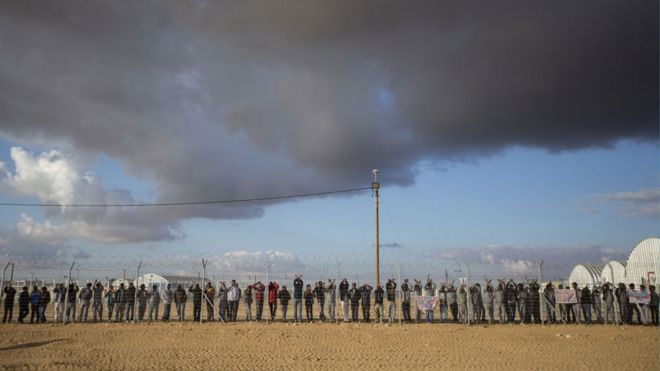
Asylum seekers stage a protest by leaning against the fence of the Holot detention centreImage copyright AFP Image caption Asylum seekers stage a protest by leaning against the fence of the Holot detention centre

For nearly a year Israel has been offering African migrants cash and the chance to go and live in what is supposed to be a safe haven in a third country - but the BBC has spoken to two men who say that they were abandoned as soon as they got off the plane. One was immediately trafficked, the other left to fend for himself without papers.

Adam was 18 when he arrived in Israel in 2011. Attackers had burned down his home in Darfur at the height of the genocide, and he had spent his teenage years in a UN refugee camp in another part of Sudan. With no prospects in the camp and no sign of an end to the conflict in Darfur, he made his way north through Egypt and the lawless Sinai peninsula to Israel.

But Israel - which has approved fewer than 1% of asylum applications since it signed the UN Refugee Convention six decades ago - has not offered asylum to a single person from Sudan. It turned down Adam's application, and last October, when he went to renew the temporary permit allowing him to stay in the country, he was summoned to a detention centre known as Holot, deep in the Negev desert.

The government calls Holot an "open-stay centre", but it's run by the prison service and rules are strict, including a night-time curfew, which, if broken, will land you in jail.

 It's in such an isolated area that there's very little to do and nowhere to go.

I talked to Adam and a group of his friends just outside the gates of Holot, where, at that time, they spent most of their day playing cards or snooker, and eating and cooking in makeshift restaurants.
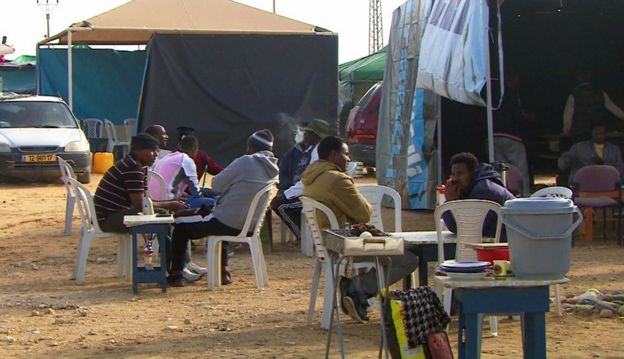
Restaurants outside Holot

They told me they took turns to make the hour-long bus ride into the nearest town, Beersheva, where they bought food. The meals served in Holot were insufficient, they said, and contained little meat or protein.

Most of the men there were young - in their 20s or early 30s. Some had been teachers, activists or students in their own countries.

"We are wasting our youth here," Adam says. "If someone lives in Holot, they have no future... You find many people here go crazy."

Since I visited Holot, those makeshift restaurants and game areas have all been demolished on the orders of the government, leaving those inside with even fewer ways to pass the time.
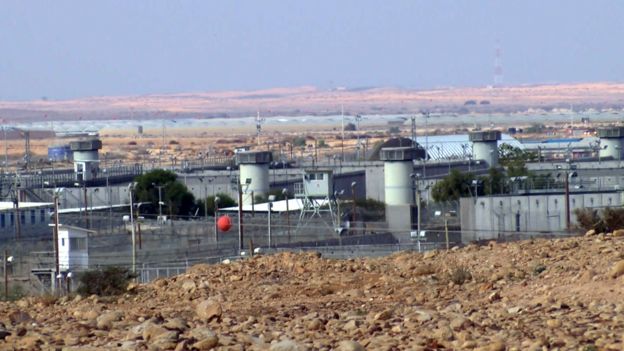
Saharonim PrisonImage caption Holot detention centre is located close to Saharonim prison, where those who refuse to leave Israel may be held indefinitely

Adam will be held in Holot for 12 months. Then he is likely to face a stark choice:

  • Go home to Sudan
  • Stay in Israel, but be imprisoned indefinitely
  • Accept departure to a third country

The Israeli government has deals with two countries in Africa to host its unwanted migrants.

It promises that people who take the option of "voluntary departure to third countries" will receive papers on arrival that give them legal status in the country.


Find out more

Watch Kathy Harcombe's TV report for Focus on Africa on BBC World News at 17:30 GMT, Wednesday 3 February.


As an extra incentive, they're given $3,500 (£2,435) in cash, handed over in the departure lounge of the airport in Tel Aviv.

Israel refuses to name the two African countries but the BBC has spoken to migrants who say they were sent to Rwanda and Uganda.

One is Tesfay, an Eritrean who was flown to Rwanda in March 2015, and he told me that far from being offered legal status, a home and the chance of a job in Rwanda - as he had been promised in Israel - he became a victim of trafficking.
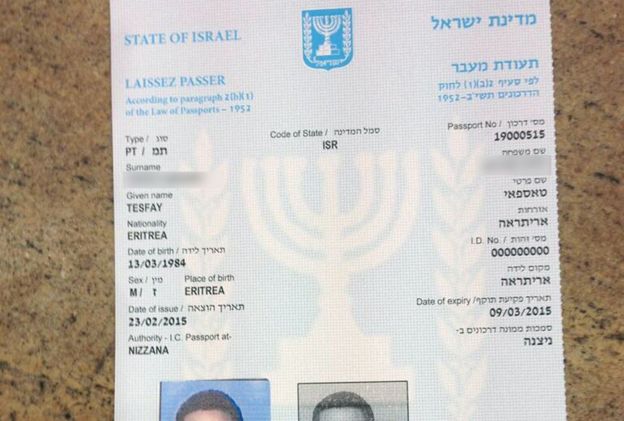
Laissez passer document from Israel

His identity papers - a travel document and a single-entry visa to Rwanda, both issued in Israel - were immediately confiscated at Kigali airport, he says.

Then, along with nine other Eritreans, he was taken to a "guest house". None of them was allowed out. It would be dangerous without papers, they were told. Then, two days after arriving, the men were told it was time to leave.

Rwanda guest houseImage caption Tesfay took this picture of the guest house in Rwanda

"You are going to Uganda. But before you go, you need to pay $150," said a man who introduced himself as John. "Then from the border to Kampala you need to pay again."

Crammed into a minibus, they made the six-hour journey to the Ugandan border, where they were told to get out of the bus.

"When we crossed the border, that's when I understood that we were being smuggled," Tesfay says. "We went on foot, silently. We were being smuggled from one state to another."

As promised by "John", they had to pay another $150 to continue their journey to the Ugandan capital, Kampala.

But inevitably, having entered as illegal immigrants, they were arrested on arrival and put behind bars - after police had relieved them of about half the cash in their pockets, Tesfay says.
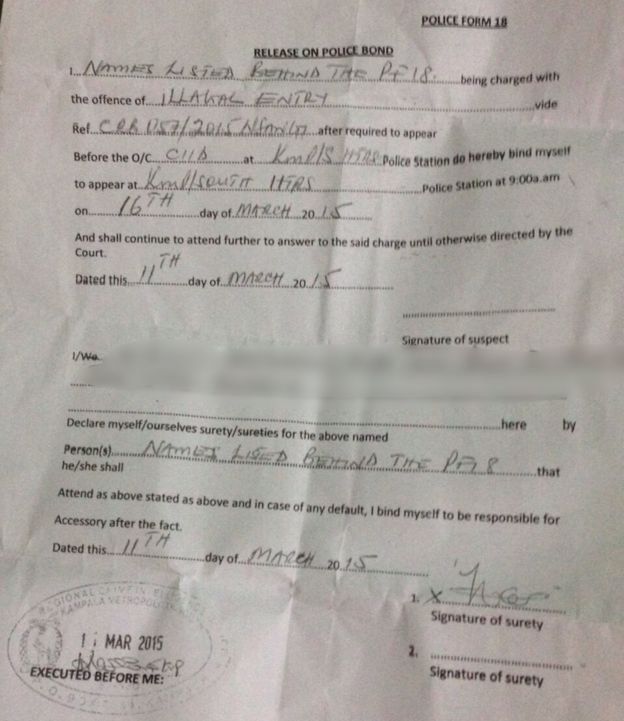
Uganda police warrant

With what was left, Tesfay managed to post bail. He was due to appear in court five days later and having already been warned he was likely to be deported to Eritrea - the repressive authoritarian state he had fled in the first place - he decided to take no chances. He paid another smuggler to get him into Kenya, where he is now seeking asylum.
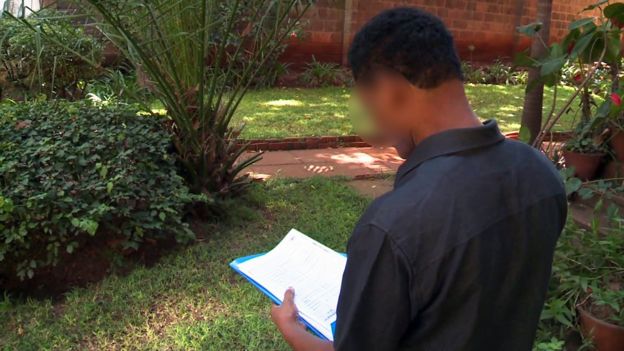
Tesfay looking at a document

Rwanda has never confirmed that it struck a deal to host Israel's unwanted migrants. The Ugandan government, for its part, has denied outright that such a deal exists - it told the BBC it was investigating how migrants who claimed to have been sent from Israel were entering the country.

The BBC spoke to a man from Darfur who said he was flown to Uganda from Israel with seven others in 2014, before the third country policy became official.

For safety reasons, he asked to remain anonymous.

"None of the things I was promised were given to me," he said. "No documents, no passport, no assistance - nothing. (Israel) just wants to take people and dump them."
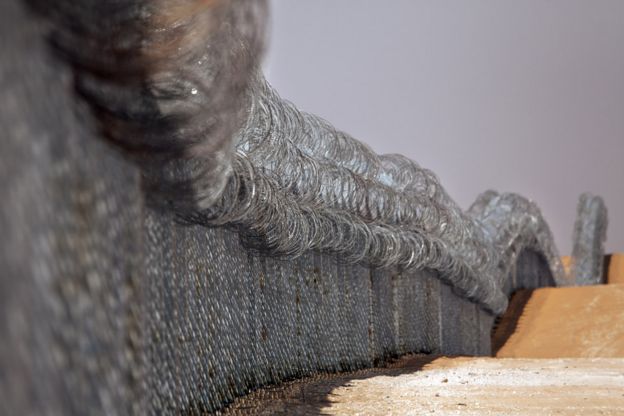
Israel border fence with EgyptImage copyright EPA Image caption Israel fenced the Egyptian border in 2013, reducing the flow of migrants into the country

In October, Israeli immigration authorities said 3,000 asylum seekers had left Israel for a third country. But the BBC has learned that only seven have registered with the UN High Commissioner for Refugees in Rwanda, all of them Eritreans, and only eight, mostly from Sudan, in Uganda.

Meanwhile, there are about 45,000 Eritreans and Sudanese in Israel. The government won't deport them - that would be a clear breach of the UN Refugee Convention, which it signed in 1954. Under the Convention, no-one can be forcibly returned to a country where they have a justified fear of persecution.

But if Israel treats them as refugees at least in this respect, why does it then refuse them asylum?

Foreign Ministry spokesperson Emmanuel Nahshon says the migrants threaten the security, and the identity, of the Jewish state.

"It's obvious that we live here in a situation which is rather complex and complicated. And if you add this element of migrants who come here and who want to stay here - undoubtedly because this is a rich and prosperous country - then it could become also a challenge to our identity here in Israel.

"It's not only about the 45,000 or 50,000 people that already are here in Israel, it's about the potential. Because those people tell their friends and families back home - 'Look, this is a very nice place. Do come over.'"
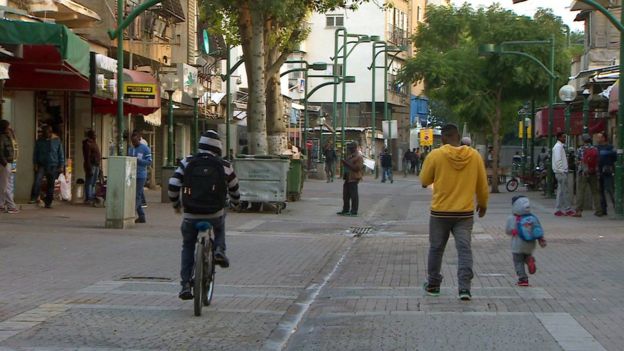
Tel Aviv streetImage caption Migrants on a street in Tel Aviv

And, of course, in Israel there is also the ever present issue of security.

"Open borders through which migrants can pass mean also open borders through which terror organisations can penetrate Israeli territory and commit terror acts," Nahshon says.

But lawyers fighting against the Third Country policy in Israel's Supreme Court argue that the country is in breach of its obligations under the UN Refugee Convention.

"[Migrants] are stigmatised as 'infiltrators' and then have their asylum application adjudicated in sort of a conveyor-belt system which rejects everyone," says one of the lawyers, Anat Ben-Dor.

"And then the whole idea of asking them to give their 'voluntary' consent to something they do not know because this is a secret arrangement... Of course this is not voluntary because you are using the threat of putting them indefinitely in prison if they refuse to go.
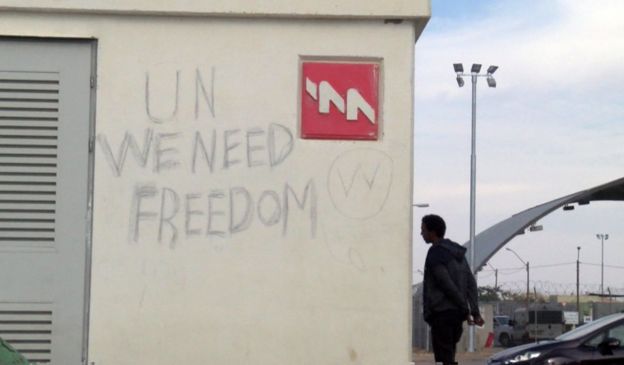
UN we need freedom signImage caption Graffiti at the Holot detention centre

"And then when they land in one of those two countries the lack of proper monitoring cannot really secure, in the necessary certainty, that those people would not end up either without [legal] status, or in prison, or - worst of all - being returned to places where they would face danger."

Sigal Rozen, from the Israeli human rights group Hotline for Refugees and Migrants, says that the failure by Israel to guarantee the migrants' security in Rwanda and Uganda means they are forced to risk their lives elsewhere.

"Some of them continue to South Sudan, others to Kenya, to Ethiopia, and many end up in Europe after they take the route through Libya and Italy. Unfortunately many others die on the way and we never hear from them again," she says.

There's a joke among the migrants, she says, that the Israeli government's departing "gift" of $3,500 is just enough money to get to Europe.

But the Israeli government is adamant that it's acting within the framework of international law and is offering a fair deal to the migrants.

But in Tesfay's opinion, he did not get a fair deal.

"The Israeli authority - it's not what they promised. I have no safety - I have no protection at all," he says.

The risk is that Adam and the other residents of Holot will experience exactly the same thing when they arrive in Africa.

Source=http://www.bbc.co.uk/news/magazine-35475403?SThisFB

Subscribe to the BBC News Magazine's email newsletter to get articles sent to your inbox.


42_child_watching_fire_theme_war_article_detail_small
28Jan2016

The UK will offer safety to more unaccompanied refugee children, the Government has announced.

The UK has asked the UN's Refugee Agency (UNHCR) to identify Syrian unaccompanied children currently living in the Middle East and other conflict zones who could benefit from resettlement. It is unclear how many children will be offered safe haven, but this scheme will be in addition to the Government’s pledge to resettle 20,000 Syrian refugees by 2020.

The Government has rejected calls to offer safe haven to 3,000 unaccompanied children who have made the perilous journey to Europe and who are living in dangerous situations across the continent.

However, the UK has promised to allow children in Europe with relatives here to finally realise their rights to be allowed to join them in the UK while their claims for asylum are examined.

While existing European rules in theory already allow this to happen, they are rarely implemented, leaving children desperate to join their loved ones with little option than to undertake a risky march of misery across the continent to try and reach them.

The Refugee Council has long called for these rules to be properly utilised to prevent refugees from being forced into such dangerous journeys and is now calling for their speedy implementation.

Refugee Council Head of Advocacy Dr Lisa Doyle welcomed the move, saying: "Children who are travelling alone in Europe are vulnerable to succumbing to freezing temperatures, abuse and exploitation. It’s vital the Government acts as quickly as possible to bring families together in order to prevent the unnecessary risk and hardship experienced by those currently forced to make treacherous journeys to reach their loved ones.”

Despite this step forward, the Refugee Council is concerned that the Government is still refusing to help share responsibility for protecting the men, women and children arriving on Europe’s shores – a deliberate failure to acknowledge the fact that these refugees are fleeing the same atrocities as those the Government is choosing to resettle and are also in dire need of protection.

The Refugee Council is calling for Britain to voluntarily step forward and show leadership in its approach to the refugee crisis by offering to help protect some of the refugees arriving in Europe, as well as by establishing alternative routes to safety for those fleeing for their lives.

Source=http://www.refugeecouncil.org.uk/latest/news/4535_uk_to_offer_safety_to_more_lone_refugee_children?utm_source=Refugee+Council&utm_medium=email&utm_campaign=6711414_Reuniting+Families+Update+%2828%2F01%2F16%29&utm_content=Link+to+Article&dm_i=I6P%2C3ZUK6%2C5PQQ7W%2CEFM33%2C1

Report: World Freedom in Decline for 10th Year

Thursday, 28 January 2016 19:22 Written by

VOA News

In another major report Wednesday on human-rights concerns, The Freedom House group said more aggressive tactics by authoritarian regimes, an upsurge in terrorist attacks and a global economic downturn have contributed to a disturbing decline in freedom worldwide.

The U.S.-based international human rights group said freedom worldwide declined in 2015, for the 10th consecutive year.

The annual report by Freedom House says 72 countries showed a decline in freedom for the year, the largest number since the downturn began.

The human rights group says of the 195 countries assessed, 50 were rated "Not Free" and 59 deemed "Partly Free." The report says Syria, the Tibetan Autonomous Region of China, Somalia, North Korea, Uzbekistan and Eritrea were among the worst offenders.

Turkmenistan, Western Sahara, Central African Republic, Sudan, Equatorial Guinea and Saudi Arabia also made the list of the worst.

Among worst offenders

The Middle East and North Africa were listed as the worst regions in the world in 2015, followed closely by Eurasia.

The report indicates people in those places suffered significant setbacks, as authoritarian leaders cracked down on rights activists and other critics.

FILE - Migrants and refugees use their sleeping blankets to keep warm as they walk along snow covered fields after crossing the Macedonian border into Serbia, near the village of Miratovac, Jan. 18, 2016.

Freedom House said democratic countries, especially in Europe, also clamped down on civil liberties, as they came under pressure from terrorist attacks and the strain of unprecedented numbers of asylum seekers from Syria and other conflict zones. It said rising populism across the European Union cast doubt on the bloc’s ability to maintain high democratic standards among both current and aspiring member states.

According to Freedom House, the global economic downturn and fear of social unrest led authoritarian regimes in Russia, China and other countries to crack down harder on dissent.

Global economic downturn

In Russia, it said, President Vladimir Putin maintained his policies of repression, including persecution of LGBT activists and independent journalists, and he pursued military intervention abroad.  It also cited Putin for his continued support for rebels in eastern Ukraine, and the airstrikes in Syria aimed at shoring up the government of President Bashar al-Assad.

FILE - Lesbian and Gay Rights activists take part in a demonstration aimed to coincide with the upcoming Winter Olympics in Sochi, against laws aimed at stifling Gay Rights in Russia, opposite Downing Street in London, Feb. 5, 2014.

It also cited Putin for his continued support for rebels in eastern Ukraine, and the airstrikes in Syria aimed at shoring up the government of President Bashar al-Assad.

Freedom House said China's communist government in 2015 intensified its persecution of human rights lawyers, journalists and minority rights advocates, and singled out new targets for abuse, including labor activists, public health advocates and women’s rights defenders.  

It said modest reforms such as the institution of a two-child policy could not offset the abuses by the government.

Conflicts, disasters

As the world's attention was diverted to new conflicts and disasters, the report said, the dramatic setbacks for freedom in Thailand, Egypt, Crimea and South Sudan that marked 2014 continued to fester.

Leaders in several countries moved to extend their terms in office during 2015, Freedom House noted, most prominently in Burundi, Bolivia, Ecuador, the Democratic Republic of Congo, the Republic of Congo and Rwanda.

The report did find that 61 nations recorded progress in efforts to establish greater freedoms, and it cited Latin America for praise.

It cited Iran and Myanmar among the countries to watch in 2016.

The report said once the newly elected legislature of Myanmar is seated and a government is formed, the National League for Democracy will be under pressure to deliver on its promises.

In Iran, moderate reformists are preparing for next month's critical elections to the parliament and the Assembly of Experts, the body that appoints the country's supreme leader.


EMDHRLogo

Convened by Centre for Citizen Participation at African Union (CCPAU) the 6th African Citizens’ Conference was held between 21st to 23rd January 2016 in Addis Ababa, Ethiopia, under the theme African Year of Human Rights, in particular, with focus on the Rights of Women”. The Eritrean Movement for Democracy and Human Rights (EMDHR) facilitated the participation of Eritrean delegation composed of five activists.

The conference deliberated extensively on the current state of governance and human rights in Africa. The focus was on the achievements and challenges facing Africa in this respect. The conference underlined the normative and practical progress made so far by African Union in the areas off governance and human rights. Notable are the mechanisms put in place by the African Union, such as the African Charter on Human and Peoples’ Rights, related protocol for the establishment and functioning of the AHPR Commission as well as the Protocol for the Establishment of African Court of Justice. With respect to governance the adoption of African Governance Architecture and related institutions and legal provisions, such as the Pan-African Parliament and the African Charter on Democracy, Elections and Good Governance, are recognized an significant progress made by the African Union. However, the implementation in the sense of adherence was identified as a major shortcoming. The Conference noted that non-compliance of member states with the commitments they made at African Union is not only indicative of the ambivalence of member state with the Africa project, but also a factor contributing for continued widespread impunity and mal-governance in the continent.

As cases in point, the Conference specifically discussed situation in countries, such as Eritrea and Burundi. Sponsored by EMDHR and the Southern African Civil Society Solidarity Team a parallel workshop was convened dedicated to human rights situation in Eritrea with the title “We are not heard, We are not heard from: Human Rights Situation in Eritrea”. Two presentations were made in this workshop. One was by Dr Bereket Berhane Woldeab wwho briefed the participants on general political situation and the wide spread and systematic human rights situation in Eritrea and its implication on the Eritrea, its people and the regional at large. By making reference to the findings of the UN Human Rights Commission of Inquiry, Dr Bereket expressed his observation about the absence of African solidarity on with the Eritrean people. The second presentation was by a young Eritrean woman refugee who recently fled from the country risking her life. The young woman narrated her personal experiences and ordeals at the hand of the dictatorial regime which touched the participants deeply. As a daughter of former top official of People’s Front for Democracy and Justice who is now in unknown prison, the young woman explained how the regime consistently and vengefully victimized the entire family, including herself, in terms of taking away all the family possessions to deny the family any livelihood means; how she was dismissed from a tertiary institute where she was studying for a degree.                                                       

In its final communique the 6th African Citizens’ Conference adopted a resolution in which the African civil society called upon the African Union to put human rights situation in Eritrea on its agenda and endorse the report of the UNHR-COI report as its own and up on the AHPR Commission to refer Eritrea to the African Union Summit. The conference also urged up on African Civil Society to lend their unwavering support and solidarity to Eritrean human rights activists in the continent.  Furthermore, participants of the conference made a number of recommendations that would be undertaken by a number of civil society organizations that is aimed at raising awareness of Africans on the situation in Eritrean and engage their respective national governments on the matter in collaboration with Eritrean civil society.

The Eritrean delegation was made up of Mr Bashir Ishaq Abdalla, Dr Bereket Berhane Woldeab, Mr Nasreldin Ahmed Ali, Young Eritrean woman refugee, Ms Khadija Khalifa Mahmoud and Dr. Adane Ghebremeskel.


Addis Ababa, Ethiopia

24th January 2016

Planning, Proceedings and Outcome of the National Consultative Conference (NCC)

                                Semere Tesfamicael Habtemariam

Boston                                                                                                                                                                                                 

Date:     Saturday, January 30, 2016                                        

Time:    6:00 PM                                                                                               

Place:    The Eritrean American Civic Association                

                590 Shawmut Avenue,

Boston, MA 02118

Washington DC

Date:     Sunday, January 31, 2016

Time:    1:00 PM

Place:    416 Cedar St. NW

                Washington DC, 20012

Semere Tesfamicael Habtemariam is a member of the Forum for National Dialogue’s (FND aka Medrekh) Advocacy Team and member and secretary of the newly established NCC Ad hoc Organ Contact Organ.

Refugees say they were forced to wear bands at all times in accommodation provided by Home Office contractor

wristband

A coloured wristband on the arm of an asylum seeker, which indicates that they are entitled to meals at Lynx House. Photograph: Gareth Everett/Huw Evans Agency


Diane Taylor

Sunday 24 January 2016 15.14 GMT Last modified on Monday 25 January 2016 00.50 GMT

Asylum seekers in Cardiff are being issued with brightly coloured wristbands that they must wear at all times, in a move which echoes the “red door” controversy in Middlesbrough and has resulted in their harassment and abuse by members of the public.

Newly arrived asylum seekers in the Welsh capital who are housed by Clearsprings Ready Homes, a private firm contracted by the Home Office, are being told that they must wear the wristbands all the time otherwise they will not be fed. The wristbands entitle the asylum seekers, who cannot work and are not given money, to three meals a day.

David Cameron considering calls by charities as Jeremy Corbyn, who on Saturday visited refugee camps in Calais and Dunkirk, urges emergency steps

Read more

It follows the news that asylum seekers in Middlesbrough had complained their houses were targeted after people realised all front doors were painted the same colour red by the private firm responsible for housing them, G4S.

Eric Ngalle, 36, spent a month in Lynx House in Cardiff, where initial accommodation is provided for asylum seekers, before he was granted refugee status in November 2015. He is now working as a writer and making a theatre production with the Arts Council of Wales.

He said: “My time in Lynx House was one of the most horrible experiences in my life. I hated wearing the wristbands and sometimes refused to wear them and was turned away from food.

“If we refused to wear the wristbands we were told we would be reported to the Home Office. Some staff implemented this policy in a more drastic way than others. I made a complaint about the wristbands to Clearsprings but nothing was done. We had to walk from accommodation about 10 minutes away to Lynx House to get food and sometimes when we were walking down the street with our wristbands showing.

“On the road we had to walk down there is often heavy traffic. Sometimes drivers would see our wristbands, start honking their horns and shout out of the window, ‘Go back to your country.’ Some people made terrible remarks to us.

“If you take off the wristband you can’t reseal it back onto your wrist so if you want to eat you have to wear it all the time. Labelling them on a daily basis with silver, red or blue tags only serves as a reminder that they are still wearing the garments of an outcast.”

Wristband2

Photograph: Gareth Everett/Huw Evans Agency

Maher, 41, who recently stayed at Lynx House but has now been granted refugee status, said he was very angry about being forced to wear the wristband.

Advertisement

“When you walk down the street all the local people who see this brightly coloured band know who we are and where we live,” he said. “We feel we are not equal with this community. All the time I tried to hide the band so people could not see it.”

Asylum seekers in the UK are not allowed to work or claim mainstream benefits. Some receive a small amount of money or an Azure card to use in supermarkets.

But newly arrived asylum seekers placed in what is known as initial accommodation by the Home Office receive neither money or an Azure card. They are placed in hotel-style accommodation and given three basic meals a day.

Mogdad Abdeen, 24, a human rights activist from Sudan, spent three months in Lynx House at the end of last year. He has now been moved to different accommodation in Cardiff while he waits for a decision on his claim.

“This wristband is discrimination, clear and simple. No band, no food. We are made to feel that we are second-class humans. People in Lynx House are scared of meeting new people in case they see the wristband and give them problems.

Wristband3“Sometimes when we are standing outside Lynx House queueing for food people shout out of their car windows ‘refugee, refugee’. When we complain about the wristbands nobody listens to us.”

When some of the occupants of Lynx House were asked if they were willing to be identified, all refused saying they were scared that they might be punished for speaking out. Instead they agreed to have their hands photographed wearing the bands.

Chloe Marong, coordinator of the Trinity Centre in Cardiff, which supports asylum seekers and refugees, has expressed concern about the wristbands.

“We have raised concerns about these wristbands with the Home Office and Clearsprings but so far nothing has been done. These wristbands mark asylum seekers out and further stigmatises them in an already very hostile environment,” she said.

Adam Hundt of Deighton Pierce Glynn solicitors said: “Concerns about this practice have been raised with us and we have been looking at it. Asylum seekers are a very scared and vulnerable group and the last thing they want to do is stand out from the crowd.

Report says Home Office guidance that it was safe to send Eritreans home is based largely on discredited Danish report

Read more

“In some areas it can be dangerous for them to do so, so it is easy to understand how asylum seekers feel they are being branded with these brightly coloured wristbands which draw unwelcome attention to them and make them feel ashamed. It is particularly concerning that wearing the wristbands is linked to whether or not they get food or go hungry. It should be possible to come up with a system to ensure that people are fed without publicly humiliating them and undermining race relations.”

Wristband4

Photograph: Gareth Everett/Huw Evans Agency

The operations director of Clearsprings Ready Homes, said: “The UK has, over recent months, seen a larger population of asylum seekers. In turn volumes of people in initial accommodation sites, including Cardiff increased quickly.

“Clearsprings has taken steps, agreed with the Home Office to increase capacity in line with this demand in the form of additional self-catering accommodation.

“Those clients in the self-catering units receive a weekly allowance in the form of supermarket vouchers and those in full-board accommodation are issued with a coloured wristband that bears no other logo or text identifying its use or origin. Full-board clients are required to show their wristbands in order to receive meals in the restaurant.”

The company said it had been operating the system since May 2015 because of the increased numbers of asylum seekers.“As well as being subject to regular Home Office inspections we are contractually required to undertake stringent monthly inspections of the initial accommodation provision and rectify any defects within contractual timescales,” Clearsprings said.

The Home Office declined to comment.

Source=http://www.theguardian.com/uk-news/2016/jan/24/asylum-seekers-made-to-wear-coloured-wristbands-cardiff?CMP=fb_gu

Aid agencies call for collective European approach to migrant crisis

Some 700 migrants rescued by Italy and the EU are undergoing health and identity checks in Sicily.

Among them are 20 pregnant women and 29 unaccompanied children.

Read also Migrant crisis tops agenda of final EU summit of 2015

Most are said to be of African origin including from Eritrea, Nigeria and Somalia. Rescue crews say they will be passed on to Italy for processing.

Read also UN refugee chief calls for 'massive resettlement' of Syrians in Europe

Commander of the Norwegian Ship Siem Pilot, Lise Dunham"Yes, we always talk to the migrants we of course try to get some information out of them, from where they come and how the journey was, and everything. And then our task, we are a Frontex ship, is to get them safe ashore, to the Italian coast and then the Italian government first will do the rest of the work."

The mass arrival comes as aid agencies call for a collective European approach to the migrant crisis. Some leaders warn the huge influx of people means the EU's passport free Schengen zone is under threat.

Source=http://uatoday.tv/society/700-migrants-arrive-in-sicily-including-20-pregnant-women-and-29-minors-577385.html