Khartoum Journal
 
 
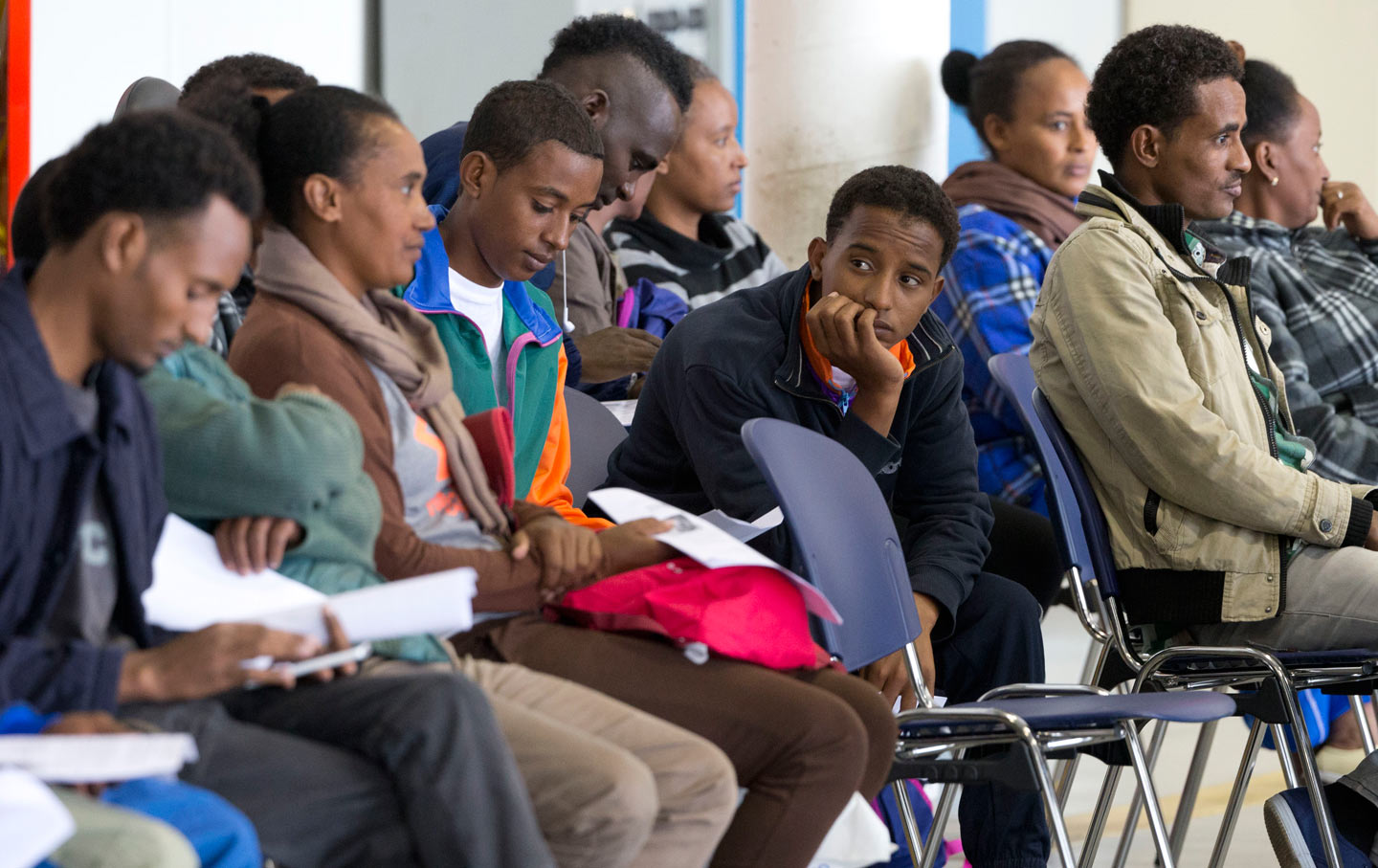
Eritrean asylum seekers meet at the Wad Sharifey refugee camp in eastern Sudan, near the border with Eritrea.
Mohamed Nureldin
 
By ISMA’IL KUSHKUSH

KHARTOUM, Sudan — He crossed the open plains of the border on foot more than a year ago.

Once inside Sudan, he was picked up by border patrol officers and sent to a crowded, decades-old refugee camp. He stayed there for one month. From there, after paying the equivalent of $500, he was smuggled on a pickup, along with 17 others, into the capital, where he worked for months in a cafeteria and tried lying low, or as he put it, “cooling it.”

Then he got ready for his next move: Libya.

“I know it is dangerous, but I am forced to,” said a nervous Yusuf Muhammad, 27, an Eritrean migrant in Khartoum. “I have no choice. I want to go to Europe or America.”

Thousands of migrants and refugees, especially from neighboring Eritrea and Ethiopia, come to Sudan every year. Many arrive with plans to earn some money and to connect with smuggling networks, making Khartoum a major launching pad for migrants heading to the Mediterranean and, ultimately, to Europe.

“There are people who come here with the sole purpose of moving, stay for a few months, work, gather money and go,” said Renata Bernardo, project coordinator at the International Organization for Migration in Khartoum.

The migrants and refugees say they are escaping harsh political and economic realities in their own countries, and sometimes both. In Eritrea, torture, extrajudicial executions, disappearances, forced labor and sexual violence are widespread and systematic, according to the United Nations, along with an indefinite military conscription system.

“Life is really hard in Eritrea, no freedom, no work,” Mr. Muhammad said.

Ethiopia boasts a fast-growing economy, but the benefits of this growth are not felt widely through the populous country, with more than two-thirds of the population living in severe poverty, according to the United Nations Development Program. The government is widely criticized for political repression and rights abuses.

Tasew Taero, 33, said he was a university student in Ethiopia, from the region of Oromia. Political unrest in his area brought on a security crackdown. He was arrested and tortured, despite not being involved in any activism, he said, so he decided to leave.

After traveling for a month and paying smugglers $350, he made it to Khartoum two years ago. Now he is waiting for an opportunity to go to Libya.

“If I get a chance, I will go,” he said. “When I have the money.”

Even after two years, some may consider him a recent migrant here. For decades, eastern Sudan has hosted refugees from both countries. Eritrea’s decades-long war of independence brought tens of thousands here, as did political strife in parts of Ethiopia. While many have accustomed themselves to a challenging life in Sudan, many of their children now are looking for better opportunities elsewhere.

“Sudan has always been at the crossroads of migration routes, for refugees and migrants,” said Angela Li Rosi, deputy representative of the United Nations High Commission for Refugees in Sudan.

Ghere Abraham, 45, is an Eritrean refugee who has lived in Sudan for nearly 30 years. A video of Islamic State fighters in Libya slaughtering Ethiopian and Eritrean migrants this year sickened him. Two of the people killed in the video had lived in his neighborhood in Khartoum.

The April evening the video was released, he went to the neighborhood church where condolences were being offered. It also reminded him of what could have happened to his eldest daughter, who tried recently to cross the Sahara to the Mediterranean with hopes of reaching Europe. He managed to stop her just in time, after threatening to kill the broker responsible for putting her in contact with smugglers.

“I cried when I saw her,” he said.

His daughter, Hiweit Abraham, 20, spoke grudgingly about the events, with no regrets about making the attempt to leave.

“I have no life, no respect, there’s nothing I can do here,” she said. “Because I am a refugee.”

Mustafa Ismail Abdalla, 25, grew up in Sudan. His father was a political activist with the Oromo Liberation Front, an Ethiopian rebel group labeled a terrorist organization by the Ethiopian government. But his life he is about working: He has been doing it since he was 8 and juggles three jobs today.

“Some of my friends went a few months ago and are in France now,” he said. “I just need a little more money and I will go.”

The high season for departures is February to October, when the waters along the Mediterranean tend to be lower, migrants here say. The smugglers have waiting lists, and many who make the trip face the dangers of detention, beatings, abuse and sexual assault in the desert.

While most of the migrants heading to Libya are from Eritrea and Ethiopia, increasing numbers are Sudanese, especially from Darfur, as well as Syrians and even Pakistanis and Nigerians who travel to the Mediterranean via Sudan. Here, they contact the smugglers through brokers, who take off into the desert from meeting points throughout the capital that shift to avoid detection.

“It’s around $1,200 to get to Libya,” Ali Ibrahim, a smuggler, said. “Prices go up and down if there are problems.”

From the outskirts of Khartoum, four-by-four pickups with 20 to 30 “heads” journey through Sudan’s northern desert to the Libyan border, where they are delivered to another group of smugglers.

“If you die in the desert, no one would know,” said Mr. Ibrahim, the smuggler, elaborating on the dangers of the trip.

In Libya, the migrants stay in smuggler camps. Those who have not fully paid are told to call their family for the balance. Sometimes, extra payments are extracted to release migrants who are effectively held hostage.

“There are children that run away, make their arrangements with smugglers, call their parents, ‘Mom, I’m in Benghazi’” Bernardo said.

The Sudanese government is paying more attention to migration. Last year, the Sudanese Parliament passed an extensive anti-human-trafficking bill and held an international conference to address the problem.

“We lack the experience and are calling for more training,” said Awad Dahia, head of passports, immigration and civil registration at the Ministry of Interior.

But some migrants contend that Sudanese officers are involved in the illegal trade as well.

“If there is credible evidence against anyone, an officer or a government official, then the law should be applied against them,” Mr. Dahia said.

For the migrants and refugees here who want a better life and to move on, there is a debate on the fruitfulness of the risks taken.

Mr. Abraham, who said that he was worried that his 14-year-old son would also try to leave, believes that the risks taken by the younger generation of refugees and migrants are not worth it.

“They are after a life that does not exist,” he said.

But Mr. Taero, the former university student, felt that was no reason to stay.

“It does not matter,” he said. “I am also dying here.”


DCSIMG


Residents explain why so many risk death to reach Europe, as the Guardian gains rare access to report from inside the country

All Eritrean are conscripted into the army – a national service that can last indefinitely. Photograph: Steve Forrest/EPA

David Smith in Asmara

Wednesday 23 December 2015 22.00 GMT Last modified on Thursday 24 December 2015 00.45 GMT


The shrill blast of a whistle still makes Almaz Russom wince. “You’re sleeping nicely, dreaming something, then it wakes you at 4.30am,” he said, clenching his teeth and mimicking the pitch. “I still don’t like the sound of that whistle.”

Inside Eritrea 1

All Eritrean are conscripted into the army – a national service that can last indefinitely. Photograph: Steve Forrest/EPA

Russom, whose name has been changed here for his own protection, was giving a rare account of a military bootcamp in Eritrea, one of Africa’s most secretive totalitarian states. It forms part of a compulsory “national service” for young men and women, an indefinite purgatory that robs them of the best years of their lives and is the key to understanding why so many flee its borders.

Eritreans are now the third biggest group of people embarking on the risky Mediterranean crossing to Europe, with an estimated 5,000 leaving every month, behind only Syrians and Afghans. As the first British newspaper for a decade to gain access to this little-understood nation, the Guardian interviewed citizens, diplomats and government ministers about the motivating forces behind the mass exodus.

Most suggested that while poverty, joblessness and political repression are important, what sets Eritrea apart from many other African countries is the conscription that forces them to take on often interminable military and civilian work for the equivalent of less than $2 a day. Speaking in the capital, Asmara, Russom said: “If they told you national service would end, it would be bearable. But it is never-ending.”

He recalled being at a military training camp in the fierce heat of the Sahel which houses 20,000 conscripts at a time. A typical stint is six months, but he was lucky to spend only half that time there. The men were forced to sleep on the floor in tents and had to bring their own blankets, he continued. “There are guys lying all around you. The food is not for fit for dogs.

“You get a timetable showing what you’ll do today and tomorrow. Today might be running and political school, which is the history of the liberation struggle. Tomorrow might be shooting practice: most guys deliberately miss the target so they won’t be recruited by the army. But they never tell you anything beyond that. They can call your name at any time and make you gather your things and you have no idea where you’re going.

“If you’re not in position when they call, they will punish you. They might say ‘Go and lie in the sun for an hour.’ It is so hot, it is worse than a beating. They can also tie you up in ‘the eight’ – binding your arms and legs behind you – and make you lie in the sun for an hour. That is very painful because it’s like a stove: 55C. It’s like you’re close to the sun.”

There is a demonisation campaign focused on the government and the president

Yemane Ghebre Meskel, Eritrean information minister

The camps are run by military trainers who have the power to impose discipline. Russom continued: “You ask yourself, ‘Why am I here? What did I do to deserve this? The next time I see my trainer in Asmara, I’ll shoot him for making me lie in the sun.’ But when you see him in Asmara, you are friends: you buy a beer and tell your friend, ‘This is the guy who tortured me at the camp’.”

Inside Eritrea 4

An Eritrean migrant tries to get into France after being blocked by border police. Photograph: Eric Gaillard/Reuters
 

There are usually two responses to any mention of Eritrea, a former Italian colony which gained independence from Ethiopia in 1993. One is a blank expression: Michela Wrong, author of a book about Eritrea, I Didn’t Do it For You, said she frequently encountered people who had never heard of the place. The other is a kneejerk characterisation of this nation of 6 million as “the North Korea of Africa”.

It is a glib analogy that bestows on Eritrea an aura of mystery that is neither desired nor deserved, and not only because the country poses no nuclear threat. Far from the cult of personality around Kim Jong-un, President Isaias Afwerki’s image is harder to find than those of leaders in many African nations, despite his 22-year rule. Tremendous progress has been made in healthcare, with HIV prevalence at less than 1%.

Residents reported that satellite television offers international news channels while Asmara’s numerous internet cafes do not block websites except those featuring pornography. The WhatsApp and Viber messaging services are popular because they are thought difficult for the government to monitor. Warnings that the Guardian’s movements would be followed by government agents in the capital proved unfounded. “You can say anything you like here,” Russom confided. “You can insult the president. It will be treated as a joke.”

Foreign diplomats and development workers based in Asmara are mostly baffled by the Pyongyang comparison. “It’s not an adventure: not that much happens here,” the spouse of one said. “It’s very safe. It feels more isolated than when we lived on an island.”

UN security council to assess expert report on alleged support for subversive activity as EU moots possibility of increasing aid to tackle migration problem

Read more

However, Eritrea’s government has been its own worst enemy in feeding conspiracy theories among the diaspora and western pundits. It has repeatedly denied access to UN investigators and independent human rights watchdogs such as Amnesty International. Foreign media have been shut out for about 10 years, with a trickle of reporters permitted only in the past few months. The immense tourist potential of its Italian art deco and modernist architecture and pristine beaches has been squandered.

Instead the country is a political and economic pariah with streets full of bicycles, donkey-drawn carriages, 1960s cars and overcrowded buses. Power cuts are a way of life, the state-controlled mobile phone network is supplemented by public payphones and there are virtually no advertising billboards, newspapers or international brands except Coca-Cola. “No, Eritrea does not resemble North Korea,” observed Richard Poplak of South Africa’s Daily Maverick after a recent visit. “It resembles Cuba 15 years ago.”

The prosaic truth is that this is just another of the nasty regimes that persist in parts of the world. Eritrea is a one-party state with no elections, has had no functioning civil society since 2001 and, with at least 16 journalists currently behind bars, is ranked bottom of 180 countries assessed in Reporters Without Borders’ press freedom index. The regime sows paranoia and uncertainty, leading to divergent views over how far the limits of free speech can be tested.

A recent UN inquiry on human rights described extrajudicial killings, torture, arbitrary detentions, enforced disappearances, indefinite military conscription and forced labour. Its report found “a pervasive control system used in absolute arbitrariness to keep the population in a state of permanent anxiety”.

This mood was evident on the streets of Asmara, where a foreign photographer who took pictures of one of numerous beggars was swiftly approached by men in plain clothes and ordered to delete them. Strangers were polite and friendly but, when conversations turned to politics, guarded and hushed. “Even standing here talking to a white man, I am taking a risk,” one man muttered. “If you publish my name, I will be taken in 24 hours.”

Inside Eritrea 6

Faded 30s glamour in the capital, Asmara. Photograph: Natasha Stallard/Brownbook


Christine Umutoni, UN’s Eritrea humanitarian coordinator

The man, who did national service for 11 years, reflected: “Now I’m 32. What future do you think I have at 32? How old are you? What had you achieved by 32? The situation hits us hard, especially young people. They are leaving because there is no hope.”

On the bustling, tree-lined Harnet Avenue, a young student kept walking as she remarked: “We don’t have diplomacy, we don’t have freedom. I cannot speak as I want. There are no jobs. I want to study in London because my university cannot afford a lab.”

And the head of an English language school pre-empted an interview by apologising: “I’m sorry, I don’t know anything about politics. I wasn’t born for that. Your questions are very interesting. If you find anyone who’ll help you, you’ll succeed.”

Money is scarce and opportunities are few. Solomon Beraki, 30, earns just 1,000 nafka (£43) a month as a student nurse. “This is very little when you see it with our standard of living,” he said. “This is the main problem, not because people dislike the government or president, but because of their financial situation. There are many educated people who don’t have enough work. They don’t dislike national service but there is no cutoff point: it is lifelong.”

Yafet Russom, who was running a small shop, said he earned just 800 nafka a month from national service. He was selling a loaf of bread for 3 nafka, a can of beans for 40, bottles of water for 35, tins of sardines for 58, cheese for 75 and a box of tea for 120. At the central fruit and spice market, a kilo of oranges went for 85 nafka, while a kilo of onions cost 60.

A different view was offered by Rebecca Haile, a retired nurse who now lives in the US but returns home to Eritrea regularly. “The government doesn’t torture people,” the 65-year-old insisted. “It’s just politics. When people go to America, they just say it to get a green card. Most of them are not Eritrean but have come by an Eritrean name. Real Eritreans love their country.”

A sticker with the words “I love Eritrea” adorns a locker in the offices of the government-backed National Union of Eritrean Youth and Students, whose courtyard has a full-size replica of the classical statue Discus-thrower (Discobolus). Okbay Berhe, 37, its deputy chairman, admitted that conscription was driving young people away but claimed it was for economic, not political reasons. “It’s not national service any more,” he said.

“It’s uncertain time and it’s not easy for the youngest to tolerate that. This creates unemployment by default. If you’re on national service you can’t make money. It is killing opportunities as you can’t make money for your family. There may be people who say they are leaving because the government is repressing them but they are trying to politicise these things. When they go to Europe about 70% send money back to their families because they know how their families are living. This is the main reason they go to Europe, logically.”

We don’t have diplomacy, we don’t have freedom. I cannot speak as I want.

Student on streets of Asmara

Berhe believes that an additional factor is that western governments give Eritreans “special treatment” when considering asylum applications. “The west motivates Eritreans to leave,” he added. “And many Ethiopians in Europe and Israel are registered as Eritreans. If someone asks where are you from, they can’t differentiate.”

The Eritrean government justifies national service as a necessary precaution in case of fresh conflict with neighbouring Ethiopia – the countries remain in dispute after a 1998-2000 border war killed tens of thousands of troops. This followed three decades of conflict that resulted in Eritrea’s independence but left almost no family untouched by loss.

Inside Eritrea 8

Medebar market in Asmara – a shopkeeper said he earned around 800 nafka (£34) a month. Photograph: Alamy Stock Photo


Yemane Ghebre Meskel, the information minister, insisted that there was still “sabre-rattling” from Ethiopia and a tense limbo of no war, no peace. “If you talk about the issue of prolonged national service, that might be debatable, but what are the alternatives? These are not hypothetical issues – we are talking about existential threats.” He claimed “migration happens everywhere” and in Eritrea’s case “there are push factors but I think the pull factors are much stronger”, in particular America and Europe’s willingness to accept Eritreans. “We’re talking about several countries which for their own reasons wanted to grant asylum for people from the national service.”

During an interview at the information ministry sitting on top of a hill along with the state broadcaster overlooking Asmara, Meskel rolled his eyes heavenward before answering each question. “It’s automatic to say, ‘parliament is not there, no elections for 20 years’,” he said. “It does not take into account the special circumstances that forced the government to abandon the project of nation building that had begun. The absence of formal opposition does not mean there is not debate within society.

“There is a demonisation campaign focused on the government and the president. I know him. There is a huge different between how he’s portrayed by the negative media and him as a person. They say ‘dictator’ but don’t talk about certain attitudes of his character. Sometimes you wonder if they are talking about the same country.”

Meskel dismissed the recent UN human rights report, claiming it was based on interviews with Eritrean exiles “who have an agenda against the country”. He continued: “The UN said the government doesn’t allow people to meet. If there is a wedding here, what happens? I go to weddings, on buses, in taxis, nobody cares. People gather together and say whatever they want. I don’t have anyone arrested for talking negatively about the government. I find it difficult to say this country is governed by fear and nobody wants to talk.”

With many of the best and the brightest living abroad there is little sign of an uprising against one-time liberator Afwerki, and that suits the international community just fine. Eritrea’s location in the Horn of Africa, notably its proximity to Yemen across the Red Sea, makes it an important bulwark.

Christine Umutoni, the UN’s resident humanitarian coordinator, said: “Eritrea is in a very strategic position. It should be in everyone’s interests to have stability in this country for the sake of international trade. Half the population is Christian, half is Muslim. There is no sign of fundamentalism. It’s an important ally. If things were to go wrong in Eritrea, it would affect the region.”

For many here, however, the peace, stability and remarkably low crime rate are illusory. Russom observed dryly: “Most Eritreans are suffering but it is in our culture to act as if we are living nicely. We like to pretend. If you go to bar, someone is pretending to live well, but if you go to their home you will see they are struggling. If you could ask 20 people how they are doing, only two will actually be living well. People like the president but, in their hearts, they do not like the president.”

Source=http://www.theguardian.com/world/2015/dec/23/eritrea-conscription-repression-and-poverty-recipe-for-mass-emigration?CMP=share_btn_fb


Merry Christmas and a Happy New Year

Friday, 25 December 2015 23:45 Written by

Christmas

Merry Christmas and a Happy New Year

Eritrean People’s Democratic Party

His Holiness Abune Diyoskoros passes away

Monday, 21 December 2015 23:15 Written by

Abune Diyoskoros

Asmara, 21 December 2015 -  The 4th Patriarch of the Eritrean Orthhodox Tewahdo Church, His holiness Abune Dioskoros, passed away today following a long illness. The Patriarch had been receiving treatment both at home and abroad in the recent months.

The Holy Synod of the Eritrean Orthodox Tewahdo Church expresses deep sorrow on the passing away of the Patriarch.

Funeral service for His Holiness Patriarch Diyoskoros will be held at Abune Abranios Monastery, Mendefera sub-zone, at noon on Saturday 26 December following prayer sermons at Asmara’s Saint Mary Church earlier in the day.

The Holy Synod of the Eritrean Orthodox Tewahdo Church kindly informs that the Book of Condolensces will be open, from Tuesday 22nd Decemebr until Friday 25th Decemeber from from 9:00 am in the morning till mid-day for signature by dignitaries, including Ministers, PFDJ Officials, other senior Government officials, Resident Ambassadors and other diplomats.

Source=http://www.shabait.com/news/local-news/20943-his-holiness-abune-diyoskoros-passes-away

A very basic indication of dictatorial rule is the absence of constitutional order that compels those in power to be accountable to citizens. In the absence of any legal restraint on their power dictatorial regimes generally tend to become self-serving, regardless of how popular their beginnings might have been. Self-serving dictatorial regimes, such as the one in Eritrea, increasingly becomepreoccupied with safeguarding their incumbency in power, especially if they encounter or perceive opposition to their rule. They deploy policy and resources primarily for purposes of ensuring their survival in power. They also engage in robbing the resources of their countries and stashing them in foreign banks to ensurecontinued luxurious lifestyle for their family members if and when their rule comes to an end. The outcome of this excruciating political and economic tyranny is misery, gross human rights violations,and humiliation of the population.

Today, Eritrea has become the third largest source of refugees next to Syria and Afghanistan, two countries plagued by long lasting civil wars. Eritrea is also the most food insecure country in the Horn of Africa next to South Sudan, which is also being destroyed by a deadly civil war. When the youth are abandoning the country in droves and the country is suffering from chronic food deficit, the frequent claims bythe regime that the country is registering impressiveeconomic progress are simply hollow. The regimealso asserts that the country is peaceful and stable. This, however,cannot be the case when the youth are forced to leave the country into a life of exile with all the hardship, humiliation, and death that faces themand when the country’s social fabric is being destroyed by their flight. There cannot be peace and stability when the prisons are filled with people who do not even get access tothe fundamental right of trial in the court of law for the crimes they have allegedly committed. Poverty-alleviation and development also remain a pipe dream as long as there is no accountability for the country’s resources. Those of us in diaspora, away from the reach of the tentacles of the regime,cannot turn a blind eye to this onslaught on our peopleand the destruction of our country, which was liberated from the clasp of Ethiopian rule with the martyrdom of thousands and painful sacrifices by the rest of the population.  

As destructive as they are when in power, self-serving dictatorscan leave behind even more hellish conditions when their rule comes to an end.One of the characteristics of dictators is that they block all effort at building of institutions of governance, after usurpingpower. They also do not allow independent existence of political parties or civil society organizations. They even emasculate the political organizations they ride to

2

power so that they don’t constrain their personal rule. The EPLF (PFDJ), for example, has become an empty shell of its old self and is hardly in a position to influence the dictator’s policy decisions. As a result, at the end of their rule dictators generally leave behind a power vacuum that can be detrimental to the survival of the state. They do not allow the different organizations of the state or the different branches of government to conduct their expected responsibility with any level of autonomy. They concentrate all power in their own hands and become centers of all policy decisions. In so doing, they make the state and the government inseparable from them. In other words, the dictator becomes the state and the government all by himself, as it has been the case in our country. Under such circumstances, whenthedictator’s demise comes there emerges the danger that the state and government also collapse, as we have seen time and again. The experiences of Somalia and Libya are good recent examples. People, enduringso much misery and humiliation under dictatorial tyranny, often find themselves in starkly horrendous situations when the state collapses with the demise of dictators. Statelessness can be even more denigrating to a population than an oppressive rule by a dictator.Under statelessness, thecountry becomes a free hunting ground for global and regional powers, which takeadvantageof the fragmentation of domestic forces. Moreover, it becomes extremely challenging to recreate the state once it collapses, as external powers obstruct such a process in order to preserve their free hunting groundby fomenting corrosive rivalries among domestic forces. In other cases, external powers may rule the country through handpicked domestic puppets, for all practical purposes colonizing the country.

Under such frightening threats to our country and our state, it is not too early for concerned Eritreans to dialogue and chart consensus arrangements that would secure the state. A number of options and arrangements might be possible. Perhaps the least risky for the state is for the Eritrean military to assume the reins of power, as the custodians of the state,for a short transitional period until an elected government is formed. However, this possibility raises somecritical questions.One is whether the military remains a cohesive force to be able to save the state. Another is whetherthe military would have benign political will and surrender power once it takes it. The answer to the first question is largely an act of faith. A force with the proud history of liberating the country and defending it at huge sacrifice, hopefully, has not been degraded into a personal security force of the dictator. The answer to the second question is rather complex. It is possible, although not likely, that the militarywould surrender power to the people, as General Suwar al-Dahab did in Sudan after he ousted President Nimeiri in 1985. More realistically, the military would retreat from power only if political partiesand civil society groups reorganize themselves and struggle in unison to demand that the military transferpower to an elected body within the shortest possible timeframe. It is, thus, absolutely essential thatpolitical organizations and civic groups overcome their myopic behavior and fragmentation in order to find common ground that would allow them to

3

have some voice. They are presently voiceless, due to rivalries, organizational fragmentation, and lack of coherent political vision. Civil society groups in the diaspora also need to form a global organization under a common agenda of saving the state. The Eritrean diaspora is rapidly growing in size, due to the exodus of the youth. It is likely to become a source of a major influence on Eritrean affairs both politically and economically. It, however, needs to be organized to influence the transition in the aftermath of the demise of the dictatorial regime. Non-inclusive meetings and workshops by selected political groups or civil groups would not advance the cause of saving the Eritrean state; they are no substitute for the proper establishment of a united and strong global civil society that is able to cultivate strong links with civil society groups inside the country. In the final analysis the will of the people and placing political power in the hands of the Eritrean people can only be guaranteed by an inclusive united front of civic organizations. For detailed discussion on transitional phase read EFND memorandum (reference link below).

The Eritrean people fought bravely for a generation with unprecedented determination, resilience,and sacrifices to secure the independence oftheircountry. Yet, they allowed their freedom to be stolen by the leaders of their liberation. Now every day that passes is bringing the endof the dictator closer. However, it may also be bringing closer a trying time for our state. This brief note is a call for us to liberate ourselves from the ‘narcissism of minor differences’ that seems to have inflicted us and unify our efforts in craftingpolitical arrangements thatwould safeguard our state. It is high time that we remind ourselves that we will not have the space for politicking and advancing our collective or private interests if we fail to safeguard our state. EFND iscommitted to do all it can to facilitate the establishment of global Eritrean civil society organization and we are confident that other civil society organizations share our views.

Previous EFND communiques, publications and conference activities

http://www.asmarino.com/press-releases/1875-communique-of-the-exploratory-meeting-oferitreans-for-facilitating-national-dialogue

http://assenna.com/communique-no-2-eritreans-for-facilitating-national-dialogue-efndstatement-of-clarification-regarding-our-mission/

http://assenna.com/communique-no-3-eritreans-for-facilitating-national-dialogue-efnd-january27-2014/

Conference video https://www.youtube.com/watch?v=Rh-NWpy-wz0(13 parts)

EFND memorandum presented at the conferencehttp://assenna.com/eritreans-for-facilitatingnational-dialogue-efnd-proposed-platform-internal-working-memorandum-october-2014/

You can contact EFND via email: This email address is being protected from spambots. You need JavaScript enabled to view it.

De-Institutionalizing Eritrea


Rewinding back to the 1950s when the UN resolved to federate Eritrea with Ethiopia, the arguments against federating Eritrea with Ethiopia included that a conflict between Eritrea with its more advanced socio-economic and legal institutions, and Ethiopia with its feudal monarchical system would be inevitable.  It would be a marriage of irreconcilable differences.   

Eritrea, enjoying the economic investments of colonial Italy, and the growth of the socio-political institutions during the 10-year British administration, which by the way dismantled many of the Italian investments, had created a rare budding parliamentary institution in Africa, while its legal system, labour unions, and other form of institutions were growing at the same time.  Eritrea’s institutions were the envy of not only Africa but much of the developing world, which consisted the vast majority the world’s nations at that time.  Unfortunately, the federation with Ethiopia began the process of dismantling Eritrea’s institutions as Emperor Haileselassie feared that it would weaken the monarchical system in Ethiopia. Hence began the Eritrean independence movement.

The very essence of our independence movement was to rebuild and grow our national institutions, and most importantly laws, but also customs, and traditions are intricately woven into fabric of institutions. 

When we gained our independence in 1991, the one issue that kept coming up in discussions about building the future of Eritrea was to how to build institutions in Eritrea.  We thought Eritrea’s independence would resume the interrupted path of the wide institutionalization of the 1950s. Instead, twenty-four years after independence, Eritrea finds itself on unabashed path towards annihilation of all forms of institutions. 

The worst irony is it is the monarchical and feudal Ethiopia that is on a path towards building its institutions.  Its parliamentary system, albeit at its infancy, is growing at natural pace.  Its civil service, private sector, public media, legal, and other institutions are growing, albeit still a long way.  But it is a clearly defined journey, rather than an elusive destination that gives hope.  Institutions and democracy don’t grow overnight, rather they go through infancy, childhood, adolescence, and adulthood - and may even face adolescence or middle-age crisis.  After all, the learning curve is part of life, and Ethiopian politics of the visionary late PM Meles Zenawi is on that learning curve, and is still at toddler stage.  As it stands today, its civil administration, social, economic and legal systems are now significantly more advanced than DIA’s Eritrea.  What DIA is doing is tantamount to infanticide of Eritrean institutions.  

Civilization is more than the invention and adoption technological advancements – or digging more illusionary dams.  That is “Animal Farm’s” windmill.  Rather it is primarily the adoption of advanced laws that bind a society, and it is institutions that foster wider public involvement in national matters.  Every Eritrean society has thousands of years of rich history and tradition that was built and sustained on the rock foundation of their socio-legal institutional systems.  DIA’s destructive assault on this proud and civilized behaviour is the single biggest threat to the very existence of Eritrea as a viable and cohesive nation.

It is not just laws - or worse decrees spewed out at the whims of one-man - and their enforcements that makes a nation law-abiding.  Rather, it is a legitimate government’s and people’s deep respect for law and rule-of-law that builds a law-abiding nation.  If government and people don’t respect the rule-of-law, and if the only factor that binds people together are harsh enforcement laws and cruel punishments, then that nation WILL fall apart.  When one says ‘Ziban Higi’ and the other person and you head straight to adjudicator or law enforcer, which is respect for law.  If one feels that one can violet any laws and can buy justice by bribing a policeman, a prosecutor, or a judge - which is becoming very pervasive in DIA’s Eritrea - there can NOT be harmony within a community, and by extension a country.  

When a large group of Eritrean elders followed the traditions of their prudent forefathers to ask DIA to pursue reconciliation and prudence in dealing with colleagues who had different political views from DIA, he arrested some and threatened the others of incarceration.  Moreover, they were told that if they met again that they would be arrested for illegal gathering.

The breakdown of law, rule-of-law, due process of law, and institutions has been gradual since independence but has become unbridled lawlessness since 2001. 

Although the illegal treatment of Jehovah Witnesses in the mid-90s was a tell-tale sign of the regime’s illegal behaviour, the first major departure from the proper functioning legal system was DIA’s decree of the ‘Special Courts’ in 1996.  Ostensibly, the ‘Special Courts’, a variant of Military Courts, was established to root out corruption.  The ‘Special Courts’ were presided by military officers with little or no legal background, and their decisions were ‘final and binding’, i.e. with no rights of appeal.  That is unparalleled legal travesty both in our traditional law and modern law.  The right of appeal is an inherent right designed to give the accused a recourse against possible injustice.  This decree, in essence, made the one to three presiding military judges the law of the land over civilian matters.  If this wasn’t a blatant invitation for legal chaos and unbridled corruption, nothing else is.     

‘Special Courts’ was NOT designed to root out corruption.  Rather, it was DIA’s way of buying the loyalty of military officers - and entrench lawlessness into Eritrean system.  It would be the opening salvo to de-institutionalize Eritrea in full throttle.   Lawlessness meant that if one needs to eliminate a pesky neighbour, a business competitor, or someone that insulted you - dole out some cash under the table to these judges and suddenly verdicts are guaranteed.  If this is not an utter betrayal of what over 100,000 of our precious brothers and sisters sacrificed their dear lives for, what is?

When arrested by police for unknown reasons, one should have the absolute right to file a writ of habeas corpus to regular courts.  Instead, in Eritrea, one finds that it is ‘Special Courts’ that issued the arrest and that regular courts do NOT have jurisdiction.  The arrested person doesn’t know the reasons for the arrest until appearing in ‘Special Courts’ and with no rights of representation to mount any defence, one is found guilty before one even drops a word.  One can languish in prison for months without even appearing in Special Court - just long enough to put one of business or give an advantage to a competitor, then released without any explanations.

A variation of ‘Special Courts’ is the ‘military courts’.  As all able-bodies between 18 and 40, but in reality up to 60, are prisoners of national service subject to military courts and military justice, they have no recourse to properly functioning and accountable legal system.  This is further degradation of Eritrea’s already weak institution and the entrenchment of injustice in Eritrea, which is a frontal assault on a key institution of any viable nation state.

Institutions

Institution is generally defined as organizations, societies, establishments and other similar groupings brought together for promotion and advancement of particular cause or program.  Most of these groupings are established for the purpose of advancing legal, educational, religious, political, cultural, and other major causes.

Institutions have many functions such as,

  • Maintaining continuity from past, to present, to the future - especially important for tradition, religion, law/legal,

  • Maintaining stability in civil service, politics, and legal systems,

  • Distribution of power - especially important in distributing political power which is critical in forestalling dictatorships,

  • Organized, inclusive, methodical, and predictable method for bringing about change,

  • Allows the accumulation, transmittal, and leverage of knowledge and know-how - thus the very foundation of civilization.

    Institutions have tendency to resist change, might be bureaucratic, and may favor the status-quo. However, like everything in life, the challenge remains finding the middle way. Change is good, and even nature’s law, but it must be done not too fast, nor too slow. It is like fire - too far from fire and one gets cold; too close, and one gets burned.

    Very few, i.e. a drop in the bucket, examples of DIA’s de-institutionalizing Eritrea,

  • Disbanding of unions, including teachers

  • Unlawful persecutions of Jehovah Witnesses [chipping away from the edges towards the middle of all religious institutions]

  • Unethical and corrupt practices in its business ventures, weakening much of the economic institutions

  • ‘Special Courts’ and the weakening of Eritrean legal system. This not only weakened modern laws, but also traditional laws – destroying Eritrea’s traditional laws, the very foundation of its old institutions

  • Refusal to implement the 1997 Constitution, which would have been the launching pad for political institution

  • Refusal to convene EPLF/PFDJ Congress last held in 1994, and disbanding of the EPLF/PFDJ Central Committee, last held its meeting in 2000, which further weakened our launching pad for political institutions.

  • Interference in religious institutions subjecting all major religions into total servitude to a point where their religious legitimacy may be questioned.

  • Weakening the civil service through deliberate policy that forced unpaid ‘national servicemen’ serving in the civil service to engage in bribery to survive.

  • Bypassing government ministries and concentrating all power in the president’s office. All political and diplomatic decisions are made by one man, instead of spreading out decision making - which is key to building institutions. For example, Central Bank of Eritrea is in name only, with all the country’s hard currency reserves managed by DIA himself through Hong Kong accounts. All Central Bank of Eritrea’s activities should be documented and available to the public, my rights as a citizen, which would only confirm that it is an institution in name only.

    Rule by Decree

    According to Wikipedia, it is defined as a style of governance allowing quick, unchallenged creation of law by a single person or group, and is used primarily by dictators and absolute monarchs.

    In a properly functioning democratic states, and even those pretending to be one, have legislative bodies responsible for promulgating laws. A constitution may provide head of state some powers to

    New Civil and Penal Codes

    The regime recently announced a new civil and penal code. The ‘good news’ was conveyed to us through, among others, wedo-geba.com (aka meskerem.net) and tesfa-less.com as if, i.e. insinuating, that the regime was unable to work with the old civil and penal codes and that with the new laws that our tireless and well-meaning government would start upholding laws. What a fantasy, or rather selling a fantasy!

    DIA has made a mockery of the transitional civil and penal codes that was supposed to serve Eritrea until the ‘new’ codes were promulgated. Frankly, I haven’t had an opportunity to look at the new codes, but I can assure my readers that the basic rights and working laws in the new codes can’t be any different than the transitional or now old codes.

    DIA, or Special Court judges, have not upheld any of the key provisions of the 1991 transitional penal codes. For instance,

    Title III Chapter I. – Offences Against Official Duties

    Article 410. – Principle

    1) All persons who are to any degree repositories of the power or authority of the State, such as members of the public authorities, government officials and agents and servants of the government and public administrations of any kind or members of the armed or police forces (hereafter referred to as "public servants"), are subject to the punitive provisions which follow where, in the discharge of their office, duties or employment, they commit any of the offences under this chapter.

    (2) Where the act which they have done or omitted to do in the discharge of their duties, and in respect to which they are charged, comes within the scope of ordinary criminal law, but there is aggravation due to the offenders' public position and the breach of the special responsibility resting upon them by virtue of the trust placed in them, the relevant provisions of the other titles of this Code shall apply.

    Art. 412. —Breach of Official Duties.

    Art. 414. —Abuse of Power.

    Art. 415. —Abuse of the Right of Search or Seizure.

    Art. 416. —Unlawful Arrest or Detention.

    Art. 417. —Use of Improper Methods.

    Art. 702. —Exclusion of Ordinary Criminal Penalties.

    Art. 703. —Arrest.

    Art. 704. —Ordinary or Police Arrest.

    Art. 705. —Home Arrest.

    Delving into detail, this penal code provides the most basic rights accorded to the accused,

  • Right to be brought to court judge within 48 hours after arrest and for the police to present their evidence

  • Right to bail hearing

  • Right to seek legal advice

  • Right of visit during incarceration

  • Right of appeal, and many other rights.

    I can assure my readers that no law abiding citizen in Eritrea wants any of these rights taken away because they don’t to fall victims to unscrupulous and dangerous people that live amongst them.

    Invariably, those who support the regime’s illegal behaviours are those who are beyond its reach, i.e. those who live abroad and enjoy full rights accorded in well-functioning legal systems - at least, one can be assured that one doesn’t get thrown into jail incommunicado and without knowing the charges for indefinite time.

    As such the new civil and penal codes are meaningless. As some would say, it ain’t worth the paper it is written on.

    New Constitution

    It is a cruel joke! Suffice to say one would have died from laughter if it wasn’t about the tragedy of our people.

    Illegal House Destructions -- Illustration of how unaccountable governments can be the single biggest threats to people’s rights

    Recently, DIA has started destroying housing throughout Eritrea claiming that they were built illegally. The only other ‘government’ known for destroying, instead of building, is the Taliban, and now its monstrous clone, IS. The recent panel discussion by Minister of Local Government, Mr.Woldemichael Abraha,regarding the illegal use of land is yet another illustration of the twisted understanding of the functioning of a government, its policies, its laws (by decree), and remedial actions.

    This is travesty of tremendous proportions. At a time when there are severe housing shortages, it is unfathomable how a regime resorts to destroying new houses. Especially considering that the regime has banned any new housing construction since 2009, this is a deliberate policy of sowing social and legal chaos in the country - as if we don’t have zillion other issues to deal with.

    No one is above the law, i.e. in a country that is governed by the rule-of-law!

    The regime supporters excuse the regime’s illegal house destruction claiming that these houses were built illegally. This has been going on for over 15 years. However, the truth of the matter is that if the regime was truly concerned about illegal housing, adverse impact on urban planning or safety, the regime should acted sooner to prevent others from building.

    The regime supporters make excuses for the Eritrean dictatorial regime as follows:

  1. The regime has been warning for years against such behaviours

    In reality: instead of just warning, it could have destroyed the very first, or second, or tenth house built ‘illegally’ 15 years earlier which would have sent unequivocal message to future builders. This is not impossible task, or requiring a whole army to do the job; rather it just takes one bulldozer to do the job.

  2. The regime is destroying illegal houses

    In reality: in properly functioning legal system, depending on the type of violation, there is a statute limitations on bringing legal action against any violation.

    Building a house is NOT a criminal activity, it could be a violation of municipal law or other government law. In such violations, government authorities and bodies have a HIGHER legal responsibility to enforce their laws within a reasonable time - usually not more than two years after they became aware of such violations.

      1. The regime was well aware for over 18 years that such activities were taking place and chose to do nothing. In not enforcing its laws, regardless of its ‘laws’ on paper, it is implicitly condoning such activities, and abrogating the law in question.  

      2. Any competent law would ask why the regime couldn’t take such actions earlier. Did it have the resources to take such actions? The answer would have been unequivocally - ‘yes it did have the resources all these years.’ It would have taken, as it did now, one bulldozer to do the job and all others would have been discouraged from doing the same over the last 18 years.

      3. Although municipalities may have administrative rights to destroy illegal houses within a reasonable time, owners/builders do also have the right to seek legal redress or injunction to stop home destructions. Once a house is identified for destruction by a municipality, owners should have the right to seek recourse from a competent courts of law, which may find the municipality of acting illegally. Without such legal recourse, who can control the illegal actions of municipalities or other authorities?  

        CRITICAL LESSON: To reiterate, if there is anything I want my readers to take from this article is that governments are and should be held to higher standards.

  1. Relationships between individual persons and the State (or government) is inherently legal in nature

  2. This legal nature of the relationship between individuals and governments can NEVER be abrogated unilaterally by governments. Even emergency laws of their limitations. Governments or presidents are not infallible Supreme Beings or endowed with infinite wisdoms.  

  3. Where there is a dispute between a citizen and the State, only a competent court of law can adjudicate on the matter. The State or government is just like any other plaintiff in court of law - no more, no less; with one caveat - it carries the higher burden of proof. The fact it carries bigger stick doesn’t give it free hand to bully individual citizens.

  4. Any properly functioning court of law should in most cases put the burden of proof on the government because it promulgate laws and should know better, have more resources to effect and enforce laws.

    The current ongoing destruction of houses is yet another manifestation of the total breakdown of the rule-of-law in Eritrea - something unheard of in the history of our precious motherland.

    Case of the late Naizghi Kiflu (For illustration)

    Many may not have the best opinion of Mr. Naizghi Kiflu who was one of DIA’s key henchmen during the struggle for independence and later during DIA’s brutal administration. Mr. Naizghi is no less brutal than DIA, just that he wasn’t a leader of the nation.

    Regardless, refusing the repatriation of his body for burial in his homeland is yet another manifestation of DIA’s illegal acts. It shows that today’s Eritrea is being run on vindictive political acts of one man than attempting to build a nation based on a continuation of our rich traditional respect for law and rule-of-law. This is where the breakdown of law-and-order starts. If DIA refuses to abide by the rule-of-law, what message is he sending to others? We will leave this to Profs. Asmerom and Ghideon to give us their spins on this one.

    Destroying the Rule-of-Law and Institutions in General

  1. Transitional Government of Eritrea (TGE)

    TGE was proclaimed in April 2013 and was formed to govern the country until May 1997 (4 years), when a Constitution would be proclaimed and a new constitutional government was to be established soon after. It was supposed to be a transition from ‘a liberation front’ to ‘legal government’. Instead, DIA chose to ignite a destructive war with Ethiopia and freeze or even reverse the progress towards a more legally representative government.

    In doing so, DIA chose to trample on any progression towards the rule-of-law, and instead pursuing arbitrary rule based on the whims of one individual supported by corrupt officials bought to maintain their loyalties. The ever pursuit of an absolute discretionary and unconstrained power is the first cause of all the political illnesses, breakdown in rule-of-law, and all the problems afflicting the country today.

    Until such time that an accountable government ruled by a Constitution, enforced through strong and independent judicial system, prudent opposition, strong public media, and civil societies, the challenges will remain. Even Ethiopia’s benevolent dictatorship is a universe away from our destructive dictatorship.

    How can a nation that is NOT governed by publicly and legally sanctioned processes, and refuses to abide by any legal norms become the very vanguard of a national legal system? How can the wolf itself become the Sheppard of a flock of sheep?

    If we are to build a nation, we can’t allow folks with the longest stick to govern, lest we encourage outlaws to get funny ideas. The future of Eritrea - the very foundation of our values - is being erected today.

  2. PFDJ

    Regime supporters pledge their allegiance to it. Opposition blame for it for the nation illness. Foreign media label the country as a one-party, PFDJ, state.

    On a recent interview on Al Jazeera, one young interviewee even labelled PFDJ as a movement.

    In reality, PFDJ is defunct. It longer exists. PFDJ, the successor of EPLF, had decided in 1993 to hold its congress in 1997, which is now almost twenty years ago. According to PFDJ’s Constitution, the PFDJ Central Committee should hold regular meetings every six months. The last time it met was over 15 years ago. Most of its members are either in jail or in political limbo. Similarly, the executive committee is a rubber stamping body for the whims of one man.

    Even Communist China, Soviet Union - even North Korea and the Derg held regular party member meetings, albeit rubber stamping ones. The Chinese Communist party in particular was very dynamic in fact, esp. before the Cultural Revolution.

    How can a regime that refuses to uphold its own organizational laws claim to hold others accountable to the laws of the nation? Isn’t this a blatant manifestation of a separation between those who are above the law and those who are below it?

    This is in utter contrast to TPLF (Woyane) and EPRDF in Ethiopia, which has been holding regular organizational meetings throughout the last 24 years, since it took over power. The last meetings were held last month (August 2015), with affirmation of new political and economic directions, while replacing veteran members with new ones.

    Why TPLF and EPRDF are succeeding although they have significantly more challenges in managing complex socio-economic, legal and political challenges in Ethiopia. Idol worshippers try to sell us that Ethiopia is ‘about to fall’, ‘division within ranks’, and other doom and gloom and yet they seem to go from strength-to-strength? Who is smoking ganja and suffering hallucinations?

  3. Succession Law

    Like all regimes with insecure leaders, potential successors are not named for fear that they may seize power. Until 2000, the Minister of Internal Affairs was assumed the second man in command. Post-2000, this position (which has been recently filled) has been largely left doldrums. In fact, there is no formal provisions in non-existing Eritrean laws that would tell anyone is second person in charge.

    I would challenge any idol worshippers and canon fodders to pin point any specific law in Eritrea that would tell them such a succession law or provisions.

  4. Civil Service

    Governments come and go, but a stable civil service is a hall mark of a stable system of government. For instance, governments used to change every six months in Italy, but the civil service continued without much interruption. The civil service, overall the structure and most of the staff, continued largely intact from the Derg regime to the EPRDF regime.

    In Eritrea, the civil service composed of ex-Ethiopia and EPLF/PFDJ went through uneasy period in the early stages of independence as it tried to integrate both. However, by the late 1990, it had found its equilibrium and was progressing towards more efficient system under the most capable guidance of the G-15.

    Tellingly, DIA commented in the early 1990s that the root cause of corruption in Africa is that civil servants were not paid salaries commensurate with cost of living. So what does DIA do? But of course!

    Today’s civil service in Eritrea is corrupt, probably out of forced necessity at the beginning, but now becoming entrenched as accepted norm - thus assaulting, weakening and eroding our social values.

    Moreover, by refusing to give pensions to veteran ‘tegadelties’ who deserve comfortable retirements, they are tied to their jobs until they drop dead, thus unable to transfer their experiences, knowledge, and positions to younger generations. This is also a form of wilful destruction of the civil service.

  5. Military Institution

    Some may argue that the military institution is an alternative to political institution, and even possibly as a vanguard against breakdown in rule-of-law, sectarianism or internal religious conflicts. Some countries that were or are ruled by military strongmen, or civil leaders with the military two steps away, include Egypt, Turkey, Burma, and Thailand. Turkey, and probably now Burma, have seen dwindling inference of the military institution in politics. Other notable ones include, i.e. Until 1970s and even 80s, many South and Central American countries, Franco’s Spain, Portugal, and many others, were also led by military strong men.

    The fact that DIA has turned the entire country in one army base doesn’t necessarily mean that he is building military institution at the expense of all other institutions. DIA’s military institution itself has become the single biggest source of corruption and epicentre of bitter power rivalries. In addition it is being turned into a mercenary-for-hire in direct competition with Blackwater USA.

    Whereas DIA has strangled all other institutions, the military institution is being destroyed through the opposite modus operandi - through unbridled corruption, breakdown in discipline, defiling young women in national service, hopelessness among rank-and-file, and encouraging rivalries.

  6. Other Institutions

    Other institutions, from educational to legal to organized labour, local non-governmental organizations (local NGOs) and others have been systematically destroyed. All the symbols of our struggles of the 1950s, the very essence of our cry for independence from ‘backward’ Ethiopia, is now being bleach washed by DIA.  


    The utter destruction of the rule-of-law and all institutions, leaving only a corrupt military as a sole institution, is the second biggest existential threat, i.e. after the utter destruction the social fabric of the nation, to the unity, peace, and prosperity of the nation. A house divided through breakdown of the rule-of-law and intolerance can’t stand for too long.

    DIA has shown his inability, unlike the visionary and prudent (late) PM Meles in Ethiopia, to foster institutions in Eritrea and to work with international institutions, such as AU, UN, IGAD, and many others. His invariable derision of all national and international institutions, coupled with total disengagement as manifested in his absence from all international meetings from many years, is at the root of all Eritrea’s ills. Unfortunately, this disengagement coupled with angry public rhetoric has led regime cohorts to resort to violence previously unheard of for Eritreans, as manifested in the threats to the members of COI. What a shame!  

    It will take the next regime and the people Eritrea tremendous efforts to reverse the utter destruction of institutions in Eritrea.

    We shall overcome!

    Berhan Hagos

    December 7, 2015

Even before Paris, European nations were maneuvering to prematurely declare Eritrea safe for return.

eritrean_refugees_italy_ap_img

Eritrean refugees wait in a hangar at Rome’s Ciampino airport in October 2015. (AP Photo / Andrew Medichini)

Aster’s one-story house in southern Eritrea was painted white and teal. Five front windows overlooked a lawn, where her four daughters could play and donkeys grazed. Her father obtained permission from the government to build in 2002; they began building in 2013. But this September, the military and city authorities came and spray-painted a giant X on the front. Aster (not her real name) gathered her children and left before a bulldozer smashed through the walls. Nothing is left of their home now but rubble.
 

As huge numbers of Eritreans continue to flee the country, Isaias Afwerki’s regime is increasingly retaliating against their families. The government already demands payments from families whose children have escaped—50,000 nafkas (US$3,333) per child. Families who can’t pay are jailed. Now the government is demolishing houses and seizing property, too.

“They want to punish people,” says her brother, Fikru, 31, who recently arrived in Geneva after seven years of bouncing between countries as an Eritrean refugee. Fikru, who recounted Aster’s story to me, says his other brothers had sent money from abroad to pay for the construction.

Experts say Afwerki needs a constant supply of young people to maintain his police state. A June 2015 UN Commission on Inquiry report on Eritrea documented in detail the regime’s indefinite military conscription. The military has drafted children younger than 15, tortured its own members and engaged in the systematic sexual abuse of women. But despite the report’s conclusion of possible “crimes against humanity”—and an Eritrean government official’s recent admission to a Wall Street Journal reporter that the regime engages in torture—some countries and right-wing political parties in Europe are jostling to send a signal to Eritreans: Don’t come here anymore.

In the aftermath of the Paris attacks, many of Europe’s right wing parties were quick to insinuate Syrian refugees were to blame and to call for stricter immigration and border controls. But even before the attacks, some European governments were already maneuvering to prevent refugees from entering their countries. Eritreans—who represent one of the largest groups of refugees seeking safety in Europe in recent years—have been a primary target of those who would close Europe’s doors.

Efforts to exclude Eritrean refugees from Europe began over a year ago in Denmark. In mid-2014, the Danish Immigration Service embarked on a fact-finding mission to Eritrea after seeing a dramatic rise in the number of Eritreans seeking asylum. The mission report—based primarily on anonymous interviews in Asmara—declared conditions had improved enough that Eritreans would no longer be recognized as refugees in Denmark. Human rights organizations denounced the report, and two men who contributed to it resigned, saying they were pressured to ensure the report allowed Denmark to adopt stricter asylum practices. After a period of public pressure, the Danish government announced Eritreans would still receive asylum in Denmark, but the report remained public.

Then in March 2015 the UK Home Office changed their asylum guidance for Eritreans using the Danish report as its key source; the recognition rate for Eritreans subsequently dropped from 73 percent to 29 percent.

Professor Gaim Kibreab, director of refugee studies at London South Bank University, was the sole academic interviewed for the Danish report and then went on record to denounce it. “What can you do when governments don’t care about principles or rights?” said Gaim in a phone interview. “There’s a competition in the EU on who is harsher on asylum seekers.” Gaim says most Eritreans who were recently denied asylum in the UK are now appealing.

On November 6, Norway’s Ministry of Justice announced on Facebook a tightening of the country’s asylum policies. It warned Afghani asylum seekers they might be denied protection and deported to Kabul, and then mentioned efforts to “conduct dialogue with the Eritrean authorities to get diplomatic assurances from the Eritrean authorities that enable return.”

Most countries base their new willingness to work with Eritrea’s regime on unconfirmed indications that Afwerki’s government may end indeterminate national service. Yet experts say there’s no evidence to support these claims. “I have not received any information emanating from the Government of Eritrea that it will no longer carry out the practice of ‘indefinite conscription,’ ” said UN Special Rapporteur on Eritrea Sheila B. Keetharuth via e-mail. “I have heard from other sources, including diplomatic sources that the Government of Eritrea has indicated that those newly enrolled will be discharged from national service duties at the end of 18 months. Yet, those concerned have not been informed that they will be released, nor have their parents been informed.”

Keetharuth also noted there has been no talk of demobilizing those currently in the military–some serving for more than 15 years. Keetharuth has requested permission at least four times to enter Eritrea, most recently in August 2015, to independently assess the situation inside the country. Each time her visa application has been denied.

The November 6 Facebook post from Norway’s Ministry of Justice is the latest in a string of moves by the ministry, which is led by a minister from the right-wing Progress Party. There are presently 13,246 Eritreans seeking asylum in Norway, and Eritreans were the largest group of asylum seekers until this year, when Syrians surpassed them. Norway’s actual asylum proceedings have not yet changed; 99 percent of Eritreans who applied for asylum so far in 2015 received protection. But in June, Jøran Kallmyr, state secretary at the Norwegian Ministry of Justice and Public Security, visited Asmara to discuss a “return agreement” after publicly commenting that Norway might alter its asylum policies for Eritreans. Kallmyr then stated that, “Eritrea has lost a large part of its youth population because of European asylum policies.” His comment echoed what Afwerki has long claimed publicly: that his regime is not to blame for the exodus.

“The government’s public statements were definitely made to send signals to Eritrean asylum seekers not to come to Norway,” said Florentina Grama, an advisor at the Norwegian Organization for Asylum Seekers in Oslo. Grama, speaking by phone, said the majority of Eritreans apply for asylum based on the indefinite national service, and a few for religious persecution. The Eritrean government only recognizes four religions: the Orthodox Church of Eritrea; Sunni Islam; the Roman Catholic Church; and the Evangelical Church of Eritrea. Those who practice other religions have to report their activities to the government, facing torture and detention.

For over a year, the European Union has also been quietly working with the Eritrean government on stemming migration and calling for, among other things, “promoting sustainable development in countries of origin…in order to address the root causes of irregular migration.” This October, the EU Development Fund announced it was resuming aid to Eritrea with a possible $229 million package for economic development in part to give people alternatives to migration. According to official EU sources, the funding will help tackle poverty and “directly benefit the population.” Such a rationale seemingly ignores that most Eritreans indicate leaving to avoid the regime’s human rights abuses—although officials said such cooperation allows “the EU to reinforce a political dialogue to highlight the importance of human rights.”

But new research reveals aid does not stem migration from poor countries—and actually has the opposite effect. Michael Clemens, a senior fellow at the Center for Global Development in Washington, D.C., found in a recent study that as people earn more, they also leave at higher rates. “The unanimous finding of half a century of research is that more economic development is associated with more migration not less, until a country surpasses middle-income status,” said Clemens on the phone. “It’s politically convenient to have an alternative narrative in which aid money will somehow make Eritrea a desirable place to live, but that runs counter to all the evidence we have.”

The recent Valletta Summit on migration made clear the EU would continue in this vein, as well as attempting to leverage development funding to force African countries like Eritrea to allow EU countries to return failed asylum seekers.

Clemens argues European countries have an alternative to their current approach to Eritrean and other refugees: flexible regulation and accommodation of the new arrivals. “When you invest in refugees, they turn into an amazing resource,” he says. “They’re an economic resource—not if one forbids them from working or confines them to camps, but if they’re given job training, language training and upfront investments. The current crisis is one of politics, not numbers.”

In October, I spoke with Hayat (name changed to protect his identity), a 16-year-old boy from Eritrea who recently arrived in Switzerland. To get here, he had traveled for days across the Sahara, crammed in the back of a truck. Two people from his group died when their truck flipped; one was a pregnant 16-year-old girl. The accident left the group stranded for four days in the blinding heat. Later, Hayat was forced to stay in underground caves in Libya while his group was bought and sold by different smugglers.

“I was very afraid,” said Hayat. “But the older people cared for me. They gave me some of their food, water and hope. I’m now missing my family, but happy to be here for my life.”

When European countries helped create the 1951 Refugee Convention in the aftermath of World War II, they realized that people fleeing persecution deserved protection. They also recognized the right not to be returned to a place where your life or freedom is threatened. Over the past few months, that right has been put in jeopardy as European countries have manipulated asylum systems so that it matters more where you flee to, rather than what you flee from.

Source=http://www.thenation.com/article/europe-is-trying-to-rid-itself-of-the-eritrean-refugee-crisis/

History shows that Eritrean justice seekers living in GTA and surrounding cities have played a leading role in confronting the dictatorial regime of Eritrea and its operatives in Toronto. We have highlighted the plight of Eritreans who were forced to leave their beloved country and family but fell into the hands of human traffickers or perished in the Sahara as well as the Sinai deserts, only to drown in the ferocious Mediterranean waters trying to reach Europe. We raised the awareness of Eritreans and Canadians alike.

Friends now more than ever we have moral obligation to re-double and re-focus our efforts to highlight the plight of thousands of Eritreans fleeing the inhumane treatment they are enduring at the hands of their own government in Eritrea. We have to expose the dictatorial regime of Eritrea for what it really is.

United we shall overcome the dictatorial regime and save our people and our beloved country. To this effect and based on the understanding at the meeting of the New York rally we are here by calling General meeting inclusive of all Eritrean justice seekers who are living in the GTA and surrounding cities.

Date:          December 13, 2015

Place:        729 St. Clair Avenue west (inside St Matthew United

                           Church hall  West of Christie St, at Rushton Rd)

Time:         3:00 PM - 5:00 PM

Main Agenda: 1. Update the October 29/2015 New York Demo

                         2. Discus and plan our next move.

Thank you

Provisional Committee of Justice Seekers Toronto

November 25, 2015

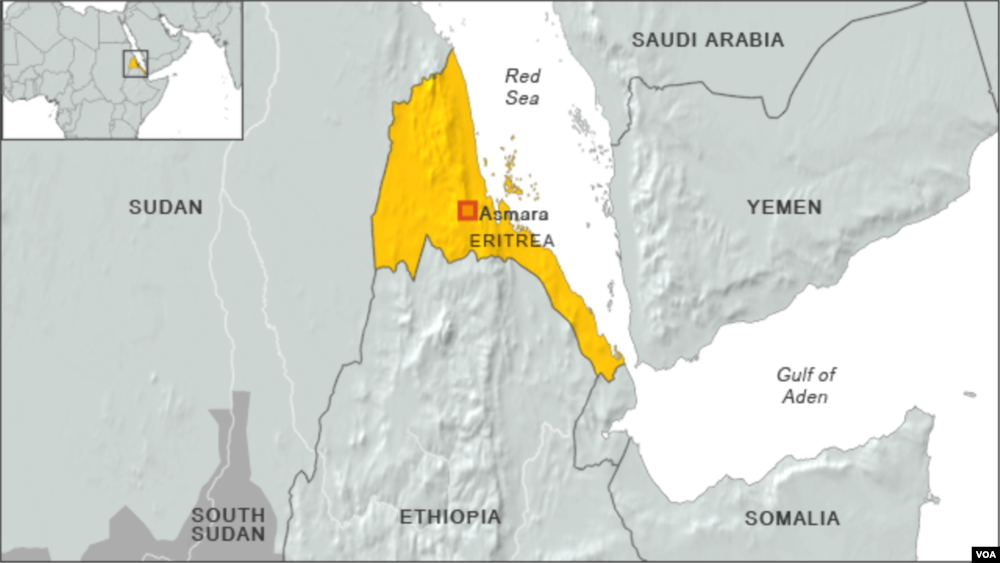
Eritrea map

Eritrea map

The Bank of Eritrea recently announced that all Nakfa notes in circulation must be exchanged for new government-issued notes.

The decision by the country’s central financial institution is expected to have a major impact on the economy.

While the nationwide currency replacement program is not meant to change the value of the money, as the exchange will be on a one-to-one basis, observers nonetheless expected the effects to be wide-ranging.

Biniam Fessehazion Gebremichael, a former Eritrean judge and legal counsel for Eritrean Airlines who now lives in Oakland, California, says the official reasons given for the exchange included introducing new banking instruments such as checking for transactions above 20,000 Nakfa, redeeming old currency and controlling illicit business.

But he also said the biggest reason for the currency replacement — hoarding of undeposited cash — was not mentioned.

“Currency hoarding ... happened because Hawala financial and business entities and individuals in Eritrea have been doing illicit foreign exchange and illicit trade with the help of some legitimate entities in Eritrea," he said. "This is the main reason.”

Despite a strictly controlled economy, Eritrea's black market is thriving. The currency has been in a state of rapid inflation in recent years, leading to a large disparity between official and unofficial exchange rates. One U.S. dollar is worth 15 Nakfa at Eritrea’s official exchange rate, but worth 50 to 58 Nakfa on the black market.

“Even the government rates its prices or other commodities ... with the black market,” Biniam said, explaining that if the exchange rates go unadjusted, it may force prices too high for the average Eritrean.

Eritreans who possess large sums of money and work outside of the formal economy have a difficult decision to make: either give up their savings or face serious penalties including confiscation, heavy taxation or imprisonment. According to Biniam, these penalties can be assessed without the accused being given right to a lawyer.

“The consequences are very, very grave,” he said.

These decisions will have to be made quickly. According to Hanibal Goitom, a foreign law specialist at the U.S. Library of Congress, the currency redemption program will occur over a six-week period, whose as-yet-unannounced start date is expected to be at the bank's discretion. The new law restricts bank withdrawals during the six-week period to 20,000 Nakfa and stipulates that all foreigners exchanging money prove that they obtained it legally.

The decision already appears to be having an impact, with reports that Eritreans are rushing to purchase commodities or property in advance of the switch. Biniam warns that the currency swap could have an impact on the value of assets as well.

“In the long run, this uncertainty will increase the price of property. People will never trust banks and will never trust currency, so people will start accumulating wealth in assets, [which] will impact the price of assets or property," he said. "The benefit is good at this time, but it will have a long impact that will be hard to eliminate at the end of the day, because if people don’t trust [their] banks, they’re not going to put cash in the banks and, as you know, governments borrow from banks to pay their debts. So in the long run it will be very unfortunate.”

Source=http://m.voanews.com/a/eritrea-currency-replacement-program-assessed/3073554.html


Associated Press
 
 
FILE - In this Oct. 26, 2007 file photo  Helmut Schmidt, ex-chancellor of Germany, smokes a cigarette at the SPD Social Democratic Party Convention in Hamburg, northern Germany. Helmut Schmidt died Nov. 10, 2015. He was 96. (AP Photo/Markus Schreiber, file)
.

View gallery

  • .
  • .
  • .
  • .

BERLIN (AP) — Helmut Schmidt was blunt and down to earth, decisive and brimming with self-confidence.


The attributes that won him plaudits as West German chancellor — as he dealt with some of the tensest moments of the Cold War and a surge in domestic terrorism — occasionally caused offense, especially later in life. But mainly they helped make him a respected and popular elder statesman across party lines.

Schmidt died at his home in Hamburg Tuesday at age 96, according to Die Zeit newspaper, where he served as co-publisher and penned regular analyses.

"He was realistic, discerning and decisive. Yet his decisions were always preceded by extensive, in-depth deliberations and consultations," Die Zeit wrote in a tribute to Schmidt. "For him, governing was not about just getting by or political survival, it was about disciplined steps taken toward a concrete goal."

Schmidt, a center-left Social Democrat, led West Germany from 1974 to 1982. He was elected chancellor by lawmakers in May 1974 after the resignation of fellow Social Democrat Willy Brandt, triggered when a top aide to Brandt was unmasked as an East German agent.

"Helmut Schmidt was not only the German chancellor, he was a mentor for the Germans," said Foreign Minister Frank-Walter Steinmeier.

"Helmut Schmidt was a chancellor of progress and a pioneer of globalization ... He has always seen Germany in Europe and Europe always on the world stage."

As Germany's new leader, Schmidt brought a sometimes abrasive confidence to the job, along with experience as defense minister, finance minister and economy minister. It served him well as he took over during the economic downturn that followed the 1973 oil crisis.

"Domestically, he sought - even in difficult times - to maintain rationality, which acted as a protective shield against fads and emotion. He abhorred excitability and wishful thinking," Die Zeit wrote. "'In politics, emotion and passion have no place, aside from the passion for rationality,' was his motto."

Schmidt's chancellorship coincided with a tense period in the Cold War, including the Soviet Union's 1979 invasion of Afghanistan.

He went along the following year with the U.S.-led boycott of the Moscow Olympics, although he later said that it "brought nothing." Schmidt said he had disputes with the United States under President Jimmy Carter over financial and defense issues at the time and concluded "that we Germans could not afford an extra conflict with America," West Germany's protector against the Soviets.

Amid efforts to ward off a global recession, Schmidt was among the movers behind the first economic summit of leading industrial powers at Rambouillet, France, in 1975, which later turned into the annual Group of Seven meeting.

He and then-French President Valery Giscard d'Estaing also played leading roles organizing the European Monetary System, aimed at protecting European currencies from wild fluctuations, which ultimately paved the way for the common European currency, the euro.

"If the euro exists, we owe that to Helmut Schmidt," said French President Francois Hollande, adding that "it's a great European whose life has just ended.

"He always said the market economy must be allowed to live but also that it needed a social dimension."

Born Dec. 23, 1918, the son of a half-Jewish school teacher in the northern city of Hamburg, Schmidt joined the Hitler Youth when his rowing team was included in the Nazi youth organization, but was suspended at age 17 — "probably because my griping got on their nerves."

Drafted as a soldier during World War II, Schmidt's unit was deployed in the Soviet Union in 1941. He was sent to the western front at the end of the war and taken as prisoner by British forces in April 1945. He was released that August.

Schmidt later said that, as a young soldier, he had recognized the Nazi regime's lunacy but not its criminal nature at first.

Schmidt entered West Germany's parliament in 1953, where he earned the nickname "Schmidt the Lip," a tribute to his sharp-tongued debating skills. He made his name back in his native Hamburg with his decisive 1962 management of severe flooding.

As chancellor, Schmidt's confidence served him well in facing down the homegrown terrorism of the Red Army Faction, which grew out of the leftist student movement in the 1960s. In a 1977 campaign of violence that became known as the "German Autumn," the group murdered, among others, West Germany's chief federal prosecutor and the chief executive of Dresdner Bank.

Schmidt stood firm, refusing to release jailed Red Army Faction leaders even after the group kidnapped Hanns-Martin Schleyer, the head of the country's industry federation.

"The state must react with all the necessary toughness," he declared.

While Schleyer was being held in 1977, hijackers commandeered a Lufthansa plane to the Somali capital, Mogadishu, to force the release of the Red Army Faction leaders. Schmidt ordered West German anti-terrorist commandos to storm the jet, successfully rescuing 86 hostages. Shortly afterward, three of the terrorist group's leaders killed themselves in prison and Schleyer was found murdered.

Schmidt later said "I was prepared to resign" if the Mogadishu operation had gone wrong. Although convinced he had taken the right action, he also conceded he felt guilty about Schleyer's slaying.

It was not easy for Schmidt being between the world's two superpowers — the United States and the Soviet Union, and his support for NATO's 1979 "double track" deploy-and-negotiate move to counter the deployments of Soviet SS-20 missiles proved divisive at home.

NATO gave the go-ahead for the modernization of its nuclear force in West Germany and elsewhere in western Europe by deploying cruise and Pershing 2 missiles while, at the same time, seeking a joint limitation of the nuclear buildup through negotiations with the Soviet Union.

Backing the NATO policy helped estrange Schmidt from his own party. Missile deployment in West Germany was fiercely opposed by many younger, more left-wing Social Democrats, and in 1983, an upstart leftist rival, the Greens, entered parliament for the first time.

"Mr. Schmidt was an insightful leader who understood that security is the result of strong defense and dialogue," said NATO Secretary-General Jens Stoltenberg

"A principled leader, Mr. Schmidt stood behind his convictions even when they were unpopular."

Schmidt's chancellorship ended with his ouster in a parliamentary vote in October 1982, when his party's coalition partner, the pro-business Free Democrats, switched its allegiance to Helmut Kohl's conservative Christian Democrats due to disputes over economic policy and the squabbling within Schmidt's party.

Schmidt did not run for chancellor again, citing health concerns.

He had been fitted with a heart pacemaker and also suffered from a thyroid condition. In August 2002, he underwent an emergency bypass operation after suffering a heart attack. Two years later, he had cataract surgery.

In September he was hospitalized with a blood clot in his leg and had been released, but in the last week his health took a turn for the worse, according to his doctors.

After stepping down as a lawmaker in 1987, Schmidt devoted himself to working as co-publisher of the weekly newspaper Die Zeit.

Die Zeit said that despite his advanced age, Schmidt came to the office three or four times a week up until close to his death.

Schmidt continued to weigh in on Germany's political debates, rarely shying away from controversy — which gave him a reputation for plain speaking that won him favorable comparisons with other German politicians.

"To this day, he ranks among the personalities in our nation who can give direction to their own country and are listened to internationally," Hans-Dietrich Genscher, his former foreign minister, wrote on Schmidt's 90th birthday in 2008.

His lasting influence was underlined by the huge success of his 1987 memoir, "Menschen und Maechte" ("People and Powers") — a best-seller for more than a year.

Schmidt argued in a 2002 book that Germany had brought in too many immigrants in an idealistic attempt to overcome its Nazi past, saying his countrymen were "for the most part xenophobic deep down."

In 2003, he drew criticism for complaining about the "whininess" of people in the former East Germany, an area that struggled economically for years after Germany's 1990 reunification.

"People complain about some things that they should not complain about," he declared.

Schmidt never abandoned his politically incorrect habit of chain-smoking. That earned him and his wife, Hannelore — better known as Loki — the honor of being parodied on German television as "Loki and Smoki."

In 2008, Hamburg prosecutors threw out an anti-smoking group's complaint against the couple after they lit up in a theater, flouting a newly introduced smoking ban.

Schmidt and Loki, the childhood sweetheart he married in 1942, had one daughter, Susanne. Their first child, a son named Helmut Walter, died in 1945 when he was only a few months old. Loki Schmidt died at age 91 in 2010.

Schmidt in 2012 introduced longtime acquaintance Ruth Loah, a former employee at Die Zeit, as his new partner.

___

Frank Jordans in Berlin, and Sylvie Corbet in Paris, contributed to this report.

Source=http://news.yahoo.com/helmut-schmidt-dies-96-ex-chancellor-elder-statesman-193847505.html;_ylt=A0LEVxQ2fEJWG9UAzthXNyoA;_ylu=X3oDMTEyYW05bXRzBGNvbG8DYmYxBHBvcwMxBHZ0aWQDQjEyNTNfMQRzZWMDc2M-

EPDP Magazines