/

Europe’s refugee crisis and the Horn of Africa

Martin Plaut[1]

This paper is a brief summary of the some of the key issues facing EU decision makers as they prepare for Wednesday’s African Union – EU summit on migration in Valletta.

I will attempt to answer three issues:

  1. Which states in the Horn of Africa are driving migration?
  2. What marks out the Eritrean government?
  3. What is the evidence of Eritrea’s response to EU initiatives to date?

Finally I will provide some lessons learnt from past engagements with Eritrea.

Which states are driving migration?

Let me begin with a simple point: human rights abusers rule all the major nations in the Horn: Ethiopia, Eritrea, Somalia and Sudan. Their people live under dictatorships of one kind or another.

  • Sudan is led by a president who is wanted by the International Criminal Court for war crimes relating to the conflicts in Darfur.
  • Ethiopia has this year held elections which were clearly rigged; freedom of the press is strictly limited and terrible human rights abuses continue in its eastern Somali region, almost unobserved by the outside world.
  • Somalia has had no effective central government since the fall of Siad Barre in 1991 and is at war with al-Shabaab.
  • Eritrea has few human rights of any kind.

In this context one might assume that any or all of these states would be major ‘drivers of migration’. This is not the case. Consider the diagram below – from the latest Frontex report.[2]

Frontex 2

Look at the red outflows from the Horn. One fact is obvious: Eritrea is the main driver of refugees. Even Somalia does not come close.

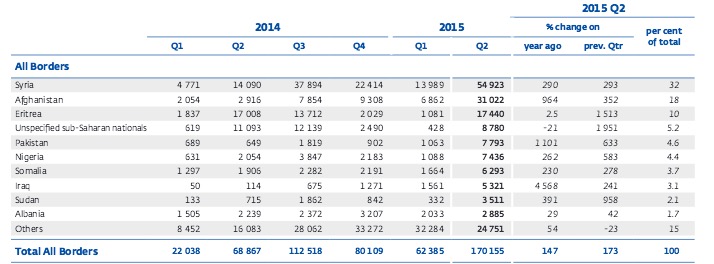
The statistics bear this out – they come from the same Frontex publication.
Frontex 1

Eritrea is responsible for the third largest exodus of refugees (10% of the total) behind Syria and Afghanistan. By comparison just 2.1% of illegal entries into the EU are from Sudan.

If one looks at the per capita statistics the result is even more striking. Eritrea has a population of 5.1 million, while Sudan has a population of 39.4 million.[3] Yet of every 100,000 Eritreans 340 sought sanctuary in the EU in the second quarter of 2015. By comparison for every 100,000 Sudanese just 8.9 took the same route.[4]

Yet Eritrea is – at least on the surface – at peace and is currently not suffering from a natural disaster. The only logical conclusion is that there is something particularly noxious about the Eritrean regime that is driving so many of its citizens to take this difficult and frequently fatal step.

The Eritrean situation is not just bad; it is uniquely bad.

The Eritrean government says that it wishes to halt this exodus. It has been co-operating with the EU in what has been termed the ‘Khartoum Process’.[5]

Officially known as the EU-Horn of Africa Migration Route Initiative, the November 2014 conference was attended by the Eritrean government. Eritrea’s Minister of Foreign Affairs, Osman Saleh, who told the gathering that:[6]

Eritrea values its partnership with the European Union and is determined to work with the EU and all European countries to tackle irregular migration and human trafficking and to address their root causes. We call for an urgent review of European migration policies towards Eritreans, as they are, to say the least, based on incorrect information, something that is being increasingly acknowledged. [emphasis in the original]

Yet since then the Eritrean regime has taken no steps to end the causes of migration and flight, which are driven by human rights abuses. The Eritrean government would welcome co-operation with Interpol, Europol, Frontex and other security agencies to prevent its citizens from escaping from the country. Offering support, training and intelligence sharing with a regime that is accused of such gross human rights abuses would be a violation of the EU’s most fundamental values.

What marks out the Eritrean government?

The UN Security Council has concluded that the Eritrean regime remains a serious threat to peace in the Horn of Africa and the region as a whole. In June 2015 the Council expressed its concern at the evidence provided by UN experts that President Isaias Afewerki was responsible for “ongoing Eritrean support for certain regional armed groups.”[7] As a result the Security Council went on to re-affirm its arms embargo against the Eritrean government.

Behind these bland phrases lies a catalogue of evidence carefully assembled by experts from the UN Monitoring Group.[8] This laid out in graphic detail just how the regime operates. It supports rebel movements in neighbouring Ethiopia and Djibouti. Eritrea is now also cynically participating in the Yemeni civil war in return for the Saudi and UAE financial support.

The UN monitors report they have: “received credible and persuasive testimony from multiple sources and independent reports indicating that Saudi Arabia and the United Arab Emirates have established a military presence in Eritrea as part of the military campaign against the Houthi rebels in Yemen and may be offering Eritrea compensation for allowing its territory and possibly its troops to be used as part of the Arab coalition-led war effort.”

The experts say that this deal was done after Djibouti rejected a similar deal with the Saudis and their allies in the UAE. The UAE are said to have struck a separate deal to use the Eritrean port of Assab for the next 30 years. Situated just 60 km from the Yemeni coast, it has lain idle since Eritrea’s war with Ethiopia (May 1998 to June 2000) – a conflict that sealed the borders between the two countries.

It is not hard to imagine what Eritrea might do with the funds from its new Arab allies, since the regime has been keen to purchase weapons. The UN monitors report that a ship – the Shaker 1 – secretly docked at the Eritrean port of Massawa in January 2015. On board were Sudanese heavy weapons, apparently en route to an armaments fair in Abu Dhabi.

Whether they ever reached their destination is a moot point. What were described as eight ‘empty containers’ were offloaded at Massawa. The monitors say they have evidence that the containers were full, not empty, as claimed. It is likely that the howitzers and rocket launchers provided by the Military Industry Corporation of the Sudan were offloaded at this time. If so, this was in clear violation of the UN’s arms embargo against Eritrea.

Serious as these violations are, they pale into insignificance beside the evidence of the ongoing Eritrean backing of armed groups attempting to overthrow neighboring governments. These operations are co-ordinated by the head of Eritrean intelligence, Brigadier General Abraha Kassa, “a long-time associate of the President” – as the UN report puts it.

These movements include a newly formed front of Ethiopian rebel organisations, whose unity was “facilitated” by the Eritrean government. The Eritreans are also said to provide support to Afar rebels operating in Djibouti. This allegation, from Djibouti itself, was put to Eritrean officials, but they failed to respond. These are exactly the kind of operations the Security Council has repeatedly demanded that Eritrea brings to an end.

One of the roles of the monitors is to try to ensure that finances are not diverted by the regime to destabilise the region. This has been difficult to achieve, since the Eritrean government refused all access to the country by the experts.

Even when senior Eritrean officials, including the senior political adviser to the President of Eritrea, Yemane Gebreab, meet with the UN’s appointed monitors, their promises of assistance have proved to be worthless. The report notes that they have yet to receive the government accounts for the past three years, promised at a meeting in Cairo in February 2014.

Given what they termed this “lack of financial transparency” the UN experts explained their concerns about reports that the European Union is considering substantially increasing aid to Eritrea. The monitors call for “due diligence, monitoring and full oversight of the dispersal of large amounts of aid to Eritrea” since there is otherwise every risk that they will be used to fund rebellions across the region.

What is the evidence of Eritrea’s response to EU initiatives to date?

The European response to Eritrea has developed over many years. It should not be forgotten that Europe supported the Eritrean people even before the de-facto independence of the country in 1991: especially during the 1984 – 85 famine, when European countries were major donors. Cross-border operations fed millions who would otherwise have starved.

Since de-jure independence in 1993 was ratified by the United Nations, Europe has attempted to build a relationship with the Eritrean government. This has not proved easy. Under President Isaias Afewerki, Eritrea has become one of the most inward looking, repressive of states. The EU has attempted to build a relationship with the Eritrean regime, but this has proved next to impossible.

Mishandling the 2001 government crackdown

In 2001 there was a generalised clampdown on all forms of opposition. Independent media were closed and senior government officials and journalists – the “G-15” – were arrested and disappeared from public view. They have never been formally charged, much less tried, and have been held inceeommunicado. Among those in detention is Dawit Isaak, a Swedish-Eritrean journalist, arrested in the 2001 round-up. The EU has repeatedly called for his release and for EU representatives to actively take up his case.[9]

When the arrests took place the Italian Ambassador to Eritrea, Antonio Bandini, presented a letter of protest to the authorities. He was promptly expelled and other European ambassadors were withdrawn in response. The EU presidency said relations between the EU and Eritrea had been “seriously undermined” by the government’s action.[10]

An internal EU document explained just how poorly the EU responded to the situation.[11] The report said that it had been decided at the time that European ambassadors would be: “conditioning their return on the willingness of President Isaias to engage on human rights dialogue. This request was never satisfied, but EU Ambassadors nevertheless returned to Eritrea, in a non-coordinated way.”

Even when it is not beset by these problems, providing aid to Eritrea has proved notoriously difficult. Most aid agencies were forced to leave after a law was enacted by the regime to control their activities in May 2005. [12] This required NGO’s to pay taxes on all goods imported into the country and prohibited international agencies from engaging in ‘development,’ surely among their core activities.

As time passed the EU re-assessed its relations with Asmara.[13] Although there had been no sign of movement on human rights by the regime it was decided to attempt to try to have a ‘new beginning’ with Eritrea. In May 2007 President Isaias visited Brussels and was “warmly welcomed” by the Development Commissioner, Louis Michel.[14] In the light of the talks that were held the European Commission altered its stance towards Eritrea, as the internal report made clear.

“In June 2007 the European Commission changed its strategy and initiated a process of political re-engagement with Eritrea. The main reason for Commissioner Louis Michel’s change of approach was his determination to ignite a positive regional agenda for the Horn of Africa, where Eritrea has a major role to play in view of its presence in the conflicts in Sudan and Somalia.”

The document concluded that for this “political re-engagement” to work both sides would be required to show that they were serious about it. Concrete evidence was required:

“Both sides need political dialogue to bring some results: the European Commission needs a visible sign of cooperation from Eritrea in order to continue to justify its soft diplomacy, while the increasingly isolated Eritrean regime might need to keep a credible interlocutor and a generous donor. The liberation of Dawit Isaak based on humanitarian grounds could be such a sign but, although welcome, it would only be a drop in the ocean.”

Instead of the making improvements to human rights, the Eritrean government ensured that Dawit Isaak remained in jail, as did the other political prisoners. There was no softening in President Isaias’s stance, despite the aid that the EU was delivering. Despite this the EU pressed ahead with its ‘renewed engagement’ strategy. Brussels had learnt nothing from the mistakes made following the 2001 withdrawal of its ambassadors. Asmara, on the other hand, believes that if it remains obdurate European politicians and civil servants will, in time, give in to its demands. President Isaias determines the agenda and has no intention of softening his stance on his people’s democratic rights.

On 2nd September 2009 the EU and Eritrea signed a Country Strategy for 2009 – 2013.[15] This acknowledged the impact of Eritrea’s 2001 crackdown on dissent, albeit in diplomatic language. “From 2001 to 2003, there was a slowdown in EU-Eritrea development cooperation, and the Political Dialogue process witnessed the emergence of substantially divergent views on developments in Eritrea and the Region.” The report talked about “limited” political dialogue, but said that regular meetings were planned.

A mission by the Development Committee of the European Parliament in late 2008 painted a more gloomy, but more accurate, picture.[16] The fact-finding mission by a delegation from the EU Development Committee to the Horn found that:

“Since the interruption of the democratisation process in 2001, EC cooperation with Eritrea has been confronted with major political and technical difficulties. Cooperation was frozen for several years in reaction to the expulsion of the Italian Ambassador, which led to a certain backlog with the 9th EDF funds.”

At the same time the delegation was able to report that relations had improved in recent years and funds had begun to flow once more.

Buoyed up by an apparently more positive situation the EU Development Commissioner, Louis Michel, re-opened talks with Eritrea. By August 2009 he was sufficiently encouraged by his discussions to visit Asmara, after receiving assurances from an Eritrean diplomat that Dawit Isaak, would be released into his care.[17] Having booked a ticket for Dawit to return with him to Europe, Louis Michel left for Asmara. But once he met President Isaias it became immediately apparent that the President had no intention of allowing Dawit to go free. Indeed, Mr Michel was not even permitted to visit the prisoner, and had to return to Europe without Dawit – a humiliation for such a senior EU representative.

A ‘useless’ engagement

Despite these setbacks the EU has remained wedded to attempting to secure its relationship with Eritrea. It is noteworthy that in October 2009, despite the fiasco surrounding the Louis Michel visit, European foreign ministries were prepared to take a considerably softer line towards Eritrea than their American counterparts. A US diplomatic cable, released by Wikileaks, reported how one European representative after another called for restraint, while opposing extending sanctions against the Afeworki regime.[18]

“Italy described Eritrea as governed by a ‘brutal dictator,’ and noted that Italy had not gotten results from its efforts at engagement. He cautioned, however, against ‘creating another Afghanistan’ by applying Eritrea-focused sanctions. The Italian representative questioned whether the sanctions should be focused on spoilers in general and include others beyond Eritrea. The French said that while engagement was ‘useless,’ France would continue on this track as there was no other option.”

Speaking at the same day-long meeting the British official, Jonathan Allen, said: “London has already made clear to Asmara that the UK was aware Eritrea was supporting anti-Western groups that threatened British security.” In reply the American senior representative, the Deputy Assistant Secretary for African Affairs, Karl Wycoff pointed out what were described as: “the inconsistency between the private acknowledgement that Asmara was not only playing a spoiler role with regard to Somalia but also supporting violent, anti-West elements and the provision by some countries provided assistance packages to Asmara. He also noted that strong actions, including sanctions, were needed to have a chance of changing Isaias’s behaviour.”

Despite the American concerns the EU pressed ahead with its strategy: a strategy in which it had little faith and which its representatives described as ‘useless’. It remains a strategy that has seldom been publicly acknowledged or openly discussed.

The situation was reviewed once more in 2011, when the EU drew up a ‘Strategic Framework for the Horn of Africa.[19] This laid out Europe’s relationship with the region as a whole: “The EU is heavily engaged in the region, with involvement focused around five main areas: the development partnership, the political dialogue, the response to crises, the management of crises and the trade relationship.”

The document then elaborates on how this would be achieved.

“The development of democratic processes and institutions that contribute to human security and empowerment will be supported through:

  • promoting respect for constitutional norms, the rule of law, human rights, and gender equality through cooperation and dialogue with Horn partners;
  • support to security sector reform and the establishment of civilian oversight bodies for accountable security institutions in the Horn countries;
  • implementing the EU human rights policy in the region;”

The Framework also declared that it was committed to involving what it describes as the “large Horn diaspora living in Europe” in the achievement of these goals. In line with these policies it was decided to provide Eritrea with aid worth €122 million between 2009 and 2013.[20]

Since the Strategic Framework was drawn up the situation inside Eritrea has gone from bad to worse. This has driven Eritreans into exile in record numbers. Although the EU continued to raise the human rights situation in Eritrea under its Article 8 dialogue, there has been no progress on the release of political prisoners, the implementation of the Constitution or on freedom of expression.[21] The country remains a one-party state, locked into permanent repression.

The United Nations Human Rights Council’s rapporteur on human rights in Eritrea, Sheila Keetharuth, made it clear in her 2014 report that there was no improvement in the situation and that: “The violations described in the present report are committed with impunity.” As Ms Keetharuth made plain, she received no co-operation from the Eritrean authorities in carrying out her mission and was repeatedly denied access to the country.[22]

So concerned has the international community become at the situation inside Eritrea that in June 2014 it took the rare step of establishing a Commission of Inquiry into the country’s human rights.[23] This initiative received the support of all EU member states.[24]

The Commission published its report in June 2015. Its key finding was that: “The Government of Eritrea is responsible for systematic, widespread and gross human rights violations that have created a climate of fear in which dissent is stifled, a large proportion of the population is subjected to forced labour and imprisonment, and hundreds of thousands of refugees have fled the country, according to a UN report released Monday. Some of these violations may constitute crimes against humanity.”[25]

Lessons learnt

Federica Mogherini, the EU’s senior diplomat, warned Eritrea recently that it had to respect human rights and urged the country to engage in deep reforms.[26] This is the background against which any consideration of a “re-engagement” with Eritrea must be judged. The following lessons can be drawn from the EU’s previous attempts to build a relationship with the regime.

  1. There is no evidence that President Isaias and his government has any intention of moving away from its current policies, which involve the systematic denial of human rights. As the EU representatives acknowledged privately in 2009, attempts at engagement are ‘useless.’[27] It would be a grave error to believe the vague promises of powerless ministers and diplomats.
  2. Repeated attempts to win over the regime have ended in failure. Past promises of reform, made by Eritrean diplomats, carry no weight. The political prisoners remain in detention, democratic rights are denied and there is no freedom of conscience or religious expression. Rather, as the EU’s experiences in 2001 and 2009 indicate, any softening of pressure is regarded by President Isaias as a sign of the weakness of international resolve. The regime believes it can out-last any external criticism.
  3. Promises of aid and international assistance have not resulted in any softening of this stance. Attempting to establish a ‘new engagement’ with Eritrea without seeing concrete, verifiable changes in the policies and practices of the regime would require abandoning the human rights agenda that is an integral part of European development policy.
  4. The EU’s initiative termed “the Khartoum process” aims to identify sources of economic support in order to stem migration. Treating the problem as economic misses the point in relation to Eritrea. As Baroness Kinnock has said: ‘The regime in Eritrea is, in short, a secretive, reclusive, authoritarian tyranny which is ruthlessly controlled by President Afewerki.’ The root cause of the Eritrean refugee crisis is the absence of the rule of law and the repression of its citizens; unless these underlying causes are addressed nothing else will work.
  5. From the above it is clear that the Eritrean government cannot be regarded as a suitable partner for the EU: its repression is worse than almost any other in Africa, its word cannot be trusted and any concessions will be regarded as signs of weakness. There is every likelihood that aid will be diverted (directly or indirectly) into the Eritrea’s military, thereby further destabilising the Horn of Africa. Given the lack of transparency of Eritrean public finances the EU will not be in a position to prevent this diversion from taking place.[28]
  6. Any proposals for co-operation between EU and international security forces and their Eritrean counterparts must be resisted. To assist the Eritrean regime in its stated goal of halting the flight of its citizens under the guise of curtailing the activities of people smugglers and traffickers would be unconscionable.
  7. In the light of the above, and given the EU’s public commitment to human rights as an integral part of the development process, Eritrea cannot be regarded as a suitable or legitimate partner in the forthcoming Africa – EU summit in Valletta.[29]

[1] Senior Research Fellow, Institute of Commonwealth Studies, University of London and former Africa Editor, BBC World Service News

[2] Frontex report, Fran Quarterly, April-June 2015

http://frontex.europa.eu/assets/Publications/Risk_Analysis/FRAN_Q2_2015_final.pdf

[3] World Bank data

[4] Put another way, in this quarter 0.34% of Eritreans arrived in Europe, 0.0089% Sudanese arrived in Europe

[5] http://ecre.org/component/content/article/70-weekly-bulletin-articles/911-khartoum-process-eu-and-african-union-launch-initiative-against-smuggling-of-migrants.html

[6] Official Eritrean government website.

http://www.tesfanews.net/eritrea-denounces-human-trafficking-urges-eu-review-of-migration-policy/#pc6Afk5gbaDFBFb6.99

[7] http://www.un.org/press/en/2015/sc12094.doc.htm

[8] http://www.un.org/ga/search/view_doc.asp?symbol=S/2015/802

[9] http://www.europarl.europa.eu/document/activities/cont/201109/20110920ATT27041/20110920ATT27041EN.pdf

[10] http://www.europeanvoice.com/article/eu-protests-after-eritrea-expels-envoy-bandini/

[11] Background Note on Eritrea, October 2008, Directorate-General for external policies of the Union, Directorate B, Policy Department.

http://eu-information-service.rs-consulting.com/Policy%20Department%20for%20External%20Relations/Countries%20and%20Regions/ACP%20Countires%20%28African,%20Caribbean,%20Pacific%29/2.%20Country%20Notes/Eritrea/Eritrea%20country%20note%202008.pdf

[12] Dan Connell and Tom Killion, Historical Directory of Eritrea, Second Edition, Scarecrow Press, Toronto, 2011, p. 399

[13] Background Note on Eritrea, October 2008, Directorate-General for external policies of the Union, Directorate B, Policy Department.

http://eu-information-service.rs-consulting.com/Policy%20Department%20for%20External%20Relations/Countries%20and%20Regions/ACP%20Countires%20%28African,%20Caribbean,%20Pacific%29/2.%20Country%20Notes/Eritrea/Eritrea%20country%20note%202008.pdf

[14] http://www.eepa.be/wcm/dmdocuments/2010-07-16_Eritrea_and_Isaias_Afewerki_a_cold_logic.pdf

[15] http://ec.europa.eu/development/icenter/repository/scanned_er_csp10NEW_en.pdf

[16] Report of the fact-finding mission of a Delegation of the Development Committee of the European Parliament to the Horn of Africa (Eritrea, Djibouti, Ethiopia) (25 October-2 November 2008)

[17] http://www.asmarino.com/news/435-an-afternoon-with-louis-michel-in-the-european-parliament

[18] http://www.telegraph.co.uk/news/wikileaks-files/somalia-wikileaks/8302251/EUROPEANS-TRACK-U.S.-ON-EAST-AFRICA-BUT-REMAIN-RELUCTANT-TO-SANCTION-ERITREA.html

[19] A Strategic Framework for the Horn of Africa, EU 14 November 2011

http://www.consilium.europa.eu/uedocs/cms_data/docs/pressdata/en/foraff/126052.pdf

[20] http://www.eeas.europa.eu/delegations/eritrea/eu_eritrea/political_relations/index_en.htm

[21] https://www.gov.uk/government/publications/eritrea-country-of-concern/eritrea-country-of-concern-latest-update-31-march-2014

[22] Report of the Special Rapporteur on the situation of human rights in Eritrea, Sheila B. Keetharuth, 13 May 2014, A/HRC/26/45

[23] http://daccess-dds-ny.un.org/doc/UNDOC/LTD/G14/062/46/PDF/G1406246.pdf?OpenElement

[24] http://www.hrw.org/news/2014/09/26/eritrea-un-names-commission-inquiry

[25] http://www.ohchr.org/EN/NewsEvents/Pages/DisplayNews.aspx?NewsID=16054&LangID=E

[emphasis added]

[26] http://diplomat.so/2015/10/21/federica-mogherini-urges-eritrea-to-respect-human-rights/

[27] http://www.telegraph.co.uk/news/wikileaks-files/somalia-wikileaks/8302251/EUROPEANS-TRACK-U.S.-ON-EAST-AFRICA-BUT-REMAIN-RELUCTANT-TO-SANCTION-ERITREA.html

[28] The UN has repeatedly made this clear, and it is important that this lesson is not ignored. This is what the UN Monitors had to say about this: http://www.un.org/ga/search/view_doc.asp?symbol=S/2015/802

“During its mandate, the Monitoring Group has received consistent information from several former government officials and independent sources with direct knowledge of Eritrean finances that the Government of Eritrea continues to maintain a PFDJ-controlled informal economy involving hard currency transactions through a non-transparent network of business entities incorporated in several jurisdictions.[28] The complete lack of financial transparency by the Government of Eritrea enables it to maintain a PFDJ-controlled informal economy. Senior officials within the Government and PFDJ continue to exert full economic control over revenue through a clandestine network of State-owned companies.33 The Group has documented extensively in its previous reports (S/2014/727 and S/2011/433) how Eritrea manages an offshore financial system controlled by elements of the Government and PFDJ to generate revenue streams.

As the Monitoring Group has repeatedly concluded, most companies in Eritrea are owned by the State and managed by senior officials of the Government, PFDJ and the military. The network of companies linked to PFDJ continues to be the driving force of the economy. The Government, through PFDJ and the military, has exclusive control of all economic activity, including the agriculture, trade and production sectors. In 2006, the Government passed Proclamation No. 159/2007 (Foreign Financed Special Investments Proclamation), which specifically limits foreign investment in financial services such as national wholesale trade, national retail trade and commission of agencies, but permits investment in other sectors.[28] Meanwhile, in 2005, the Government suspended all private enterprises from conducting construction in the country and effectively awarded all public contracts to businesses controlled by PFDJ.”

[29] http://www.consilium.europa.eu/en/meetings/international-summit/2015/11/11-12/
Eritrea Liberty Magazine Issue No. 35

Thursday, 05 November 2015 13:34 Written by

Attorney general overrules National Insurance Institute's decision in case of man killed when mistaken for terrorist, stating that he was a victim of terror and qualifies for benefits.
Tova Zimuki
Published:  10.28.15, 18:39 / Israel News


The family of the Eritrean man who was killed after being mistaken as an assailant during a terror attack will receive compensation, Attorney General Yehuda Weinstein announced on Wednesday.
 
Follow Ynetnews on Facebook and Twitter
 
Habtom Zerhom was shot six times by a policeman in Be'er Sheva's central bus station after a terrorist stole a soldier's weapon and opened fire, and as rumors spread during the chaotic moments of the attack that there was a second gunman.

Memorial service for Zerhom at Tel Aviv's Levinsky Park (Photo: Motti Kimchi)
 

Zerhom sustained a fatal wound from the gunfire. A few angry civilians kicked and hit him as he lay dying, whom police said were being identified.
 
The National Insurance Institute had decided that compensation for the incident would not be provided, but Weinstein ruled that Zerhom was a victim of terror and thus his family should receive the associated benefits.

Memorial service at the bus station where Zerhom was killed (Photo: Herzl Yosef)
 
The attorney general was briefed on the details of the investigation earlier this week and instructed that findings be prepared as soon as possible.
 
Police examined security camera footage and video taken by witnesses in order to identify individuals who attacked Zerhom. According to investigators, members of the Israel Prison Service (IPS) were among those participating in the violence. An officer and warden from the IPS were arrested along with two other people suspected of involvement.
 
Habtom Zerhom
Habtom Zerhom
 

Israel paid for the flight bringing Zerhom's body to Eritrea. The National Insurance Institute initially opposed the funding out of concern that it would be interpreted as recognition of his status as a terror victim, but ultimately changed its position and split the costs with the Foreign Ministry.

Source=http://www.ynetnews.com/articles/0,7340,L-4717696,00.html

Public Call for Support

Friday, 30 October 2015 10:07 Written by

EMDHRLogo

Public Call for Support

The Eritrean Movement for Democracy and Human Rights (EMDHR) is calling up on all Eritreans to share the burden of legal fees and admin expenses related to the Eritrean players.Now the players have been granted political asylum and are safe. This success came about as a result of collective effort of Eritreans and their friends across the world. However, it is the EMDHR that mandated and signed a contract with Bayford and Associates attorneys who professionally represented and defended the rights of our ten youngsters. The legal fee for the nearly three weeks exclusive handling of the case has amounted P301,200.00 (three hundred and one thousand two hundred Botswana Pula) which is equivalent to $30,000.00. On top of that the EMDHR has incurred $3000.00 for administrative fees that include transportation, phone bills, notarizing and sending documents via DHL and etc.

The EMDHR is grateful for any contribution towards settling the outstanding fees. Below is the banking details if you would like to contribute to this cause. The EMDHR thank you for your generosity beforehand.

መጸዋዕታ ንደገፍ ኤርትራውያን ተጻወቲ ኩዕሶ

ኤርትራዊ ምንቅስቓስ ንዲሞክራስን ሰብኣዊ መሰላትን (ኤምዲሰመ) ምስቲ ናይቶም ኣብ ሃገረ ቦትስዋና ዑቕባ ዝሓተቱ 10 ተጻወትቲ ሃገራዊት ጋንታ ኩዕሶ እግሪ ኤርትራ ዝተሓሓዝ ንጠበቓታት ዝኽፈል ገንዘብ ነዋጽእ ስለዘሎና፡ ኩሉ ኤርትራዊ ዓቕሙ ዘፍቀዶ መጠን ሓገዝ ክገብር ብትሕትና ንጽውዕ። መንግስቲ ቦትስዋና ነቶም ተጻወትቲ ናይ ፖለቲካ ዑቕባ ስለዝሃቦም፡ ህይወቶም ኣብ ውሑስ ኩነታት ይርከብ። እዚ ዓወት ግና ብኸምኡ ዝተረኸበ ዘይኮነ ብናይ ሓባር ጻዕሪ ናይ ብዙሓት ኤርትራውያንን መሓዛ ኤርትራውያንን እዩ። የግዳስ ኤምዲሰመ እዩ ነቶም ተጻወትቲ ክውክሉዎም ነቶም ጠበቓታታ ሓላፍነት ብምሃብ ውዕል ዝተፈራረመ። እቲ ነቶም ጠበቓታት ዝኽፈል ገንዘብ ድማ P301,200.00 (ሰለስተ ሚእትን ሓደን ሽሕን ክልተ ሚእትን ናይ ቦትስዋና ፑላ) እዚ ማለት $30,000 (ሰላሳ ሽሕ ዶላር) ኣቢሉ እዩ። ብተወሳኺ ኤምዲሰመ ከባቢ $3000 (ሰለስተ ሽሕ ዶላር) ዝኣክል ገንዘብ ንመጎዓዝያ፡ መቁነን፡ ተሌፎን፡ መልኣኺ ዶክመንት ተመሳሳሊን ወጻኢታ ከምዝገበረ የዘኸኻር።

በዚ ኣጋጣሚ ኤምዲሰመ ዓቕሚ ዘለዎ ኤርትራዊ ነዚ ዝተጠቕሰ ወጻኢታት ንምሽፋን ዓቕሙ ከበርክት ብትሕትና ይጽውዕ። ንኹሉ ሓገዝኩምን ልግስኹም ድማ ኣቐዲምና ምስጋናና ነቕርብ።


Banking Details

Bank: ABSA Bank

Account Name: EMDHR

Account Number: 928 419 2880

Branch Code: 632 005

Reference: Football

Swift code: ABSAZAJJ

Kind Regards,

EMDHR

The Eritrean Movement for Democracy and Human Rights (EMDHR) is pleased to announce that the ten Eritrean national football players have been granted political asylum by the government of the republic of Botswana today the 28th of October 2015.

It is to be recalled that the ten Eritrean players who came to play world cup qualification match against Botswana refused to go back to their country and applied for political asylum on the 14th of October 2015.  Subsequently, the Eritrean ambassador to the Southern African Development Community (SADC) region, Mr Saleh Omer, threatened the players to forcibly return them home. Faced with stiff resistance, the Ambassador defaced their passports by making holes through them. The Minister of Defense, Justice and Security of Botswana made a pronouncement that the Eritrean players would be deported back home.

To this effect the EMDHR approached their lawyer Bayford and Associates to launch an urgent application to stop the move by the ambassador and the government of Botswana. To that effect, the Botswana high court in Lobatse issued an order by consent on the 16th of October with the following decisions:

1. The Respondents (the Government of the Republic of Botswana) shall not remove from the jurisdiction of the Botswana certain Eritrean Nationals, all members of the Eritrean National Football Team, ten in number, who on or about 14th October, 2015 presented themselves to Botswana Government officials at Francistown seeking political asylum.

2. This Order together with all originating process and any pleading (if any) filed by the Respondents shall be served personally upon the asylum seekers by the Applicant within 14 days of this Order.

3.  The parties shall file all pleading prior to the date of Status Hearing (11 Dec 2015); and

4.  The Applicant's legal representatives shall have access to the asylum seekers.

 After nearly two weeks the due process for the players’ asylum application has been completed. The Botswana government has now granted the ten Eritrean players political asylum. We are grateful to the government of Botswana for providing full protection to these ten Eritrean youngsters. This is clear demonstration of the prevailing rule of law in the country. We are grateful for the sympathy and solidarity shown by the people of Botswana, civil society and media. We are also highly appreciative tour lawyer Bayford and Associates for their commitment, dedication and professional handling of this highly sensitive case. We are also thankful to Eritreans across the globe for standing behind EMDHR and the players and taking ownership of the issue.

 Eritrea is ruled by fear and not by law. It has no constitution, no parliament, no judiciary, and all forms of freedoms and rights are either banned or severely restricted. Citizens are often arbitrarily arrested, disappeared, tortured, and even extra-judicially executed. The UN Commission of Inquiry on Human Rights in Eritrea confirmed in 2015 the “systematic, widespread, and gross human rights violations” in the country. The Eritrean youth are at the receiving end of the regime’s ruthlessness and brutality. Today the youth are wasting their potential and talents in a forced and indefinite military conscription and doing forced labour. Today, Eritrea has become a country where even high school students are taken into a military training camp and forced labour programs. As a result these appalling conditions in their country, Eritrean youth are fleeing in mass seeking refuge in exile where they are granted asylum and hope to reconstruct their lives.

 EMDHR

28 October 2015

Pretoria – South Africa

Eritrean President Isaias Afwerki (L) reviews the honor guard during his welcome ceremony in the Sudanese capital, Khartoum, on June 11, 2015. Photo: AFP

Eritrean President Isaias Afwerki (L) reviews the honor guard during his welcome ceremony in the Sudanese capital, Khartoum, on June 11, 2015. Photo: AFP

New Delhi , India ( DIPLOMAT.SO) – Reliable sources to Diplomat News Network confirmed that the Eritrean and Algerian President did not attend the Indian-Africa forum summit for reasons not disclosed to the local and international media.

According to a report published on the website Livemint – In hindsight, I should have known. On Monday, I called the Eritrean embassy in New Delhi, located in the Vasant Vihar neighbourhood, to find out if I could meet the Eritrean leader, the man they call Africa’s Kim Jong-un (or any other member of North Korea’s Kim dynasty).

The response from the person at the other end was interesting. “We don’t know where he is. No one knows where he is. It is not possible to meet him. He is in India on a private visit,” she said. Except that the Eritrean leader, Isaias Afwerki, is not on a private visit. He is one of the participants in the India-Africa Forum Summit (IAFS) that starts in New Delhi on Thursday.

Eritrea, a small country of 6.5 million people, is located on the coast of the Red Sea in a region known as the Horn of Africa. The country gained de facto independence from neighbouring Ethiopia in 1991, ending a three-decade-long war between the two countries which culminated in the liberation of Eritrea.

Following its de jure independence in May 1993, Eritrea has been ruled by one man (and one party), Afwerki, its first “elected” head of state, after a United Nations-sponsored referendum. Elections may not be held in Eritrea for a long time to come, with Afwerki in May 2008 declaring that the country might hold elections in “three or four decades” or longer because they “polarize society vertically”.

Much like his North Korean counterpart, not much is known about Afwerki (his name literally translates to ‘mouth of gold’ in native Tigrinya), except for his starring role in the country’s 30-year-long independence movement, as part of the Eritrean People’s Liberation Front (EPLF).

The EPLF, as part of its post-war transition, renamed itself the People’s Front for Democracy and Justice (PFDJ), the only political party recognised by the government. In one of the US diplomatic cables released by Wikileaks in 2010, an Ethiopian intelligence official quoted one of Afwerki’s former bodyguards as telling him, “Isaias was a recluse who spent his days painting and tinkering with gadgets and carpentry works…. Isaias appeared to make decisions with no discussion with his advisors. It was difficult to tell how Isaias would react every day and his moods changed constantly.”

Afwerki, after Eritrea’s indepedence, was considered one of Africa’s most promising leaders. Former US Ambassador to Eritrea Robert McMullen, in a 2009 cable, said, “Immediately after liberation, Isaias seemed to be providing (like Mugabe) reasonably good governance to his traumatized nation. The accelerating decline into dictatorship began in 1996 with an alleged assassination attempt against Isaias by Ethiopian PM Meles Zenawi, followed by the bloody 1998-2000 Border War, and the ‘treason’ of the inner-circle critics called the G-15.”

Similarly, as a 2010 Foreign Policy (FP) article on Eritrea notes, “Once hailed as the vanguard of a ‘new generation’ of responsible African leaders, he (Afwerki) has long since won the dishonor of being one of the continent’s most repressive.” McMullen, in his summary of the cable, worte, “Young Eritreans are fleeing their country in droves, the economy appears to be in a death spiral, Eritrea’s prisons are overflowing, and the country’s unhinged dictator remains cruel and defiant.”

Afwerki’s repressive regime

The repression is mainly because Eritrea is a highly militarized nation. It has the largest army in sub-Saharan Africa, with about 320,000 active soldiers. “It’s number of soldiers per capita puts Eritrea second only to North Korea,” the Foreign Policy article adds. The country imposes what is known as “indefinite conscription”, where all its citizens, including men and unmarried women, are conscripted into mandatory national service. The Human Rights Watch’s (HRW) 2014 country report says that “although Eritrean law limits national service to 18 months, most conscripts serve for much of their working lives”. Besides, the report continues, “conscripts are routinely added as forced labor on essentially civilian jobs”. Failure to complete the service results in arrest.

The HRW report adds, “Former conscripts described working long hours for minimal food rations, primitive lodging, and wages too low to sustain themselves, much less their families. They were not allowed to leave the work site.

Children as young as 15 are inducted and sent for military training, according to recent interviews by refugee agencies. They and other recruits are regularly subject to violence and ill-treatment for raising questions or for other perceived infractions. Beatings, torture, and prolonged incarcerations are common. Women are subject to sexual violence from military commanders, including rape. No mechanisms for redress exist. Since mid-2012, all men in their 50s, 60s, and 70s are compelled to perform militia duty: carrying military weapons; reporting for training; and going on periodic patrols.”

Even to graduate from high school, students, the FP report says, “were required to attend national camp during their final year.”

Worst place to be a journalist, restrictions on religion

Besides indefinite conscription, the Afwerki’s government is also known to impose severe restrictions on practising religion, other than those recognized or controlled by the government, including Sunni Islam, Ethopian Orthodox, Catholicism and Lutheranism. Violations by citizens are punished with arrest.

Eritrea has been described as the “worst place to be a journalist”, repeatedly finishing in the bottom of the Reporters Without Borders’ press freedom index. The government, the HRW report says, “maintains a complete monopoly on domestic sources of information since it closed all local press outlets in 2001 and arrested their staff.

Telephone and Internet communications are monitored. Eritrea expelled the last accredited foreign correspondent in 2008. Although foreign language transmissions are accessible, the government jammed Al Jazeera in early 2013 and has long jammed overseas transmissions from Eritrea diaspora stations. At least six government journalists arrested in 2009 and 2011 remain in solitary confinement without trial.” However, earlier this month, a Wall Street Journal (WSJ) reporter, gained access to Eritrea. Her dispatches can be read here and here.

Begging could land you in jail. Or for that matter, a permit is needed for a dinner hosted for three or more people, since it’s classified as a “gathering”. And then there’s arbitrary detention, where “thousands of ordinary citizens are arrested and incarcerated without charge, trial or opportunity to appeal, and without access to lawyers, or independent prison monitoring organizations,” says the HRW report.

Brutal detention conditions

Detention conditions are described as “brutal”. The HRW report continues, “Death in captivity is not unusual. Many prisoners disappear, their whereabouts and health unknown to their families. Former prisoners describe being confined in vastly overcrowded underground cells or shipping containers, with no space to lie down, little or no light, oppressive heat or cold, and vermin. Medical treatment is poor or non-existent. Food consists of a piece or two of bread a day, occasional servings of lentils or beans, a cup of tea, and insufficient water. Beatings and torture in detention are common; wardens are able to impose any physical punishment they devise. A former interrogator told Human Rights Watch he ordered beatings of prisoners until they confessed to whatever they were accused of; they were then beaten to implicate others.”

The UN through its Commission of Inquiry on Human Rights in Eritrea said in June this year that it “found that systematic, widespread and gross human rights violations have been and are being committed in Eritrea under the authority of the Government. Some of these violations may constitute crimes against humanity”. The chairperson of the commission, Mike Smith, said, “Eritrea’s dire human rights situation can no longer be ignored…. Is it any wonder that Eritreans—most of them young people—are the second largest nationality after Syrians to resort to seaborne smugglers to cross the Mediterranean to Europe?”

The refugee crisis

It is against the backdrop of forced, indefinite conscriptions, that many Eritreans, especially the young population, are escaping the country. Even while doing so, they are essentially defying a shoot-to-kill order by Afwerki’s government. Eritrean refugees, much like North Korean defectors to China, have the constant fear of repatriation to their native country.

However, this doesn’t bother Afwerki, who in 2008 dismissed reports of increasing Eritrean refugees by calling them “deliberate distortions” caused by an “orchestrated, organized operation financed by the CIA”.

The exodus has seen nearly 5% of Eritrea’s population leave the country since 2003, when the exodus began. Their preferred destinations include Italy (Eritrea was a former Italian colony), the United Kingdom and Nordic countries like Sweden and Norway. An estimated 5,000 people, according to the UN, leave Eritrea each month. As of December 2014, there are as many as 363,077 Eritrean refugees, with nearly 53,662 of those seeking asylum in other countries.

Indo-Eritrean relations

India maintains what President Pranab Mukherjee in May 2015 described as “cordial relations” with Eritrea. Soon after it received de jure independence, India formally recognized Eritrea in 1993. It currently maintains a non-resident embassy (a consulate) in Asmara, Eritrea’s showpiece capital. The High Commissioner to Kenya also serves as India’s top diplomat for Eritrea.

According to the ministry of external affairs, India’s bilateral trade with Eritrea was around $244.73 million in 2014-15, a substantial increase from 2012-13, when it was only around $29.89 million. India is also among the highest exporters to Eritrea along with Italy and the UAE.

For more news and stories, join us on Facebook,Twitter and Subscribe our Youtube Channel, or contact us through our Emails: This email address is being protected from spambots. You need JavaScript enabled to view it.,This email address is being protected from spambots. You need JavaScript enabled to view it.,This email address is being protected from spambots. You need JavaScript enabled to view it.

During the 133rd Assembly of the Inter-Parliamentary Union (IPU) held in Geneva from 18 to 21 October, the Socialist International held its regular meeting of parliamentarians belonging to SI member parties to exchange views on the main issues on the agenda of the IPU, and to share information on developments within their own countries.

Parliamentarians from SI member parties in Angola, Belgium, Czech Republic, Dominican Republic, Finland, Ghana, Guinea, Guinea-Bissau, Hungary, India, Iraq, Italy, Mali, Mauritius, Mongolia, Morocco, Namibia, Pakistan, Palestine, Romania, San Marino, South Africa, Spain and the United Kingdom, attended the meeting, as well as from Sri Lanka as guests.

The dominant theme of this Assembly’s discussions was that of Migrations and how to implement a fairer and more humane way of dealing with this phenomenon. The emergency item of debate also focused on the protection of refugees and ensuring compliance with international and humanitarian law. The SI Secretary General, who chaired the SI meeting, recalled the extensive discussions on these issues that had been taking place at different levels within our International and made specific reference to the Charter for the Rights of Migrants that had been elaborated by the SI Committee on Migrations and adopted by the SI Council at its last meeting in July 2015. In the discussions on these issues, participants highlighted different aspects from their national perspectives. A common thread in the contributions was that whether dealing with regular migration, which was a constant, or with refugees, what we were dealing with in essence was human beings and it was the responsibility of all governments to protect them and to respect their dignity. Particular attention was paid to the plight of the most vulnerable, including women and children.

The need to tackle the root causes of mass migration and growing numbers of internally displaced people and refugees was emphasised and a call was made for more decisive and effective action by governments and international institutions to achieve fair and lasting solutions not only in regard to conflict resolution,  but also in the fight against poverty and unemployment.

Another aspect that was highlighted, related to ensuring respect for the general rules of labour laws. In relation to migrants and refugees, it was pointed out that issues surrounding the right to work, exploitation of domestic labour, women and children needed to be further addressed, as well as trade union rights for migrants.

Among the reports on national situations, the meeting heard from the Palestinian representative on the deteriorating situation between Palestine and Israel, and from the chairman of the IPU’s Middle East Committee. Here again the underlying causes of the conflict were highlighted as fundamental issues that could only be resolved with the equal will and commitment of both sides.   

Participants also received a report on the worrying situation in Iraq from the head of the PUK delegation in the Iraqi parliament, who underlined the need for international solidarity. The country was struggling to cope with the threat of ISIS, it had four million internally displaced people and women and girls were being kidnapped and trafficked in growing numbers.

The meeting also welcomed a report on the recent elections in Guinea, which saw the return to power of President Alpha Condé at the head of the second democratic government of that country.

At the conclusion of the meeting, emphasis was put on the importance of international bodies in bringing people together and promoting common solutions. In the SI we stood for multilateralism and solidarity. Also stressed was the need for more politics, which was about values and ideals, which were in deficit today in many places around the world. 

‘Haba’e Kuslu, Haba’e Fewsu’ (Part III)

Saturday, 24 October 2015 08:55 Written by

Part III: Tearing the Very Eritrean Social Fabric

As a note to my readers:

l   In writing an article, one must first determine who the target audience might be. One size may not fit all. Moreover, articles may have various purposes; it could be to express an opinion or commentary on current issues, an in-depth analysis, or to educate readers.

l   The next couple of articles will include long numerical illustrations to compensate for the lack of data supplied by the Eritrean regime. Both democratic and communist regimes love their numbers (statistics). Although all regimes fudge their numbers, democratic governments are subject to independent scrutiny from political opposition and public media, whereas communist and dictatorial regimes are not subject to similar scrutiny thus making their statistics highly political and unreliable.

l   The Eritrean regime is allergic to any statistics and hard data pertaining to social welfare and economic performance. The only hard numbers given in its propaganda media are the number of graduates at its so-called ‘colleges’ and ‘schools’. One would be hard pressed to find any data anywhere else. This is in sharp contrast to Ethiopia. Rather, the regime has substituted hard data for the regime’s tired media which relies on re-run of old videos showing some highly choreographed social activity or minuscule economic projects to show that it is making socio-economic progress.

l   The lack of data diverts political discussions away from the myriad socio-economic (and legal) issues and focuses on highly divisive and theoretical issues. As important it is to debate and reach consensus on basic principles that form a nation, a consensus can’t be reached without injecting hard data into our discussions. Burying data is designed to bury discussion.

l   The lack of data deprives the wider political arena, especially Eritrean youths, from understanding the myriad issues involved in political discourse and from understanding on how to construct their political stance.

l   The purpose of such discourse isn’t to divert attention in any way from current struggle to remove the regime, which is a priority, but to mingle our discussion with the wider issues that we will encounter the SECOND the regime falls. Discussion can’t start the day after the regime falls, because it will be too late. A nation with myriad of socio-economic and legal issues can’t wait for the succeeding regime to formulate a plan. We will be operating in an emergency mode soon after the regime’s downfall.

l   Opposition political parties can’t engage in discussion of complex and contentious issues without creating internal strife. Rather, such discussions should come from the wider opposition which, hopefully, can build consensus over long grinding process. Once a consensus starts to build, the opposition political parties can then begin adopting or changing their political stance.

l   As I will show below (as was in some of my past articles), the lack of statistics and data from the regime doesn’t mean we are totally blind. Rather, we can construct numerical data that will unequivocally show the kind of socio-economic challenges we face, how little the regime is doing, and the challenges awaiting the next regime.

l   I am not expert in socio-economic issues. My educational background is limited, and my experience in this areas is even less. I welcome any corrections, constructive criticisms, or for others to expand what is contained here.

Background

Regardless of ethnicity, religion, or any other groupings, family is the core nucleus of any society. It is NOT money, ideology, self-righteousness, political power, or military might that is the building block of a nation. Rather, it is a healthy family that builds a nation. The social hierarchical ladder of a nation - from the individual, to the family, to the community, is its building blocks to a viable, peaceful, and prosperous nation. One can’t separate out each of these components and claim that a nation is developing its individual citizens without simultaneously addressing its impact on the higher social orders.

When young women are taken to Sawa and given to unscrupulous male soldiers who operate above the law; when young people are condemned to lifetime slavery campaign and prevented from forming the building block of Eritrean society and nation; when there are NO young people to help old people to farm their lands; when there is no affordable housing; when there is no income to feed family; when thousands of fathers and mothers are incarcerated without due process of law; when people are fleeing in droves, even the brain dead understands there CAN NOT be a family , and by extension, there can NOT be a viable country - guaranteed.

Although we rile the regime for failing to deliver on economic development, the Eritrean regime’s greatest crime against the nation is its cruel social experiment on the Eritrean people. The social damage inflicted on the Eritrean people is tantamount to the destruction of our identity, our tradition, and our values - and of our traditions and cultures which some see as hindrance to creating a modern state. It is Mao, Pol Pot and Pinochet rolled into one.

No amount of spin or excuses by the cannon fodders such as www.wedo-geba.net (aka meskerem.net), alenalki-for-nothin’_and_excuses.com, tesfa-less.net, or dehai-of-fewer-and-fewer.org will change the fact that our rich social values and our very social fabric is being destroyed for petty politics. These cannon fodders ONLY fill their sites with so many tragic events, mostly news from war torn areas, around the world to say that Eritrea’s tragedy is less by comparison. That is temberkaknet! That is like your child coming home with mediocre or failing grades and telling you that others are doing worse, instead of comparing him/herself to many others who are doing above average. You just say, ‘Anta himak’!

DIA’s damages on the social fabric of Eritrea will take generations to heal, if not irreparable. For comparison,

Damage                                          Time to Inflict Damage                           Time to Heal

Economic                           Immediate                                                         15 years

Political                                         Immediate                                                         25 years

Institutional                                    Immediate                                                         25 years

Legal                                             Immediate to 5 years                              A generation

Social                                            5 to 10 years                                                      Many generations, if ever

Note: The time to heal is arbitrary and thus for illustration purposes only. However, it is indisputable that the time frames required to rehabilitate legal and social institutions is much longer than the others.

For instance, a regime can usurp all the economic factors immediately for some impractical reasons - thus inflicting immediate damage - but the damage can be repaired immediately. For instance, Far East nations, including China took off economically within decades of changing their old systems. Closer to home, Ethiopia has embarked on ambitious economic development program in the last 10 years despite being doldrums for decades before that.

It is easy to cause damage, but most damages take years, if not generations, to heal!

The Social Challenges

Social issues are understood as being centred on education, health, housing, and generally the well-being of families and societies.

It would take volumes to discuss the failures of the Eritrean regime in addressing the various social issues. Instead, this will highlight some of the issues, and as repetitious as they are from my past articles, ultimately all efforts and aspirations are to improve the following,

Education

Where does one start - there are so many! The regime, which is overstretched in its military budget, that it has no funds for the education system.

Unmanageable Class sizes - have grown tremendously because the regime isn’t building new schools fast enough, if at all. It has built some primary schools in some rural areas with funds obtained from foreign donors in the past, but with funds drying up, and increasing population, class sizes have increased to over 60 students per class overloading teachers and school facilities.

Over-burdened and underpaid teachers - many teachers are national service people who feel that they are providing free service to a brutal regime that doesn’t give them any hope of leading a normal life or delivering a law-abiding and prosperous life. Enthusiasm for one-time well respected profession in Eritrea is now at its lowest - with teachers who abscond, and students who disrespect their teachers saying that one's fate as an Eritrean teacher is just slavery because teachers are either on national service or paid salaries not commensurate with standard of living. When DIA informants are making ten times the teachers’ salaries for doing nothing, what is the incentive to work harder? Shouldn’t one just flunk school and become DIA informant and earn much higher pay?

Bringing foreign teachers paid by the UNDP hasn’t improved the education system either.

Higher institutions of learning - despite the fact that the regime’s propaganda machine that keeps telling us that many are graduating from agricultural or nursing schools, possibly except the medical school, these schools are churning out graduates, who may be bright, who may not qualified because of lack of educational standards, both at domestic and international levels.   Even the medical school, Orotta Medical School, is now being sabotaged. In contrast, Ethiopia has opened over 35 universities and colleges.

Public Libraries - No new public libraries, except a couple, have been opened in the last 15 years (post G-15). As a result, the youths have no place where they can study and borrow books. How could one develop an education system if students do not have sufficient resources to stimulate and exercise their brains? How much money and resources does one need to open a library? The world is ready to send millions of books their way, but the negligence can only be characterized as deliberate efforts to destroy the youth and education system.

Sport Facilities - Shouldn’t there be sport facilities, both indoor and outdoor, to keep our youths occupied and expending their energies on positive activities? How much money would needed to build a local football field, basketball court, tennis court, volleyball court, and other facilities? The price of five tanks for the whole country, one useless fighter plane?

Overall - when students can’t dream of graduating from school and obtaining decent jobs and salaries commensurate with cost of living, students no longer have incentives to strive and excel in school. The only incentive might be to avoid the slavery campaign for 2-3 years while learning and living in military camps disguised as institutions of higher learning.

Health Care

As symptomatic of the deep health care crisis in Eritrea, veteran doctors have left the country, and the new ones are following their footsteps. This crisis is a deliberate DIA policy designed to wreck an already miserable health care system.

For decades doctors were required to work in public hospitals, but also allowed to run their own private clinics to supplement their incomes. Few years ago, out of its infinite wisdom and deliberate efforts to destroy the health system, the regime closed all private clinics in Eritrea. Public hospitals paid doctors meagre amounts despite their rigorous education.

Regime propagandists tell us that doctors shouldn’t be paid any more than any other civil servants. But this is false campaign by those who don’t live in Eritrea and thus aren’t affected by the inadequate health care system in Eritrea, or are high-level regime officials who are allowed to travel abroad for medical treatments.

The regime’s argument that all civil servants should be equal in their miserable income is disingenuous. In reality, loyal regime supporters - esp. high military officers, party official, and informants - are allowed to dip into slush funds, engage in illegal and questionable commercial activities, or given exclusive import licences to enrich them as their rewards. In contrast, medical health professionals are reduced to receiving salaries less than regime informants. That is a perverse system.-

The biggest ‘kusli’ in today’s Eritrea, reward isn’t based on hard work or merit, but blind loyalty or supporting the regime illegal activities.

Housing

This issue is raised to illustrate how the regime is deliberately engaged in destroying the very Eritrean social fabric.

For emphasis again, and for the benefit of skim readers, it is worth reiterating that family is the very building block of a nation. Family is generally defined as a father, a mother, and children. A healthy and prosperous family translates to strong community, which in turns builds strong nation.

A properly functioning family needs food, clothing - and shelter, among other things. If affordable housing isn’t available, the consequences include: unwillingness of young people to marry; or if married, to stay with parents who already live in an already overcrowded housing.

The regime has not built a single affordable housing to alleviate the challenges facing Eritrean youths. Let us examine the challenges facing today’s Eritrea,

l   Domestic population is estimated at 5.5 Million (another 1 million outside Eritrea)

l   Based on typical third world country demography, two-third (2/3) of the population is under 25 years old.

l   Therefore almost 3.7 Million of population is under 25 years old

l   Assuming equal distribution of ages, each age has 148,000 people (3.7M /25 age years), i.e. for instance, there are 148,000 18-year-olds, 148,000 21 year-olds.

l   Assuming that portion of the young people in properly functioning society should be married by age of 25 or at least live on their own, assume 50% marry. Every year 148,000 people become 25-year olds with housing needs. There would be 74,000 married (i.e. 37,000 couples = one shelter) and 74,000 unmarried couples.

l   This means that minimum 37,000 affordable houses are needed to meet the needs of married people every year. If all 25-year olds are taken as bench mark, i.e. including unmarried ones - 111,000 houses need be built (37,000 couples and 73,000 singles) EVERY YEAR.

l   Every year that the regime hasn’t built affordable housing, the total shortage is minimum 888,000 (37,000 houses/year * 24 years of independence). If housing is need for single people too, then 2.6 million houses need be built.

l   Note: some may argue that 70% of the Eritrean population is rural. Even so, at least 266,000 affordable houses (30% of 888,000) would be needed. Others might say, not all youths work and thus can’t afford, etc. and may reduce the numbers again. Regardless, hundreds of thousands of houses need be built to accommodate a well-functioning family system in URBAN Eritrea alone.    

This is in total contrast to Ethiopia where affordable housing is built - mostly in Addis Ababa but also in major urban areas in the country under various financing schemes. Even civil servants are provided with adequate salaries to afford buying houses.

l   Over 300,000 built in Addis Ababa in the last 5 years

l   Overall, 960,000 affordable housing to be built around the country over the next ten years. This is still not enough, but still a major effort for developing country, and infinitely more than what DIA is doing for Eritrea - which is zilch, nada, nothing - except for top military brass that need to be bribed.

Other Indicators of Well-Being

Care of the Elderly: who takes care of the elderly in today’s Eritrea? If one is lucky to have family members living abroad, then, at least, one MAY have a source of financial support.

But that is not the typical Eritrean family in today’s Eritrea. Most likely, if you have in advanced age group, you have children between the ages of 18 and 50 year olds who are condemned to indefinite national service doing nothing, i.e. most likely not productive on national service because there are no meaningful work for vast majority of the 250,000 national service people.

For older people who live in rural areas, either as farmers or herders, they no longer have younger bodies to till the land for them or tend livestock for them. They must now rely on even younger children to fetch waters or for any errands.

For older people who live urban areas, the situation is even more dismal. They do not have pension or any other source income. Their children can’t support them because they are tied up in the politically motivated national service, or they are imprisoned.

For the elderly, today’s Eritrea is a death sentence - condemned to dishonourable discharge by the very same people claiming to speak the same language and to help them from the evil hoongoogoos.

Pension: Although confined to civil service in most third world countries, yet DIA has even eliminated this entitlement which didn’t even happen during the Derg years. As a result, civil servants must work until they die. For instance, a seventy year old ‘tegadalai’ must work until his expiration because he/she has no other source of income or couldn’t be kicked out of government housing. That is a cruel mental punishment, and has adverse impact on the civil service itself. It encourages corruption, and may impede innovation and progress. Some say that civil servants shouldn’t get any more privileges than private sector workers. But pension is a critical component of the well-being of society - and a government can’t achieve well-being by going backwards. Instead, a well-functioning government would have tried to expand a pension scheme that would cover private sector workers too.

Without Pensions:

l   Aging people, esp. civil servants and army, won’t be able to retire. They must work even if 80 year olds.

l   Surviving spouses of civil servants who pass away have suddenly no incomes.

l   If senior civil servants aren’t encouraged to retire, new job openings for young employees can’t be made available, promotion is stagnant, and new ideas and workings can NOT be introduced.

Eritrea’s public service is stuck until it rots.

Clean Water: Aside from EU funded projects, no work has been done to expand the availability of clean water, and especially to poorer neighbourhoods in urban areas and most of the rural areas. According to DIA and its idol worshippers, water is only needed for their phantom ‘agricultural’ products and projects, for which we still are waiting to see even one kilo of crop or produce 24 years later.

How much water is needed? It is recommended that 5 litres of water is needed per person per day for drinking and cooking. One can guess the amount of water needed for washing clothes, flushing toilets (if any used) and personal showers. One can comfortably estimate the amount of water needed. For illustration, assuming a population of 750,000 people in Asmara, 1.4 million cubic meter of water is needed. If one adds for bathing, washing dishes, cloths, floors, some houses for flushing toilets, some commercial and industrial uses - all significantly more water consuming than for drinking and cooking - four (4) times the amount, i.e. 6.4 million cubic meter of water is needed, for a total of 7.8 million cubic meter of water. Tokor Dam holds 17 million cubic meter of water. Between evaporation and piping leaks, one may assume only 50% of the dams capacity is available, i.e. 8.5 million cubic meter. Fortunately of the City of Asmara, there is also Mai Nefhi Dam and direct pumping of ground waters supplies its water needs. One or two low rainy seasons puts the city at risk of no water. In reality, the regime has neglected Asmara and all other major urban areas claiming that it is a priority or urban areas shouldn’t be given any more service than rural areas, resulting in severe water shortages in most parts of Asmara. There is a plan to build Tekera Dam with a capacity of 20 million cubic metres to supply water to Asmara and other areas.

As for rural areas, if one assumes there are 5,000 villages with an average of 800 people each (about 160 families), of course large difference for agriculturalists vs. Pastoralists, only 5,000 wells (if not reservoirs) and pumps would be needed to pump water to communal water stations. If regime had built even 200 community water holes a year, every Eritrean in all corners of Eritrea would have had enough clean water by this year. Finding and pumping water isn’t a rocket science. The Egyptians, and esp. the Romans, the Greeks, and many other civilizations over 2000 years ago had perfected the technology of clean water by using aqua-ducts. What can’t this regime do better than people two thousand years ago?

Employment: If people can’t work and earn decent wage enabling them to buy the most basic things in life - food, shelter, and clothing, then this leads to breakdown of society. In today’s Eritrea, no Eritrean between the ages of 18 to 40 (in reality, closer to 50 or over), aren’t allowed to work for wages and forced to languish in national slavery campaign that has not yielded a single tangible result.

Even those who work earn salaries that can’t even cover rent. Most rank-and-file civil servants and regular soldiers earn 1,000 Nfa a month, and higher level civil servants earn up to 4,000 Nfa-a-month. Professionals such as doctors and engineers earn less than 5,000 Nfa-a-month. In contrast, a regime informant with no education earns about Nfa 3,000/month plus expenses. Compared in Ethiopia, professional engineers earn at least 8,000 Birr/month, and medical doctors earn significantly more than that. When adjusted for currency difference, i.e. 20 Birr = 1 USD vs. 55 Nfa = 1 USD, at least at face value, Birr has 2.75 times the purchasing power. As such a professional engineer earning 8000 Birr a month in Ethiopia is equivalent to 22,000 Nfa a month in Eritrea. Refer to online Ethiopian Reporter newspaper advertisements for salary scales.

Food/Proper Diet: In one of his independence speeches, DIA told us that 900 calories is enough per person. Another of Mao lectures. It is just that those who tell others to live on 900 calories can’t even survive on 3,000 calories a day. Look at the Real Housewives of PFDJ and one can quickly notice that even 4,000 calories isn’t enough.  

It is a shame when a country can’t produce enough milk for its population, and especially for its young children. Twenty five years after independence, Eritrea still faces extremely [added for emphasis] severe milk shortages. Why? This is yet another deliberate policy to stunt the growth of our children - mentally and physically. Thanks to the milk farmers of America and EU, our idol worshippers feed their kids gallons of milk a day, yet tell us that Eritrean youths in Eritrea don’t need it. Hypocrisy galore!

What about other food groups - milk, meat and fruits - luxury! Asmara Dairy produces pathetic 9,000 litres a day.

In short, 24 years after independent, a country that can’t make enough milk available for its kids has no interest in social programs. That is pathetic even by African standards.

I will discuss the state of agriculture in my next article.

Welfare of the Young People: Suffice to say the epic proportion of the refugee crisis speaks for itself. Nothing is more telling about the dire future of Eritrea than the destruction of the youth population. DIA is creating hopelessness, anxiety, while encouraging selfishness, myopic thinking, and sowing crisis mentality.

Nothing is more telling of the destruction of the youth population than depriving them of decent livelihood through gainful employment and affordable housing.

In contrast, the Ethiopian regime, esp. in Addis Ababa, has been building tens, if not, thousands of affordable houses. The ideologues may argue that why should urban population benefit at expense of rural population. But this is the mentality of those who believe in lose-lose outcome and racing to the bottom. The ‘can-do’ mentality functions within positive trajectory only.

As if Eritrea doesn’t have extreme housing shortages, the regime has recently begun destroying ‘illegal’ houses in large numbers. Aside from its adverse impact on the well-being the families, the regime’s behaviour is yet another glaring manifestation of its own utter disregard for the ‘rule of law ‘.

Garbage disposal and Sewage Treatment: I have raised this issue more as illustration the challenges of administrating a growing urban areas. Many countries dealt with it centuries ago. The Italians felt important enough to build sewage system over 100 years ago. Instead of building on this infrastructure, the regime has neglected urban centres giving the lame excuse that urban centres shouldn’t get better services than rural areas, but this is a recipe for destroying a nation. Instead of formulating long term plans to bring municipal services to growing rural areas, we are turning them a urban centres into rural ones, with adverse health consequences due to nature of urban centres. It is an excuse for destruction.


Crime and Security: the clearest example of Eritrean people’s culture is its respect for law and order. Eritrea is known for its safety NOT because of efficient state security apparatus but the population is one massive ‘community/neighbourhood watch’, aside from its respect for law.

It is corruption, rather than any other form of crime, that is the biggest threat to the security of the nation. In mid-1990s, DIA told us that the rampant corruption in African countries is due to inadequate civil service salaries to afford decent living. In one of the independence speeches in early 2000s, DIA told us the biggest threats to Eritrea are, in this very order: corruption, AIDS, and Woyane. So what does DIA do, precisely proceed to create the most corrupt system.


Ironically, the noticeable increase in crime and breakdown in law-and-order and security is directly attributable to the regime’s purposeful efforts to forestall any potential threat to his power. Some of the regime’s blatant schemes and activities include;

  1. At the core is corruption within military designed to buy the loyalties of military officers. They are encouraged to enrich themselves through front-men who engage in business on their behalf. Turf wars leading to assassinations and revenges on Cosa Nostra (Mafia) level.
  2. Again corruption within military that at the very centre of human trafficking. It is unfathomable that traffickers call from within the bosom of the regime, from within Eritrea, without the regime’s intricate web of snitches knowing it.
  3. Again corruption within military that allows male military men to abuse our sisters and daughters in Sawa. It is a crime; it is a war against the future mothers of Eritrea.
  4. Corruption, embezzlement, and bribery within civil service were forced upon civil servants by purposely turning salaried staff into ‘national servicemen’ with only 150Nfa a month. This is also true within the military. This includes selling ‘administrative leaves’ to national service slaves and/or allowing company, platoon, or higher leaders to claim or steal pocket monies of national service slaves who do or allowed to abscond.

Religion and Faith: The regime has declared war on religion since it ascended to power in Eritrea. It has been accosting fear, schism, and intolerance towards other faiths. It is communist ideology where religion is viewed as nothing more than a source of societal division that needs to be eliminated. Soviet Union, China, all the Eastern bloc countries banned all religious institutions to no avail. It failed and instead creating even bigger monsters - religious intolerance, i.e. radicalization.

We don’t live in ancient times when rulers and invaders imposed their belief systems and values on others. In today’s world, world interconnectedness brought about by instant communication has significantly more impact on our belief systems than rulers. Unfortunately, the world is moving towards less tolerance through a vicious cycle. Political systems that predicate their survival on intolerance will only sow the seeds of destructions due to domestic situations exacerbated by importations of intolerance.

Creating a mess has nothing to do with building a nation. THE REGIME IS FAILING EVEN BY AFRICAN STANDARDS.

We shall overcome!

Berhan Hagos

October 23, 20

Thousands flee isolated Eritrea to escape life of conscription and poverty

Nichole Sobecki for The Wall Street Journal Nichole Sobecki for The Wall Street Journal
 

ASMARA, Eritrea—On a cool March evening soon after his 16th birthday, Binyam Abraham waited until his mother and young siblings were sleeping and slipped away to begin the long trek toward Eritrea’s southern border.

With his father trapped in open-ended military service that would soon snare him, too, Binyam walked for 19 hours without food or water to reach Ethiopia. He made a choice 5,000 of his countrymen make each month, by a United Nations estimate: to flee Eritrea and brave the world’s deadliest migrant trail, across the Sahara and the Mediterranean to Europe.

They leave behind one of the world’s fastest-emptying nations: a country of about 4.5 million on the Horn of Africa, governed by a secretive dictatorship accused of human-rights violations, that is playing an outsize role in the biggest global migration crisis since World War II.

Eritrean women gather water at a community point in Adi-Harush Camp, one of the refugee camps in Ethiopia where people fleeing Eritrea stay, for months or sometimes years, before paying smugglers to take them to Europe.Eritrean women gather water at a community point in Adi-Harush Camp, one of the refugee camps in Ethiopia where people fleeing Eritrea stay, for months or sometimes years, before paying smugglers to take them to Europe. Photo: Nichole Sobecki for The Wall Street Journal

“I didn’t tell my mother before I left, but I didn’t have a choice,” Binyam said, sitting in a mud-brick shack at Adi-Harush, a refugee camp in the foothills of Ethiopia’s Simien Mountains that has become ground zero for Eritrea’s exodus. Flanked by five young friends, all planning to brave the same dangerous journey, he said: “I have to go to Europe so I can help my family.”

Attention is focused, amid the intensifying migration crisis, on Syrians fleeing civil war and making a dramatic run to Europe. Yet by some measures, the exodus from the smaller Eritrea is more extreme. From the start of 2012 to the middle of this year, 1 in 50 Eritreans sought asylum in Europe, nearly twice the ratio of Syrians, based on data from the European Union statistical service Eurostat.

The U.N. estimates that 400,000 Eritreans—9% of the population—have fled in recent years, not counting those who died or were stranded en route.

Watch the video: Binyam Abraham (above) and Shewit Hadera talk about why they decided to leave Eritrea and what’s ahead for them. Photo: Nichole Sobecki for The Wall Street Journal

On the rickety smuggling boats crossing the Mediterranean, Eritreans comfortably outnumber other nationalities. More than a quarter of the 132,000 migrants arriving in Italy between January and September were Eritreans, according to the U.N. High Commissioner for Refugees.

Eritreans accounted for a majority of the 3,000 people who have drowned in the Mediterranean this year, humanitarian agencies say.

Despite this toll, emigration here is accelerating. The number of Eritreans seeking asylum in Europe quadrupled from 2011 to 46,000 last year. The exodus is catapulting the African country to the center of a divisive EU debate over which nations’ migrants should be granted refugee status, as the bloc struggles to respond to the wave from Syria.

The Eritreans flee one of the world’s most isolated nations, governed under emergency rule since a war with Ethiopia in 1998. Eritrea earlier fought a 30-year struggle for independence from Ethiopia, which is 20 times its size.

An Eritrean woman and her young son outside their hut in Adi-Harush refugee camp in Ethiopia, a country that hosts tens of thousands of Eritreans who have fled their harsh and poor country and hope to make the journey to Europe.An Eritrean woman and her young son outside their hut in Adi-Harush refugee camp in Ethiopia, a country that hosts tens of thousands of Eritreans who have fled their harsh and poor country and hope to make the journey to Europe. Photo: Nichole Sobecki for The Wall Street Journal

This David-and-Goliath dynamic has spurred Eritrea to maintain a state of emergency for 17 years, officials in Asmara said—suspending political, economic and social progress for the sake of national security.

A June U.N. report accused the regime, led by former rebel commander Isaias Afewerki, of “crimes against humanity” targeting its own population, including torture, mass surveillance and indefinite military conscription that amounts to a form of slavery. The government said the report, based on interviews done outside the country, was biased and false.

Eritrea is also under U.N. sanctions on a charge of supporting al Qaeda-linked terrorism in Somalia. In Eritrea, which is evenly split between Christians and Muslims, the government denies the charge.


Eritreans have been welcomed as refugees by EU governments since the 1980s, when they were fighting for independence against a Communist government in Ethiopia, according to the International Organization for Migration. But EU officials and migration experts say that now, Europe’s visceral debate over migration is pushing governments to reconsider that stance.

African asylum seekers are already being sidelined, say migration policy makers from the U.N. and other organizations.

Refugees from Eritrea staying at Adi-Harush camp in Ethiopia and other such camps use their smartphones to stay in touch with their families back home and with friends along the smuggling trail to Europe.Refugees from Eritrea staying at Adi-Harush camp in Ethiopia and other such camps use their smartphones to stay in touch with their families back home and with friends along the smuggling trail to Europe. Photo: Nichole Sobecki for The Wall Street Journal

“While Syrians are fleeing an obviously terrible and documented civil war, Eritreans are fleeing abuses which to the rest of the world are largely invisible because of the regime’s secretiveness,” said Kristina Touzenis, head of the of the Migration Law Unit of the International Organization for Migration, or IOM.

In some countries, a policy shift has begun. The U.K. in the second quarter of this year cut the number of Eritrean asylum seekers accepted to 29% of applicants from 77% in the previous quarter. 

The secrecy of Eritrea’s government, which expelled foreign correspondents in 2008, makes it difficult to document forces behind the exodus.

Seen on a rare trip by a Wall Street Journal reporter to Asmara—Eritrea’s showpiece capital famed for the fading grandeur of its Italian architecture—the slow pace of life contrasted with the region’s buzzing and chaotic metropolises. Residents gathered at cafes or loitered under modernist facades. Staples like milk were in short supply.

Eritrean officials say asylum seekers exaggerate hardships and leave because Europeans grant them refugee status. “If people feel that if you get to Europe asylum is easy, that’s a pull factor,” said Information Minister Yemane Ghebre Meskel.

Indefinite conscription and isolation are necessary, he said, because the country remains effectively at war with Ethiopia, which he said occupies Eritrean territory in violation of a U.N.-sponsored peace agreement. Ethiopia denies that any land it controls belongs to Eritrea.

Eritreans abroad say they are pushed to leave by conscription that enlists every man and woman in the military during their last year of high school. Last week, 10 Eritrean soccer players who were in Botswana for a match defected there. Some Eritrean refugees fled to Israel through the Sinai Desert until Israel erected a fence there. This week, an Eritrean man was killed in Israel when attacked by a mob who mistook him for an assailant at an earlier bus-stop attack.

Eritreans at Adi-Harush refuguee camp in Ethiopia watch films and soccer matches, squeezing into a corrugated-steel shack and paying a few cents to a business that popped up to provide the access.Eritreans at Adi-Harush refuguee camp in Ethiopia watch films and soccer matches, squeezing into a corrugated-steel shack and paying a few cents to a business that popped up to provide the access. Photo: Nichole Sobecki for The Wall Street Journal

Teenagers are inducted at the Sawa military base, get four months of training, then take an exam that determines whether they are put in active service or allowed to continue their education as reservists. Around two-thirds are immediately mobilized as soldiers. But all remain conscripts, often for decades. They are locked in a system that pays a monthly stipend of 500 nakfa, about $10 on the black market, and forbidden to leave the country.

Eritrean officials said they are in the process of introducing a pay scale that better rewards educated and more experienced conscripts.

“A lot of our population, especially the young, were forced to be engaged in the defense of the country rather than in the productive sector,” said Hagos Ghebrehiwet, the ruling party economics chief. “Our land is occupied, and the international community is not doing anything.”

Officials say the exodus has one upside for the impoverished nation: hard currency. Money from the expanding diaspora provides a badly needed boost to the economy.

An Eritrean woman, left, and a man pray at dawn beside an Orthodox Church at Adi-Harush refugee camp in Ethiopia. The man, 25-year-old Shewit Hadera, arrived after an earlier attempt to flee Eritrea landed him in jail, where he says he was tortured. Eritrea’s information minister said, ‘Torture is not allowed; that does not mean it may not happen here and there.’An Eritrean woman, left, and a man pray at dawn beside an Orthodox Church at Adi-Harush refugee camp in Ethiopia. The man, 25-year-old Shewit Hadera, arrived after an earlier attempt to flee Eritrea landed him in jail, where he says he was tortured. Eritrea’s information minister said, ‘Torture is not allowed; that does not mean it may not happen here and there.’ Photo: Nichole Sobecki for The Wall Street Journal

In late September, dozens of emigrants who had secured citizenship and livelihoods in Europe, offering protection from the Eritrean regime’s policies, were sipping macchiatos at Asmara’s Cinema Roma cafe, preparing to return to Northern European capitals after vacationing with family. The appearance of a leisurely pace of life in Asmara contrasts to testimonies of abuse, especially in more remote and hard-to-reach areas.

On one cafe table, a 70-year-old Eritrean visiting from Stockholm drank coffee with his 17-year-old nephew from Asmara. They declined to give their names, saying they were “just ordinary Eritreans,” but the youth said he wanted to be a doctor and had plans to join a relative who is a surgeon in Germany. Inside the grand hall of the Cinema, a 1930s bar served Negroni cocktails to a group of young women, impeccably manicured, who spoke among themselves in German.

The IOM says the presence of wealthier migrant relatives spurs the exodus by reinforcing the notion that emigration is a path to freedom and wealth.

“It’s a dilemma for the government,” Mr. Ghebre Meskel said: “On the one hand, they come up with whatever stories they like to obtain asylum. But they support their families, there are remittances.”

A hundred miles south, some of the 113,000 refugees waiting in refugee camps at the start of their journeys to Europe said they felt little choice but to flee.


Life in the camp

In Adi-Harush camp, a patchwork of concrete huts and muddy tracks in a mountainous region, more than 20 residents spoke of their hope to escape Eritrea’s conscription and its economic and social breakdown. The camp is a staging ground for the trek to Europe, but refugees here have yet to confront the rigors of the journey ahead.

In the huts, groups gather to plot travel plans and track friends’ progress on cellphones. Several times a week, crowds pay a few cents to squeeze into corrugated steel shacks to watch one aspirational image of the prosperity of Europe on TV: the English soccer league.

Refugees say the camp houses a sophisticated network of Eritrean and Ethiopian smugglers who can organize journeys if residents have the money.

Some who leave for Europe will never make it. The camp’s “mourning house” is where people go to cry and pray for friends or relatives who perished on the journey.

Billboards warn: “Illegal movement is like walking blindfolded. Let’s be aware, let’s be curious.” The Eritreans aren’t deterred, passing through the camps in ever-greater numbers, according to Ethiopian authorities.

Binyam, the 16-year old, said he arrived six months ago after fleeing poverty and forced conscription that had trapped his father for decades.

“For as long as I’ve known, he’s been a soldier…. Each year I saw him once, when he was allowed leave,” said Binyam, wearing a soccer jersey stained with food and dirt. “Now I will get to Europe to help my family.”

He said he walked through the night with a friend from his village, avoiding border guards to reach the Ethiopian frontier. His friend left the camp earlier this year for Sudan, the first stage of a dangerous journey across the Sahara and ultimately the Mediterranean.

Treacherous Trail

Eritreans are the biggest group coming to Europe through the Sahara, Libya and the Mediterranean, the deadliest migrant route in the world.

ITALY

Europe

Nearly 36,000 Eritreans arrived in Italy across the Mediterranean this year, through Some 3,000 migrants, a majority Eritreans, have drowned this year.

Tripoli

Eritreans make their way here and pay smugglers to transport them across the Mediterranean.

LIBYA

Ethiopian camps

Camps host about 113,000 Eritrean refugees, including 39,000 at one called Adi-Harush.

SUDAN

ERITREA

Khartoum

Refugees make their way to the Sudanese capital, where smugglers arrange their journey across the Sahara.

Asmara

ETHIOPIA

500 miles

500 km

500 miles

ITALY

500 km

Europe

Nearly 36,000 Eritreans arrived in Italy across the Mediterranean this year, through September. Some 3,000 migrants, a majority Eritreans, have drowned this year.

Tripoli

Eritreans make their way here and pay smugglers to transport them across the Mediterranean.

LIBYA

Ethiopian camps

Camps host about 113,000 Eritrean refugees, including 39,000 at one called Adi-Harush.

Khartoum

Refugees make their way to the Sudanese capital, where smugglers arrange their journey across the Sahara.

SUDAN

ERITREA

Asmara

ETHIOPIA

ITALY

LIBYA

SUDAN

ERITREA

Asmara

500 miles

ETHIOPIA

500 km

Ethiopian camps

Camps host about 113,000 Eritrean refugees, including 39,000 at one called Adi-Harush.

1

Khartoum

Refugees make their way to the Sudanese capital, where smugglers arrange their journey across the Sahara.

2

Tripoli

Eritreans make their way here and pay smugglers to transport them across the Mediterranean.

3

Europe

Nearly 36,000 Eritreans arrived in Italy accross the Mediterranean this year, through September. Some 3,000 migrants, a majority Eritreans, have drowned this year.

4

Sources: U.N. High Commissioner for Refugees; interviews with refugees

ENLARGE
 

Like many youngsters here, Binyam is unsure how he will pay for his journey and whether he will survive it: “I heard people are dying, being tortured or enslaved. I heard some die in the desert or the sea,“ he said. ”But some arrive. I hope for that.”

In a nearby hut, nine young men holding a traditional coffee ceremony, boiling the aromatic brew on coals, laid out their plans. Semere Ab said his aunt in Canada would use the hawala cash-transfer system to send smugglers $25,000. “There are smugglers in this camp. You pay them when you move from here,” he said. “In four months, I will go. We will all go together.” The boys nodded.

Ethiopian and Eritrean authorities accuse each other of profiting from the smuggling. The Ethiopian refugee agency called ARRA said it was planning to crack down. Local officials said they have arrested suspected smugglers.

Shewit Hadera, a 25-year-old refugee who works with unaccompanied Eritrean children in the care of the Norwegian Refugee Council, carries physical and emotional scars. Imprisoned in 2008 for trying to flee, he said, he was regularly tortured. He showed a leg covered in scar tissue he said was from being burned with boiling tea.

“They beat us at night, especially around midnight,” he said. “You couldn’t identify them because they wore masks.” He said his father was jailed for six months as punishment for his flight.

Eritrean officials conceded torture occurs in some prisons but said it wasn’t systematic. “Torture is not allowed. That does not mean it may not happen here and there,” said Mr. Ghebre Meskel, the information minister.

“Sometimes you will meet people who have fled here and they will have some marks. It can happen in some units,” he said. “But one has to draw a difference: It is not systematic, it’s not officially sanctioned, it’s not in the law.”

Drawings from Eritrean Children Depict Loss and Hope

Children at a refugee camp in Ethiopia are encouraged to draw as a way of processing their experiences.

fullscreen
A drawing made in camp by nine-year-old Eyouel Teshome, a native of Tserona, Eritrea, shows an Eritrean flag outside a school and a boat to transport refugees to Europe. Eyouel’s sister crossed the Mediterranean and now lives in Germany, where he hopes to join her someday.
Refugee children are encouraged to draw to process their experiences. When Eritrean children at a refugee camp in Ethiopia called Adi-Harush made drawings in school, 11-year-old Henok Mahri, above left, drew maps of Eritrea and Ethiopia and also wrote on his assignment: ‘I have no mother that gives me advice or guidance. You [his mother] have no child, and I am not your son. What good is it if I stand first in my class in a foreign country?’
Twelve-year-old Yosan Equbit, who came to the refugee camp four years ago from Dubuaruba, Eritrea, drew a group trying to cross the Mediterranean Sea by boat. Yosan’s sister fled to Europe across the Mediterranean and lives in Germany, while her father is currently in Libya waiting to cross. Children at the camp in Ethiopia are given materials and encouraged to draw as a way of processing their experiences.
Eyouel Amanuel, 11, drew a boat on its way to Canada from Eritrea. Eyouel, who left the Eritrean capital of Asmara four years ago and has been in the Ethiopian refugee camp ever since, said he has heard that life in Canada is good and people there are happy.
A drawing made by 10-year-old Nahom Selomun portrayed his father riding a donkey back from church while they were still living together in Moraguz, Eritrea. His father left the refugee camp in Ethiopia a month ago and made it to Sweden, while Nahom remains in the camp with two siblings.
Natnael Equbay, 14, drew a smuggler sitting beside a truck waiting to take three Eritrean refugees across the border into Sudan. Natnael said his sister died at age 23 when a smuggling vehicle she was riding in across the border from Ethiopia to Sudan came under fire. The text of the boy’s drawing reads: ‘Let us stop trafficking.”
Robel Amanuel, 12, drew two giraffes playing in front of “Shrek” from the animated film. Robel had never seen a movie before coming to the Ethiopian refugee camp from Senafa, Eritrea, three years ago. A business at the camp screen films for a small entrance fee. The text of Robel’s drawing reads: ‘Robel Amanuel, 100 years old.’
A drawing made in camp by nine-year-old Eyouel Teshome, a native of Tserona, Eritrea, shows an Eritrean flag outside a school and a boat to transport refugees to Europe. Eyouel’s sister crossed the Mediterranean and now lives in Germany, where he hopes to join her someday.
Refugee children are encouraged to draw to process their experiences. When Eritrean children at a refugee camp in Ethiopia called Adi-Harush made drawings in school, 11-year-old Henok Mahri, above left, drew maps of Eritrea and Ethiopia and also wrote on his assignment: ‘I have no mother that gives me advice or guidance. You [his mother] have no child, and I am not your son. What good is it if I stand first in my class in a foreign country?’
1 of 7
SHOW CAPTION HIDE CAPTION
fullscreen
A drawing made in camp by nine-year-old Eyouel Teshome, a native of Tserona, Eritrea, shows an Eritrean flag outside a school and a boat to transport refugees to Europe. Eyouel’s sister crossed the Mediterranean and now lives in Germany, where he hopes to join her someday. Nichole Sobecki for The Wall Street Journal
Refugee children are encouraged to draw to process their experiences. When Eritrean children at a refugee camp in Ethiopia called Adi-Harush made drawings in school, 11-year-old Henok Mahri, above left, drew maps of Eritrea and Ethiopia and also wrote on his assignment: ‘I have no mother that gives me advice or guidance. You [his mother] have no child ...
Twelve-year-old Yosan Equbit, who came to the refugee camp four years ago from Dubuaruba, Eritrea, drew a group trying to cross the Mediterranean Sea by boat. Yosan’s sister fled to Europe across the Mediterranean and lives in Germany, while her father is currently in Libya waiting to cross. Children at the camp in Ethiopia are given materials and encouraged to draw as a way of processing their experiences. Nichole Sobecki for The Wall Street Journal
Eyouel Amanuel, 11, drew a boat on its way to Canada from Eritrea. Eyouel, who left the Eritrean capital of Asmara four years ago and has been in the Ethiopian refugee camp ever since, said he has heard that life in Canada is good and people there are happy. Nichole Sobecki for The Wall Street Journal
A drawing made by 10-year-old Nahom Selomun portrayed his father riding a donkey back from church while they were still living together in Moraguz, Eritrea. His father left the refugee camp in Ethiopia a month ago and made it to Sweden, while Nahom remains in the camp with two siblings. Nichole Sobecki for The Wall Street Journal
Natnael Equbay, 14, drew a smuggler sitting beside a truck waiting to take three Eritrean refugees across the border into Sudan. Natnael said his sister died at age 23 when a smuggling vehicle she was riding in across the border from Ethiopia to Sudan came under fire. The text of the boy’s drawing reads: ‘Let us stop trafficking.” Nichole Sobecki for The Wall Street Journal
Robel Amanuel, 12, drew two giraffes playing in front of “Shrek” from the animated film. Robel had never seen a movie before coming to the Ethiopian refugee camp from Senafa, Eritrea, three years ago. A business at the camp screen films for a small entrance fee. The text of Robel’s drawing reads: ‘Robel Amanuel, 100 years old.’ Nichole Sobecki for The Wall Street Journal
A drawing made in camp by nine-year-old Eyouel Teshome, a native of Tserona, Eritrea, shows an Eritrean flag outside a school and a boat to transport refugees to Europe. Eyouel’s sister crossed the Mediterranean and now lives in Germany, where he hopes to join her someday. Nichole Sobecki for The Wall Street Journal
Refugee children are encouraged to draw to process their experiences. When Eritrean children at a refugee camp in Ethiopia called Adi-Harush made drawings in school, 11-year-old Henok Mahri, above left, drew maps of Eritrea and Ethiopia and also wrote on his assignment: ‘I have no mother that gives me advice or guidance. You [his mother] have no child, and I am not your son. What good is it if I stand first in my class in a foreign country?’ Nichole Sobecki for The Wall Street Journal

Eritrea is seeing its future walk away. Relative to its population, Eritrea has the biggest group of refugees who are unaccompanied minors.

At Norwegian Refugee Council facilities, 540 unaccompanied children, as young as five, get basic schooling. Social workers say some resist school because it is what happens before one gets conscripted.

Not so for 11-year-old Henok Mahri, the top student in class. “I want to fly abroad and continue my education and help my family by getting a job,” he said, sitting on a white plastic chair, tiny legs dangling.

“I have no mother that gives me advice,” he wrote on a drawing he made of his mother back in Eritrea. “You are childless and I am not your son.”

Asked when he thought he would see her again, he paused for a moment.

“When God allows.”

A billboard set up by Ethiopian authorities in Adi-Harush camp for Eritreans who have fled their country warned about human smugglers, saying, ‘Illegal movement is like walking blindfolded. Let’s stay alert.’ The refugees, who want to get to Europe, aren’t deterred.A billboard set up by Ethiopian authorities in Adi-Harush camp for Eritreans who have fled their country warned about human smugglers, saying, ‘Illegal movement is like walking blindfolded. Let’s stay alert.’ The refugees, who want to get to Europe, aren’t deterred. Photo: Nichole Sobecki for The Wall Street Journal

Source=http://www.wsj.com/articles/eritreans-flee-conscription-and-poverty-adding-to-the-migrant-crisis-in-europe-1445391364?mod=e2tw
Carl Lohan
DM Westmoreland

The Eritrean Movement for Democracy and Human Rights (EMDHR) is disgusted by the barbaric killing of, Habtom Zerihun, an innocent Eritrean refugee in Israel on 18 October 2015. Habtom was shot by security guard while crawling for safety during an incident in a bus station in Beersheba, Israel (https://www.youtube.com/watch?v=4WSNmbux6jI). As seen in another video (https://www.youtube.com/watch?v=kY-3e-Hraek), a mob of Israelis then brutally attacked him while bleeding to death on the floor of the bus station. No one attempted to either call an ambulance or to stop the abominable acts of the people attacking him. The heartless kicking and beating by the group of Israelis hastened Habtom’s death. The EMDHR joins the global outrage and condemns the senseless killing of an innocent refugee by coldblooded mob. We make the following demands to the Israeli government:

  1. Bring the callous perpetrators of this savage crime to justice and this is not difficult to do as videos and human evidence is available. 
  2. Immediate arrest of the security guard who shot the victim, Habtom Zerihun. Again a video evidence is available and there can never be an excuse to not bring the criminal to justice .
  3. Repatriate the body of the victim to Eritrea and hand it to his family.
  4. His family to be fully compensated for the brutal murder of their loved one. 

Eritrean Movement for Democracy and Human Rights (EMDHR)

20 October 2015

Pretoria, South Africa

Email: This email address is being protected from spambots. You need JavaScript enabled to view it. 

www.emdhr.net

CC: 

  • Israeli Government 
  • Israeli Foreign Affairs
  • Israel diplomatic missions
  • Media