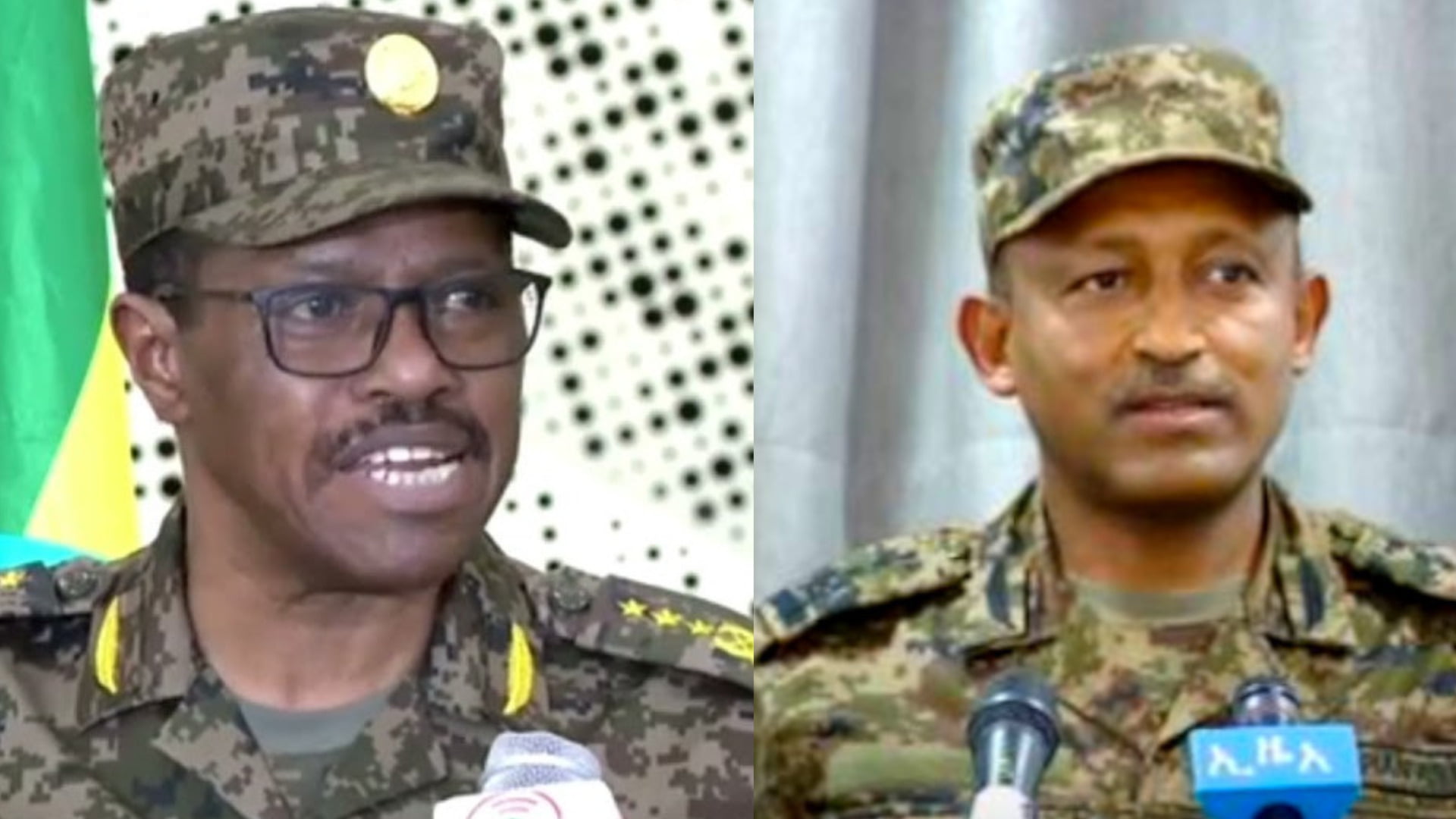
Maureen Achieng – head of United Nation’s migration agency in Ethiopia – withdrawn after she called the TPLF “dirty” and “vicious”, vowing never to return to Tigray.
The United Nation’s migration agency has put its Ethiopia chief on administrative leave, citing “unauthorised interviews” in which she complained of being sidelined by UN higher-ups she claimed were sympathetic to Tigrayan rebels.
The departure of Maureen Achieng, confirmed in a letter dated Monday and seen by AFP, risks further undermining an aid response still shaken by Ethiopia’s decision last month to expel seven other senior UN officials for allegedly “meddling” in its affairs.
It comes more than 11 months into a brutal war in northern Ethiopia that has driven hundreds of thousands of people into famine-like conditions, according to UN estimates, and sparked mounting global concern.
Last week, multiple recordings surfaced online of Achieng and another senior UN official granting a lengthy interview to Jeff Pearce, a writer who has published multiple articles defending the government’s conduct of the war against the Tigray People’s Liberation Front (TPLF).
In the recordings, Achieng, the International Organization for Migration’s chief of mission to Ethiopia, tears into colleagues who “descended on” Addis Ababa after the war erupted last November and, in her telling, sidelined officials on the ground.
She also calls the TPLF “dirty” and “vicious”, vowing never to return to Tigray.
At one point she accuses the rebels of plotting to have Tigrayan migrant workers facing deportation from Saudi Arabia sent to Rwanda.
“And then you don’t know what guerrilla movement starts from Rwanda. I mean, it’s dirty,” she says.
In an internal note to colleagues last week, also seen by AFP, Achieng said she was “deeply disturbed and disappointed” by the audio, which she said had been “surreptitiously recorded and selectively edited.”
However at several points during the interview the participants openly discuss that it is being recorded.
– ‘We do not take sides’ –
On Monday Antonio Vitorino, director general of IOM, wrote a letter distancing the agency from Achieng’s comments.
“The opinions attributed in the audio recordings to the staff member do not correspond to IOM’s principles and values and should not in any way be considered as expressing IOM’s positions,” it said.
The letter, which does not refer to Achieng by name, says she was “immediately recalled” and “put on administrative leave” pending an investigation.
Her interview violated the IOM’s values and code of conduct, Mohammed Abdiker, the agency’s regional director for the East and Horn of Africa, told AFP.
“In all our operations we try to be impartial and neutral in our work. We do not take sides in a conflict,” Abdiker said, adding that Achieng’s comments raised security concerns for staff members on the ground, including in Tigray.
The dust-up comes amid fears fighting is about to intensify again, with the TPLF saying Monday that government troops had launched ground offensives “on all fronts” including in the northern region of Amhara.
Ethiopian officials have not confirmed the new offensive, though a spokeswoman for Prime Minister Abiy Ahmed said the government had “a responsibility to protect its citizens in all parts of the country from any acts of terrorism”.
Humanitarian and rebel sources told AFP over the weekend that Ethiopian troops had launched air and ground strikes as part of the first phase of an offensive which — if confirmed — would come just one week after Abiy was sworn in for a new five-year term.
A US State Department spokesperson told AFP Monday that Washington was considering “the use of targeted economic sanctions to hold accountable those responsible for, or complicit in, prolonging the conflict”.
“Prominent members of the Ethiopian government or pro-government activists have been ramping up anti-Tigrayan rhetoric, as well as anti-journalist, anti-activist, inflammatory rhetoric targeting anyone who might be deemed critical of the Ethiopian government or critical of the Ethiopian government’s narratives. This has more or less normalized the state violence that’s been targeting ethnic Tigrayans over the course of the past 11 months, instilled a degree of fear amongst Ethiopian population.”
A whistleblower says Facebook’s algorithms could be stoking tensions and fanning ethnic violence in Ethiopia.
AUDIE CORNISH, HOST:
Hate and division on Facebook are not just a problem in the U.S. That’s one of the messages whistleblower Frances Haugen took to Congress last week, where she accused Facebook’s algorithms of quote, “literally fanning ethnic violence in Ethiopia,” a country that’s endured nearly a year of civil war.
(SOUNDBITE OF ARCHIVED RECORDING)
FRANCES HAUGEN: My fear is that without action, divisive and extremist behaviors we see today are only the beginning. What we saw in Myanmar and are now seeing in Ethiopia are only the opening chapters of a story so terrifying, no one wants to read the end of it.
CORNISH: The United Nations says millions of people have been forced from their homes. Hundreds of thousands are facing famine-like conditions because of the conflict between the Ethiopian government and Tigray rebels. Freelance journalist Zecharias Zelalem has been reporting extensively on Ethiopia, and he says he agrees with Haugen’s assessment. And we’ll pause here to note that Facebook is among NPR’s financial supporters.
Now, earlier, Zelalem described the role of social media in the conflict.
ZECHARIAS ZELALEM: Just looking at the instances of documented evidence over the course of the past three years in which prominent Facebook posters would post unverified, often inflammatory posts or rhetoric that would then go on to incite mob violence, ethnic clashes, crackdowns on independent press or outspoken voices.
CORNISH: Who were some of the perpetrators of this kind of violence? I mean, when you say someone posts misinformation, what could that look like that could start a mob?
ZELALEM: Well, in recent times, if we’re going to make reference to the ongoing conflict now, prominent members of the Ethiopian government or pro-government activists have been ramping up anti-Tigrayan rhetoric, as well as anti-journalist, anti-activist, inflammatory rhetoric targeting anyone who might be deemed critical of the Ethiopian government or critical of the Ethiopian government’s narratives. This has more or less normalized the state violence that’s been targeting ethnic Tigrayans over the course of the past 11 months, instilled a degree of fear amongst Ethiopian population.
CORNISH: The Ethiopian government has denied ethnic cleansing accusations. Can you talk about how the conflict is upending the lives of civilians?
ZELALEM: Well, I mean, the ethnic cleansing accusations are something that are very well-documented and corroborated by dozens of credible media sources and diplomatic sources, human rights organizations. At this point, 11 months into the conflict, it’s not really something that’s up for – it’s not really something that’s up for debate anymore.
CORNISH: Facebook has responded to Haugen’s criticisms by saying, quote, “to suggest we encourage bad content and do nothing is just not true.” They also talk about the idea of having to balance freedom of expression in places where people use the platform. What, if anything, is this conversation like in Ethiopia? Is anyone talking about Facebook? From your position, are they doing what they say?
ZELALEM: Well, with regards to your second question, Ethiopia being a relatively authoritarian society, critical conversation is not something that’s encouraged. It’s something that could wind you up behind bars. So there isn’t that much of an open societal debate. But I can quite honestly say that Facebook has – if it has done anything, it’s not nearly enough, at least, because there have been more than enough documented incidents.
I know of a very recent instance where a media outlet posted an inflammatory post blaming members of an ethnic minority for carrying out the murders and kidnappings that took place on September 27. And this Facebook post got hundreds of shares, hundreds of likes, all sorts of reaction. And a day later, on the 28 of September – so just barely two weeks ago – the village cited in the Facebook post was ransacked, burnt to the ground, inhabitants murdered. Like I said, this is very recent. This is barely two weeks ago. And despite multiple efforts to report the post, it remains up and live as of this moment.
CORNISH: We’ve been speaking to journalist Zecharias Zelalem. Thank you for sharing your reporting.
ZELALEM: Thank you for having me.
CORNISH: We reached out to Facebook. They told NPR that Ethiopia is a company priority and that it has worked to improve proactive detection to remove more harmful content at scale.
Kombolcha – Amhara Region, Ethiopia - “UNFPA is here today to make sure we provide the support needed for the 700,000 displaced people in Amhara region and that the health facilities - which are already overstretched - have the capacity to deliver life-saving services” said Ms. Dennia Gayle, UNFPA Representative, during the official handover ceremony of medical supplies on September 22 in Kombolcha, Amhara Region to address the recent humanitarian crisis in the region. Emergency reproductive health kits and dignity kits were handed over at the ceremony in the presence of H.E. Dr. Dereje Duguma, State Minister of Health and officials of the Amhara Region Health Bureau.
UNFPA delivered 20,000 Dignity Kits and 145 emergency reproductive health kits to serve more than 200,000 internally displaced people in 22 health facilities. Meanwhile, emergency reproductive health kits and dignity kits were also handed over to the Afar Region to respond to the recent humanitarian crisis in the region bringing the total worth of the medical and hygiene supplies donated by UNFPA to the Amhara and Afar regions to nearly 1 million USD.
Nearly 900,000 people have been newly displaced as a result of the conflict in Tigray which has spiraled into bordering areas of the Amhara and Afar regions since July, 2021. Climate-related shocks and intercommunal conflicts are also impacting more than 5 million people across Amhara and Afar regions.
Mentioning that essential health care services have been disrupted as a result of the conflict, H.E. Dr. Dereje Duguma, State Minister of Health of Ethiopia expressed during the ceremony his appreciation for the support and leadership of UNFPA to provide “life-saving supplies to serve our mothers and sisters at the right time and when it is most needed”.
Ms. Dennia Gayle reassured that “UNFPA is particularly concerned for the thousands of displaced women and adolescent girls who remain in urgent need of essential and life-saving health, protection and support services. We will do everything at our hand to deliver the urgently needed support and to ensure no one is left behind in both Afar and Amhara regions”.
Since the onset of the conflict in northern Ethiopia, UNFPA has been closely working with government implementing partners and other humanitarian actors to address the humanitarian needs of IDPs and host communities with gender-based violence prevention and response, sexual and reproductive health and psychosocial support interventions.
In Amhara region alone, UNFPA life-saving sexual and reproductive health supplies and dignity kits have reached nearly 400,000 conflict-affected people and 28 health facilities with a budget amounting 559,000 USD. In Afar region, UNFPA provided sexual and reproductive health kits for 16 health facilities reaching out to more than 283,000 people, 20,000 Dignity Kits and one ambulance with the financial support of the Government of Denmark, the Ethiopian Humanitarian Fund (EHF) and the CERF Anticipatory Action Framework project.
I cannot think of a previous occasion when a UN Secretary General told a member state – to its face – that he didn’t believe it.
Yet that’s effectively what Antonio Guterres did on Wednesday. He challenged Prime Minister Abiy Ahmed to provide evidence of UN staff wrongdoing.
“It is my duty to defend the honor of the United Nations,” Guterres told reporters after the rare public exchange with Ethiopia’s U.N. ambassador, Taye Atske Selassie Amde, at the end of the council meeting on the situation in the country.
“Twice, I asked … the prime minister. Until now, I had no response to these requests,” Guterres said. “The people of Ethiopia are suffering. We have no other interest but to help stop that suffering.”
Full report below, with another report on the stand of the European Union and a third on the current humanitarian situation.
Ethiopian porters unload food aid bound for victims of war after a checkpoint leading to Tigray in Mai Tsebri town, Ethiopia June 26, 2021. Picture taken June 26, 2021. REUTERS/Stringer/File Photo
UNITED NATIONS, Oct 6 (Reuters) – U.N. Secretary-General Antonio Guterres hit back at Ethiopia on Wednesday over the government’s expulsion of seven U.N. staff, demanding proof of accusations against them raised by Ethiopia’s U.N. ambassador during a Security Council meeting.
“It is my duty to defend the honor of the United Nations,” Guterres told reporters after the rare public exchange with Ethiopia’s U.N. ambassador, Taye Atske Selassie Amde, at the end of the council meeting on the situation in the country.
The Ethiopian government last week expelled seven senior U.N. officials for meddling in internal affairs. Selassie expanded on that on Wednesday, accusing the U.N. staff of making up data, falsely claiming hunger was used as a weapon of war and that people had died from hunger, and of supporting government foe – the Tigrayan People’s Liberation Front (TPLF).
“To use their own words, they were looking to create a Darfur-like situation,” said Selassie. “They, suddenly and overnight, created one million victims of health disaster.”
Guterres responded in the council, saying he had not seen any information from Ethiopia about these claims. He said he told Ethiopian Prime Minister Abiy Ahmed twice that if there were any concerns about the impartiality of U.N. staff then Abiy should share the information so Guterres could investigate.
“Twice, I asked … the prime minister. Until now, I had no response to these requests,” Guterres said. “The people of Ethiopia are suffering. We have no other interest but to help stop that suffering.”
U.S. Ambassador to the U.N. Linda Thomas-Greenfield described the Ethiopian move to expel the U.N. officials as “reckless,” adding: “There’s no justification for the government of Ethiopia’s action, none at all.”
“The U.N. is impartial. The U.N. is neutral,” she told the 15-member council. “U.N. personnel barred from Ethiopia must be allowed to return immediately.”
‘CHILDREN ARE STARVING’
War broke out 11 months ago between Ethiopia’s federal troops and forces loyal to the TPLF, which controls Tigray. Thousands have died, millions have fled their homes and the conflict has spilled into neighboring Amhara and Afar.
Guterres said up to 7 million people in Tigray, Amhara and Afar need help, including 5 million in Tigray where some 400,000 people are estimated to be living in famine-like conditions.
“Our colleagues on the ground are sharing increasingly alarming eye-witness testimony of the suffering – including growing accounts of hunger-related deaths,” Guterres said earlier in the council meeting.
“In locations where screening has been possible, we are seeing acute malnutrition rates that remind us of the onset of the 2011 Somalia famine,” he said.
He called on the government to allow the urgent delivery of aid “without hindrance” and the “unrestricted movement of desperately needed fuel, cash, communications equipment and humanitarian supplies” into Tigray, Amhara and Afar.
“Ethiopian children are starving. People are dying because they cannot access food, water and basic health care. This is not a situation caused by natural disaster. It is caused by those who continue to choose the path of war,” Ireland’s U.N. Ambassador Geraldine Byrne Nason told the council.
Guterres urged the Security Council to back U.N. aid efforts. However, any strong action by the body – such as sanctions – is unlikely as Russia and China have made clear they believe the Tigray conflict is an internal affair for Ethiopia.
China’s U.N. Ambassador Zhang Jun on Wednesday called for “quiet diplomacy in order to prevent a deadlock” over the expulsion of the U.N. officials.
EU Commissioner: Ethiopia’s Narrative ‘Dangerous’, Condemns Expulsion of UN Officials, Calls for Enhanced Collective Pressure
October 6, 2021
Globe News Net
The EU commissioner for international partnerships, Jutta Urpilainen condemned Ethiopia’s blockade on Tigray and the expulsion of 7 UN representatives who were mainly coordinating the humanitarian responses and engaged in the investigation into the atrocities in Tigray.
The commissioner in her speech at the European Parliament Plenary Debate on the Humanitarian Situation in Tigray On Tuesday, October 5, called on Europe for an ‘enhanced action and collective pressure for immediate and unhindered humanitarian access’.
Urpilainen said that the government of Ethiopia has sealed off Tigray making humanitarian aid delivery difficult while the needs are rising. The commissioner said that malnutrition in Tigray is raising and that to according to the commission’s estimates, closer to a million people in Tigray are now in famine condition.
In her speech, Urpilainen called Ethiopia’s governments narrative towards relief organizations “negative and dangerous”.
The commissioner concluded that Eu should press for respect of international humanitarian law are needed towards the Ethiopian authorities and all parties to the conflict for respect of international humanitarian law.
Beneath is the Full Textof the Commissioner’s Speech:
” It is since the beginning of the crisis last November that we have repeatedly raised our voice about the situation in Tigray.
The EU has been at the forefront of the diplomatic action and engaged with its Member States, likeminded-partners as well as Bretton-Wood Institutions to advocate for a concerted response. The EU has postponed budget support disbursements already last December.
Despite our and some other international actors’ efforts almost a year into the conflict, the situation does not improve. On the contrary, the tragic humanitarian crisis unfolding in Tigray is reaching dramatic levels and is increasingly posing considerable implications to the wider Horn of Africa.
Close to one year into the conflict, over 5 million people are in need of urgent assistance and 2.1 million people are displaced. The Famine Review Committee (FRC) predicted in June that there were 400,000 people at risk of famine. We believe this number is probably closer to 1 million people and we have now evidence that the number of malnourished children has dramatically increased.
Colleagues,
No meaningful humanitarian aid in Tigray has reached the region since mid-July. While seventy-five percent of the Tigray territory is now accessible for the humanitarian staff and supplies that are already inside Tigray, the Ethiopian government has sealed off the region.
Humanitarian aid entering Tigray is anecdotal compared to the needs, while on another scale, needs are increasing in Amhara and Afar as the Tigray conflict spills over into these regions.
The operating conditions for humanitarians have deteriorated sharply in the past two months, with organisations running out of supplies, fuel and cash and suffering from severe administrative access impediments.
Furthermore, the narrative of the Ethiopian Government towards relief organisations is becoming increasingly negative and dangerous.
In a shocking move, seven senior UN officials were declared “Persona Non Grata” last week, having to leave Ethiopia within 72 hours. One of them is involved in the investigation on possible war crimes and human rights violations. Two major humanitarian organisations were suspended this summer.
The gap left behind is unbridgeable. This results in a climate of fear and self-censure of relief actors.
Faced with this situation, the EU continues supporting civilians affected by the conflict through our humanitarian response efforts. Our absolute priority now is pushing for access to ensure that significant humanitarian aid reaches all those in need.
Enhanced action and collective pressure for immediate and unhindered humanitarian access and for respect of international humanitarian law are needed towards the Ethiopian authorities and all parties to the conflict. Our discussions next week during the high-level geopolitical dialogue with the EP on future cooperation under NDICI are also part of these efforts.”
Ethiopia is facing an ‘immense humanitarian crisis’, UN chief warns
An aid worker screens a child for malnutrition in Adikeh, in the Wajirat district of the Tigray region of northern Ethiopia on 19 July, 2021. Photograph: Christine Nesbitt/AP
Ethiopia is facing an “immense humanitarian crisis” amid civil war and famine, United Nations secretary general António Guterres has warned.
The UN chief made the comments during an emergency meeting of the security council on Wednesday, calling for Addis Ababa to grant “unhindered” aid access, a week after the country expelled seven UN officials.
It is the second emergency meeting in a week to address the expulsion of seven UN officials from Ethiopia as conflict and famine-like conditions plague the north of the country.
The UN estimates conflict has driven 400,000 into famine-like conditions with up to seven million people in need of food assistance in regions such as Tigray, Amhara and Afar.
Last year, long-running tensions between prime minister Abiy Ahmed and the Tigray People’s Liberation Front (TPLF) erupted into fighting.
“The country is facing an immense humanitarian crisis that demands immediate attention,” Guterres said. “All efforts should be squarely focused on saving lives and avoiding a massive human tragedy.”
The secretary general described the decision by the Ethiopian government to expel seven senior UN officials – most of them humanitarian staff – as “particularly disturbing”.
“This unprecedented expulsion should be a matter of deep concern for us all as it relates to the core of relations between the UN and member states,” Guterres added.
He urged Ethiopian authorities to allow the UN to deliver humanitarian aid “without hindrance and to facilitate and enable our work with the urgency that this situation demands” and criticised the country for not following the procedures in place in case of problems with UN officials within countries.
US ambassador to the United Nations, Linda Thomas-Greenfield, also called on the Ethiopian government, the TPLF, and regional militias to “end the fighting now, allow humanitarian access, and move toward a negotiated ceasefire immediately” in a series of tweets on Thursday.
The explusions of Unicef, UNOCHA, and UN human rights staff were “an affront to the security council, she said. “There is no justification for the Ethiopian government’s actions. None at all,” she added.
Officials from Ethiopia were due to take part in the UN meeting.
On Friday, the security council met to discuss the expulsion of officials who were accused of “meddling” in Ethiopia’s internal affairs and of political manipulation of humanitarian aid.
Following the 30 September decision, the UN wrote to the Ethiopian government, stating that declaring a staff member persona non grata, and demanding they leave the territory, is inconsistent with a country’s obligation under the UN charter.
In a letter seen by Agence France-Presse, the UN says it has not been given “any information” on the officials’ alleged actions.
A UN spokesman, Stephane Dujarric, said on Tuesday that Ethiopia has not provided any additional information.
The meeting on Wednesday was requested by the United States, Ireland, Estonia, Norway, Britain and France.
On Friday, the security council could not agree on a statement proposed by Ireland due to opposition from China and Russia.
Speaking on condition of anonymity, an ambassador of a security council member state told AFP that “we should move on to political negotiations.”
The expulsions sent shockwaves through the UN, where such moves are rare.
The UN’s humanitarian chief, Martin Griffiths, whose recent statements about the “blocking” of humanitarian aid and a growing risk of famine could be behind the decision, dismissed the allegations against the UN as false at the security council meeting on Friday, but did not say what they were, another ambassador of a council member told AFP.
The ambassador also said that the expulsions in Ethiopia could set a dangerous precedent for conflicts in Myanmar or Afghanistan.
“If we don’t resolve the situation in Ethiopia, it could create a snowball effect,” the ambassador added.