Posted 4 August 2016 18:37 GMT

Eritrean diaspora on social media. Photo by Yonatan Tewelde, used with permission.Eritrean diaspora on social media. Photo by Yonatan Tewelde, used with permission.


Written by Abraham T. Zere

A few months ago an Eritrean acquaintance called me to discuss an article he wanted to write for PEN Eritrea’s website. He had worked as a journalist in Eritrea, where we’re both from, before fleeing the country nearly ten years ago.

He had recently spoken out (under a pen name) about his former colleagues who were languishing incommunicado in detention centers in Eritrea, a story that was then covered by various media including The Guardian, in partnership with our organization.

Before I could congratulate him on this, he began discussing safe ways to send the article. He said he wanted to write the article anonymously. He lives in the United States under a grant of political asylum.

I gave him both my email address and an official email address for article submission. “But email is not safe,” he replied. “Eritrean security can crack it.” He explained that he wanted to avoid imperiling family members back home.

I countered that it was unlikely that Eritrean security would bother to hack the email accounts of two relatively unimportant Eritreans living in the US. This is an unfounded fear that exaggerates the reach of Eritrean security, I said. I explained that PEN Eritrea is trying to fight such inherent fear and discourages authors from writing anonymously or under pen names unless the person is at great risk, say from inside the country. It is our policy to request that all contributors to take full responsibility for what they write. We also require contributors’ email addresses to be included for publication.

A culture of fear that goes beyond borders

My colleague is not alone. His is a pervasive fear that has been inculcated among many Eritreans. They have experienced one of the world’s most repressive dictatorships, a place where the populace is subject to mass surveillance. Once they flee the country, it can take years for expatriate Eritreans to fully comprehend what was happening to them. Many live under extreme paranoia, suspecting conspiracies around every corner.

I frequently encounter Eritreans living safely in the West, with political asylum, who feel they can’t even “like” social-media posts that are critical of the regime back home. Instead they prefer privately writing or calling the individual whose post they wanted to react to. They fear the regime is tapping everyone’s social media account.

And their fears aren’t entirely unfounded. It is public knowledge that the prime job of Eritrean consular offices and their surrogates throughout the diaspora has been reduced to watching who’s associating with whom, in order to report when somebody with “incorrect” associations returns to Eritrea. This practice has imperiled many Eritreans when they went home to visit family members. As Tricia Redeker Hepner discusses in her book “Soldiers, Martyrs, Traitors, and Exiles: Political Conflict in Eritrea and the Diaspora” (2009) the trend also extends to audio recording by their compatriots via hidden devices to report to the state security back home.

This innate fear has been cultivated by the ruling elites’ longstanding tradition of ignoring the rule of law and behaving irrationally and unpredictably. At any point, a torturer might turn into the victim. The steady flow of arbitrary arrests and intimidation of journalists, in particular, and the populace in general, has resulted in a total disregard for rule of law. Such incidents, as common as they are, erode the confidence of the people to the point where they can’t trust any government institution. This tradition has also fostered an inherent culture of fear and mistrust among citizens.

This culture of paranoia has created the impression, among many, that the Asmara regime has the power to spy on every Eritrean in any corner of the world. The regime has successfully portrayed itself as omnipresent—which is fundamental to its survival.

Asmara, Eritrea's capital city. Photo by Yonatan Tewelde, used with permission.Asmara, Eritrea's capital city. Photo by Yonatan Tewelde, used with permission.

These dynamics are compounded by a lack of credible information coming out of the country, which has also played a major role in cultivating mistrust and fear. Alongside the regime’s long tradition of severely punishing state and independent journalists—the last accredited international correspondent was expelled in 2007— there is no independent source to confirm the veracity of any information.

When seven of the country’s private newspapers were banned in 2001 amid a political crackdown, 12 journalists were taken into custody. This swift action was followed by the raid and ban of the educational Radio Bana in February 2009, and the jailing of about 50 journalists and staff members. These assaults on both state and independent media have crippled free flow and exchange of information. News sources today are limited to the state media’s monotonous propaganda organs, which make nationals wary of any information coming through the official line.

The Eritrean state media, which was mostly institutionalized under the longest-serving propaganda minister, Ali Abdu (who later fled the country), is characterized by a lack of accountability and a habit of character assassination. The Ministry has absolute power to put down anyone they perceive as having even slight differences of opinion, or for really any reason at all.

Many Eritrean citizens became victims of character assassination in the national media under Abdu and his “hit team.” Public figures such as artists, political leaders and athletes were typical prime targets. Naturally, these attacks were published under pen names, although it was not difficult to know who was the mastermind behind the curtain.

Anonymity abounds. But what about accountability?

This tradition of character assassination and using pen names to attack anyone who expresses a contrary or different opinion has been adopted by Eritrean social and mass media in the diaspora, both pro- and anti-regime. Fake accounts and pen names are common, making it nearly impossible to tell who is who. Not surprisingly, pro-regime attacks have the effect of silencing many critics who fear the consequences of speaking against their country’s government.

On one side, there are there regime loyalists who vigilantly troll on social media with fake Facebook accounts and Twitter handles. Characteristically, these regime cheerleaders will use Eritrean flag or an emblem of that sort as their profile images, and will use account names such as “Eritrea Never Kneel Down,” “Hands Off Eritrea,” or “Eritrea Not for Resale.”

Dissident voices are mercilessly countered by anonymous users. This normally involves intimidation and in some cases extends even to death threats.

The opposition camp is not immune from such practices either. Many regime opponents employ similarly abusive language and fabricate information to destroy people on the other side.

The tradition of anonymity and character assassination is manifested in independent websites as well. It’s common among Eritrean independent media to use pen names to destroy someone in the opposite camp. Or else—in the name of freedom of expression—individuals will combine abusive language with an absence of facts and often get away with it.

In this extremely polarized political environment, most topics are reduced to simplistic, back-and-forth arguments between “opposition” and “pro-regime.” And predictably, many websites on both sides continue to publish anonymous articles to avoid accountability. These practices erode credibility and cultivate a tradition where it is nearly becoming impossible to discern reality from made-up facts. In the end, these interdependent practices only serve to damage collective intellects, leaving institutions in tatters and prolonging the life of the dictatorship.

Abraham T. Zere is the executive director of PEN Eritrea in exile.

Source=https://globalvoices.org/2016/08/04/anonymous-eritrea-communicating-in-a-paranoid-state/

Pope Francis meets with refugee children

Thursday, 04 August 2016 23:42 Written by

Pope Francis \ Activities


Pope Francis met with a group of 65 child refugees from Syria and Eritrea on Wednesday during his General Audience. - AFP

(Vatican Radio) Pope Francis met with a group of 65 child refugees from Syria and Eritrea on Wednesday during his General Audience.

The children are staying in the small town of Castelnuovo di Porto, located 25 kilometres north of Rome.

The children were wearing shirts saying “Grazie Papa Francesco” [Thank you, Pope Francis], and gave the Holy Father a large teddy bear. They also held up a sign saying “Our house is where peace resides.”

Pope Francis washed the feet of refugees from the Centre for Asylum Seekers at Castelnuovo di Porto on Holy Thursday in March.

Source=http://en.radiovaticana.va/news/2016/08/03/pope_francis_meets_with_refugee_children/1249034


Addis Ababa Letter: concern their fraught history may once again lead to full-scale war

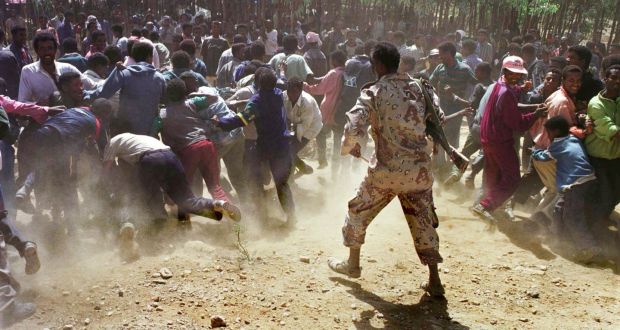
An Eritrean soldier beats back a crowd of Ethiopian detainees at a camp in Sheketi, Eritrea in June 2000. The  two-year war brought about a disastrous loss of life – 70,000-100,000 people are estimated to have died in scenes of modern trench warfare. Photograph: Tyler Hicks/Liaison

An Eritrean soldier beats back a crowd of Ethiopian detainees at a camp in Sheketi, Eritrea in June 2000. The two-year war brought about a disastrous loss of life – 70,000-100,000 people are estimated to have died in scenes of modern trench warfare. Photograph: Tyler Hicks/Liaison

 
AddThis Sharing Buttons
 

Tensions between EthiopiaandEritrea snapped in June in their most dramatic way for the last 15 years.

Fighting that erupted at their border involved tanks and heavy shelling and left hundreds dead. While military ordinance has stopped falling for now, any truce – if that word is applicable, such is the ill will on both sides – hangs by a thread, as does the welfare of both countries and the fragile peace and development spreading in the Horn ofAfrica.

Initially, speculation circulated among critics of both countries’ governments that the clash was a fabrication to distract from recent critical reports published by theUnited Nationsand advocacy groupHuman Rights Watch. Such scepticism, however, became harder to sustain as reports mounted about the gravity of the clash near the border town of Tserona.

Eritrea calls Ethiopia the aggressor engaging in “reckless military adventures” and puts the number of Ethiopian dead at 200 and wounded at 300. While rejecting that toll, Ethiopia’s government acknowledges that “a major engagement” took place; observers suggest it took action over Eritrean support of subversive elements inside Ethiopia.

This flash of instability actually occurred amid increasing harmony across the region thanks to increasing trade and economic integration between the likes of Ethiopia,Djiboutiand Somaliland.

Stalemate

However, any sort of harmonising effect has long been absent at the Ethiopia-Eritrea border, which is frozen in a cold war-type stalemate following a fraught history between the two and in spite of shared bonds such as language, culture and family ties.

After Eritrea was subsumed into Ethiopia in 1962, it fought a 30-year liberation war against the powers inAddis Ababa, the Ethiopian capital. This culminated in the fall of Ethiopia’s military dictatorship in 1991 after Eritrean fighters teamed up with Ethiopian rebels.

A referendum followed in 1993 in which the Eritrean people voted in favour of independence. Ethiopia’s new government – created by those same rebels – supported the referendum and its decision, while Eritreans had great hope for their country’s future.

But relations between the two then went downhill and by 1998 fighting broke out over the border around the village of Badme, an inconsequential piece of land; pride, however, has never been in short supply in either country.

The following two-year war brought about a disastrous loss of life – 70,000-100,000 people are estimated to have died in scenes of modern trench warfare – and of financial resources for both sides.

A ceasefire was followed in 2002 by an internationally brokered border resolution to safeguard the peace. Overall it suited both sides, apart from one key detail: Badme was to return to Eritrea.

With forces already ensconced in Badme, the Ethiopian government was loath to withdraw from territory gained through thousands of Ethiopian lives lost. So it proposed that implementation of the resolution required further talks – which didn’t happen – while its troops remained on what everyone acknowledged as Eritrean land.

That’s the way it has stayed ever since, though it has not helped that the international community has looked the other way. Now the worry is of the increasing possibility of full-scale war breaking out with a fight to the finish.

On paper, Ethiopia, with its larger, well-trained and better equipped military, backed by years of economic growth and development while Eritrea stagnated, would come out on top.

But there’s no telling how a final contest, or its aftermath, would play out. And if a decisive blow was delivered against Eritrea’s regime, what then? There are enough examples of how the travails of winning war prove nothing to sorting what follows.

‘Economic locomotive’

The last thing Ethiopia needs as it tries to cement its recent economic and developmental gains is another failed state next door, while the likes of Djibouti and Somaliland do not want a country that many call the “economic locomotive of the region” impeded in its progress – or worse, derailed.

Other reasons exist to dissuade either side from instigating a final round of destruction: Ethiopia is trying to become a more respected and engaged international player, while Eritrea shows increasing signs of tiring of its economic isolation and of contemplating increased international co-operation.

However, when a conflict’s fault lines are defined along common heritage, among neighbours and even relatives, the sense of betrayal and anger felt is personal and runs deep – proving much more difficult to resolve than antagonism between strangers.

All the while there remains that apparently unmovable hurdle throughout the decades, pride, which is nurtured by mutual loathing between the respective governments.

So now would be an excellent time for international diplomacy to finally help sort out a real and lasting compromise settlement – but with diplomacy of an assertive nature, rather than the half-hearted approach of before. Neither Ethiopians nor Eritreans are pushovers.

Source=http://www.irishtimes.com/news/world/africa/tension-high-between-ethiopia-and-eritrea-despite-harmony-in-region-1.2742951


  • 2016-08-02
  • BNS/LETA/TBT Staff/Riga

The Latvian Office of Citizenship and Migration Affairs has decided to grant refugee status and alternative protection to 17 people from Iraq, Syria, and Eritrea who have been moved to Latvia from southern European countries, the migration authority relayed to LETA. 

Refugee status has been granted to five individuals from Iraq, while alternative protection has been provided to 12 individuals from Syria and Eritrea. The Iraqi and Syrian families were moved from Greece and the Eritreans came from Italy. 

The families are currently living at an asylum centre in Mucenieki and searching for permanent homes. 

Although refugee status in granted indefinitely, alternative protection is provided for a period of one year. If after one year the circumstances in the nation of origin remains unchanged so that the individual in question no longer needs protection, he or she is issued a new one-year residence permit. 

Two families from Syria and two from Iraq were brought to Latvia from Greece under an EU-wide programme, while two Eritreans were relocated from Italy. 

Alternative status can be provided to an individual if there is a reason to believe that this person is in danger of being exposed to death penalty or corporal punishment, torture, inhuman or degrading treatment, or degrading punishment in his or her country of nationality or previous country of residence (if a person is stateless); this individual needs protection due to international or domestic armed conflicts and cannot return to his or her country of nationality or previous country of residence (if a person is stateless). 

Refugee status can be awarded if an individual has reasonable fear of persecution in his or her country of nationality or previous country of residence (if a person is stateless) due to his or her race, religion, nationality, membership in a social group, or political beliefs. 

At present, Latvia has accepted 53 individuals under the EU-wide refugee relocation programme. Latvia has agreed to admit 531 refugees within two years. While the majority of them will be relocated from EU member states Greece and Italy, 50 people have to be moved from third countries, most likely Turkey.

Source=http://www.baltictimes.com/latvia_grants_asylum_to_17_iraqis__syrians__eritreans_relocated_from_southern_europe/#


MPs say it is unacceptable for Home Office to continue basing decisions on guidance acknowledged to be wrong

 Zecahrias, an Eritrean refugee, at Leeds PAFRAS service for refugeesZecahrias, whose asylum claim was rejected, said he believed the Home Office was trying to deter Eritreans. Photograph: Kate Lyons
 

Thursday 28 July 2016 19.59 BST

Hundreds of asylum applications from Eritreans are being incorrectly refused by the government owing to its “unacceptable” policy on accepting refugees from the country, MPs have said.

The home affairs select committee has called on the Home Office to explain why it still has not updated its guidance on asylum seekers from Eritrea, even though it has acknowledged the guidance to be wrong.

The cross-party committee of MPs noted in a report published on Wednesday that 86% of appeals from Eritrean asylum seekers were decided in their favour in the first quarter of 2016.

“This suggests to us that the Home Office country guidance for Eritrea was wrong and applications for asylum from Eritrean nationals have been incorrectly refused,” said the report. “This is the third consecutive report in which we have commented on the approach of the Home Office to asylum-seeking Eritreans. It is unacceptable that the Home Office is still getting so many of its decisions regarding nationals of this country wrong.”

Until it controversially updated its country advice in March 2015, while Theresa May was home secretary, the Home Office advised that it was not safe to return most asylum seekers to Eritrea, which has been described as “the North Korea of Africa”. But the updated Home Office guidance claimed that citizens who left Eritrea without permission – many of them to escape its indefinite military service – would not face persecution if they returned.

The change of advice was based on a report, produced for the Danish government, that has since been discredited and from which the Danish government has distanced itself. One expert, who led an independent inquiry into the Home Office guidance, said in January that “an undergraduate would be failed” for producing such a document.

The home affairs committee said that where there were concerns over the accuracy of country guidance, as there were with Eritrea, the Home Office should “suspend decisions until such a time that those concerns have been investigated and, where necessary, revised guidance put in place”, or risk repatriating people to countries that were known to be unsafe or clogging up appeals courts unnecessarily.

In 2015, Eritreans accounted for the largest group of people applying for asylum in the UK, with 3,726 applications. The changed Home Office advice resulted in the number of Eritreans granted protection in the UK plummeting, from a 73% approval rate in the first quarter of 2015 to 34% in the second quarter.

However, the majority of these rejections are being overturned on appeal. In the first quarter of 2016, 86% of all appeals of Eritrean nationals were granted. This number is far higher than the appeal grant rate for other nationalities – the next highest successful appeal rate is for Iranians at 52%. The home affairs committee also suggested that the Home Office review its country advice on Iran, given that such a large number of decisions were being overturned on appeal.

The cost to the government of asylum appeals from Eritreans has risen by more than £5m since the change of country advice came into effect. An asylum claim costs an average of £1,300 to the government; this increases to £3,300 if the claim goes to appeal, according to the Ministry of Justice.

According to freedom of information data obtained by the Guardian, in the year before the country advice was changed (April 2014 to March 2015) there were 308 appeals of asylum decisions from Eritrean nationals, at a cost to the government of roughly £1m. In the year after the change of country advice (April 2015 to March 2016) there were 1,894 appeals by Eritreans, costing taxpayers £6.25m.

Zecahrias*, a 35-year-old Eritrean who came to the UK just after the Home Office guidance changed and had his initial asylum claim rejected, said he believed the Home Office was deliberately rejecting Eritreans to try to deter others from seeking asylum in Britain.

“They know what’s going on, they know the truth and we know what they are doing. Maybe the Home Office are saying, because we give them [asylum] easily, people are flowing to us, so if we reject them then people will not come,” he said.

Zecahrias was serving in the Eritrean military – as part of an indefinite mandatory military service scheme – when he left the country after learning that he was in danger of being arrested and possibly killed by the government. Zecahrias’s father was “disappeared” by the government in 2000 and the family have had no news of him in 15 years.

“I decided it’s better to do something and die than wait for them [to] kill me,” he said.

Zecahrias underwent a harrowing journey from Eritrea: he crossed the Sahara, was twice arrested in Libya and travelled in a boat for 15 hours on the Mediterranean. While he was in Libya he met his girlfriend, who is also a refugee. On arrival in the UK he thought he was safe.

“We believed the UK government is the best-organised, the one who was looking after human rights, who have the power to change everything and make it right,” he said.

When his asylum claim was rejected, Zecahrias’s girlfriend was pregnant and the news devastated him. He struggled to leave the house and lived in fear that the government would send him back to Eritrea, where he thought he would be arrested, if not killed.

“If the government of [the] UK was planning to take me back home on the plane, I was planning suicide,” he said. “It’s not what I was expecting when coming to England.”

He had his asylum claim granted on appeal, something he says is now expected by Eritrean asylum seekers. “I want to thank [the British government] for what they do,” said Zecahrias, who is now working in Leeds and supporting his girlfriend and son. “But they know the truth, they can solve this.”

“All country information and guidance is based on a careful and objective assessment of available evidence from a range of sources including the Foreign and Commonwealth Office, local, national and international organisations, and media outlets,” said a Home Office spokesperson.

“We continually review our country information and guidance to ensure it is up-to-date, accurate and relevant, so that staff can make fair and considered decisions.”

*Name has been changed

Source=https://www.theguardian.com/uk-news/2016/jul/28/hundreds-of-eritrea-asylum-applications-still-incorrectly-refused

EMDHRLogo


Starting from 9th July 2016 over 27 000 Eritrean school children were bused to various forced labour camps around the country. This shocking latest action against school children comes in the wake of a damning report by the UN Commission of Inquiry on Human Rights in Eritrea which confirmed Crimes Against Humanity have been committed by the ruling regime since 1991 in what it called ‘systematic, widespread, and gross violations of human rights’ including enslavement, forced conscription and forced labour. The students are often taken to remote places without the the protection of their parents or guardians and are exposed to all sorts of abuses including sexual abuses against girls, and hard labour. Any student who refuses to participate is denied access to education and rounded up for forced conscription. This practice violates the 1999 Convention on the Rights of the Child and Convention of the Worst Forms of Child Labour which prohibit any work that denies children the right to education and any form of forced labour.

20160718 150329

The student forced labour grogram known as ‘Students Summer Work Program’ in Eritrea usually comes before the indefinite forced conscription of all high school students who are made to finish their secondary education in a single military training, juggling between classes and military training. Once the students or any other youth are forced into conscription there is no way out. For all intents and purposes they are owned by the regime which the UN report rightly described as modern slavery. The regime enslaves around half a million Eritrean youth at any given time as confirmed by the UN report. As a result, the desperate youth continue to risk their lives to flee the country to seek for protection elsewhere. The tragic mass drowning of Eritreans in the Mediterranean Sea, the gruesome beheading of Eritrean migrants in Libya, and harrowing trafficking and kidnapping for ransom and organ harvesting of Eritrean in the Sinai desert and the hundreds of thousands of refugees (including unaccompanied children) in camps in Ethiopia and Sudan are consequences of the desperation Eritrean youth feel under the most brutal regime in the world. Many others are languishing inside Eritrean chain of prisons or serving as slave soldiers and labourers in the army.


We call upon the world to stand with us and defend the rights of Eritrean school children and stop all forms of slavery, forced conscription, and forced labour in Eritrea. This is the time to challenge the brutal rulers in Eritrea and force them to free the Eritrean youth from modern slavery. Let’s demand for:

1. The immediate return of all Eritrean students currently in forced labour camps to their families

2. Immediate and total ban of Forced Labour in Eritrea

3. Immediate and total ban of Forced Conscription in Eritrea

For the financial compensation of all those who participated in forced labour

4. All those responsible for the enslavement, forced conscription, and forced labour to be held accountable


Eritrea is the only country in the world without a constitution and is ‘ruled by fear’ as the UN report accurately describes it. There have never been any national elections since its independence, no national assembly, no justice system, no civicl society, no independent press, and all forms of freedoms and rights are banned. The one-man regime has terrorised the people in order to stay in power unchallenged.


EMDHR

24 July 2016

Pretoria, South Africa

This email address is being protected from spambots. You need JavaScript enabled to view it.


By Tesfa-Alem Tekle

July 22, 2016 (ADDIS ABABA) – An Ethiopian armed opposition group, Afar People’s Party has returned home abandoning an arms struggle in pursuit of peace.

JPEG - 26 kb
Ethiopian soldiers (AFP)

The leader of the opposition group Alo Aydahis and some 400 of its fighters laid down their arms and returned home after years of exile in arch- foe Eritrea.

The group on Thursday said it has favoured to engage in peace full struggle than the armed one.

The opposition movement according to the leader, Alo Aydahis, abandoned the armed struggle after it negotiated with the Ethiopian government.

Alo said the group has agreed to act in accordance with the law of the country.

Chief administrator of Afar regional state Haji Siyum Awel said the people and the government the Afar regional state have welcomed the group.

Sudan Tribune was told that the group had been serving the regime in Asmara to accomplish anti-Ethiopian missions and to further carry out attacks to destabilize the horn of Africa’s nation.

It is not yet clear what has prompted the Afar rebel group to abandon the struggle and flee to its home country.

However their move comes nearly a year after another rebel group, The Tigray People’s Democratic Movement (TPDM) similarly returned home from Eritrea.

The leader of TPDM (Demhit), General Mola Asgedom, and 800 of its fighters fought their way out of Eritrea in September last year after Eritrean Army attempted to stop the fighters leaving.

They fought their way with three Eritrean brigades.

But they managed to arrive the Sudanese border town of Hamdait overpowering the Eritrean army.

Once in Sudan, they were then assisted by the Sudanese Armed Forces and the government of Khartoum to cross borders to Ethiopia.

Some Ethiopian politicians believe that the formation of the new Ethiopia opposition coalition might have prompted to abandon the armed struggle.

Last year, TPDM and three other Eritrea based Ethiopian opposition groups including a terrorist designated opposition movement Ginbot 7 formed a coalition known as United Front for Salvation of Ethiopia.

The groups say they were merged to launch a new armed struggle against the Ethiopian government.

But some Ethiopian politicians say their alliance intends to organize anti-Ethiopia conspiracy and to further stage other destructive missions in collaboration with Asmara.

A previous UN report said Ethiopian opposition group inside Eritrea have dual function - as armed opposition group and as a protectors of the President Isaias Afwerki’s regime.

Eritrea gained independence from Ethiopia in 1991 after a 30-year war.

Relations between the two rival neighbours remain at odds since the two neighbours engaged in a deadly two-year long border war which ended in 2000.

Ethiopia and Eritrea routinely trade accusations of backing rebels trying to destabilize and topple the other’s government.

(ST)

By Editorial_Staff -

AFRICANGLOBE – Add to it the Qatari soldiers that have already been present on the ground for a few years to “mediate” the border dispute with Djibouti, and the most important members of the Gulf Cooperation Council (GCC) have unexpectedly converged in what many might think to be among one of the most unlikeliest of places. While it may have been difficult to foresee this happening, in hindsight it actually makes quite a lot of sense, and contrary to the conventional assessment that this is about Yemen, the argument can be made that it’s also just as much about Ethiopia as well. Unbeknownst to many, Qatar is the “ox driving the cart” in this case, and whether they like it or not, the rest of the GCC states will be reluctantly forced to follow its destabilizing lead if Doha decides to throw Ethiopia into chaos.

The research expands on the briefing first laid out by South Front and should be seen as a continuation of their original work. It begins by setting the context for what’s been going on along the Horn of Africa lately and how the GCC’s military advances fit into the larger context of recent history. The piece then investigates the levers of influence for how Qatar could destabilize Ethiopia as well as its radical ideological motivations for doing so. Finally, the article concludes with a scenario study of how Qatar could engineer an Unconventional War to bring down Africa’s next up-and-coming power.

The Crowded Coast

Geostrategy:

The Horn of Africa is one of the most geostrategic regions in the world due to its location along the Bab-el-Mandeb strait that connects the Gulf of Aden with the Red Sea. In a broader context, one can say that it’s one of two maritime chokepoints (the other being the Suez Canals) that link Europe with South, Southeast, and East Asia, and until the Northern Sea Route becomes operable sometime in the next decade, all sea-bound trade between the EU and these corners of Eurasia must transit through its narrow passage. As could be expected, this makes control over the strait a heightened prize for any power or combination thereof, and it’s not for naught that most Great Powers scrambled their navies to the region over the past decade ostensibly to “combat piracy”.

Come One, Come All:

What was really happening was that the US was trying to militarize the waterway under the auspices of countering “Somali pirates”, which it must be reminded, were bogeymen that were blown completely out of proportion by the Western mainstream media for premeditated geopolitical ends. The US wanted to create the conditions where the rest of the world would accept the continuous presence of its fleet operating in these strategic international waters, but precisely because their legal status, it meant that any other fleet could do the same thing on identical grounds, which is exactly what happened. While the UK and French navies were obviously there to support their American ‘big brother’, Russia, China, India, and Iran also sailed their ships there too, but for the purpose of both watching the West and symbolically showing that they won’t allow NATO to completely control this space.

The Strategic Illusion:


While the “pirate” hype has largely died down and the multilateral naval positioning over the Bab-el-Mandeb has markedly subsided since its frenzied height in the late 00s, the importance of the strait obviously hasn’t changed, and the American-initiated competition over its control merely took on another form and amphibiously migrated landward. The US joined its French partners in Djibouti by moving into Camp Lemonnier in 2001 (Paris never left the country after independence), thus giving it an on-land presence from which to project naval power if it chose to do so. It also opened up “anti-terror” facilities in Yemen during this time as well, but just like with the Djibouti base, these could also achieve the dual purpose of influencing the strait. With both of these power nodes already occupied by the US prior to the “anti-piracy race”, it might seem strange why America started such a game in the first place, but more than likely, it did so as a manifestation of the “exceptional” hubris of the Bush Administration that was also continued during the early reign of his successor.

Thus, while the non-NATO states may have felt they somehow lessened the US’ control over Bab-el-Mandeb by placing and then removing their navies from the Gul f of Aden, it was all just a carefully crafted illusion (one which hopefully resulted in the multipolar states acquiring some degree of useful information about the Western fleets). The US still retained its positions in Djibouti and Yemen, albeit without the ability to directly apply the same amount of force had its naval presence still been there in the same capacity, so nothing really changed in a simple strategic sense. That status of affairs would remain until the Yemeni Revolution finally succeeded in casting off the American- and Saudi-installed government in early 2015, which dramatically led to the US having to evacuate its military personnel from the country. For the first time since the end of the Cold War (when the Soviets had a naval base in Aden), the US didn’t’ fully control the Bab-el-Mandeb, and the strategic panic that this produced is partly why Saudi Arabia made the fateful and ill-planned decision to invade Yemen.

Bab-el-Mandeb And The War On Yemen:

The Saudis and their lackeys have succeeded in blockading the Yemeni coast and conquering Aden, thus returning most of the unipolar world’s control over their lost ‘real estate’ in this ultra-strategic region, but capitalizing on their unofficial casus belli to make sure that they can indefinitely retain control there, the GCC decided to ‘jump the pond’ to the Horn of Africa, hence its interactions with Eritrea and the contracting of Amara’s ‘services’. In a sense, Eritrea is envisioned as being the Gulf’s “back-up Yemen”, a friendly territory under its proxy influence from which punitive measures can be launched against the people of Yemen if they ever do succeed in once more nearly liberating the entirety of their country.

So long as Eritrea is under the GCC’s sway, then from a strategic-logistical standpoint, the Yemeni War of Independence will be all the much harder to win because the Saudis’ and their bloc have a ‘rear guard’ base almost directly abutting the country. The GCC’s actions in Eritrea can thus be seen as a type of “double insurance” in making sure that as many of the Yemenis remain under the Gulf boot for as long as possible, with such an unnecessary strategic consideration being seen as coming from a position of fear and weakness on their part, not strength. They fear the Yemeni militias so much that they’re preemptively creating this ‘rear guard’ supply and logistics facility in Eritrea “just in case” a counter-offensive one day manages to unsuspectingly cripple their occupying forces.

It’s appropriate at this juncture to take stock of all the international military forces currently present along the Horn of Africa. The Saudis and Emiratis now have a naval presence in Eritrea, and as previously reported (and which was verified separately this summer), the UAE is also seeking to open a naval base in Berbera along the northern coast of Somalia in the breakaway Somaliland region. The US and France have an on-ground presence in Djibouti, but they’re also joined by the Japanese, which opened their first military base abroad since World War II in 2011 under the opportunistic ‘justification’ of “anti-piracy”. They might, however, soon be joined by China, if the rumors of Beijing eyeing the country for its first overseas base are true. China could of course call upon the convenient slogan of “anti-piracy” to justify any possible forthcoming presence, but no matter what its stated grounds for doing so are, such a base would serve the additional purpose of safeguarding the Chinese-financed Djibouti-Addis Ababa railroad to the fastest-growing economy in the world and the headquarter state of the African Union.

Gulf Interests Move Inland

Now’s a good time to elaborate more in-depth about the continental African interests that the Gulf States seek to pursue through their partnership with Eritrea. To be more specific, it’s better to look closely at Qatar’s geopolitical objectives in this case, since the tiny emirate ironically leads the regional pack in its preexisting involvement in East Africa.

Eritrean Backgrounder:

This coastal state is one of the world’s newest, having gained its independence from Ethiopia in 1993 after fighting a three-decade-long war to achieve it. Peace came only after the government in Addis Ababa, at that time run by a military entity known as “The Derg”, was dissolved in 1987 and its leader Mengistu Haile Mariam was ousted in 1991 by a coalition of ethno-centric rebel groups. Due to the near-continuous fighting that took place on its territory, post-independence Eritrea was a wreck, but President Isais Afwerki helped to achieve stability and elevated living conditions, as attested to by journalist Andre Vltchek who visited a year ago. Nevertheless, the economy is in dire straits and Eritrea is largely isolated from the world community, partly due to the border disputes it has with all of its neighbors, and also because of successful Ethiopian lobbying against it. According to Ethiopia, Eritrea supports a variety of anti-government rebel groups and even has links to Al Shabaab in Somalia.

The Qatari Connection:

The last point is extremely contentious and has never fully been proven, although to clarify a bit, a Wikileaked US diplomatic cable quoted the Somalian President accusing Qatar in 2009 of using Eritrea as a financial conduit for Al Shabaab. Considering Doha’s support to other terrorist groups such as ISIL, this doesn’t seem implausible, and it might even be that rerouted Qatari funds channeled through Eritrea (which might have received a modest cut) could be to blame for why Ethiopia would allege that its nemesis was aiding terrorists.

No matter what shape it takes, Eritrea’s direct or indirect links to Al Shabaab are one of the reasons why the UNSC initiated an arms embargo on the country in 2009 that was just renewed last month. In this connection it’s relevant to remind one of Qatar’s role in the region, and it’s that it was asked to deploy “peacekeepers” along the Eritrean-Djibouti border by each of their governments in 2010 to assist in “mediating” their border dispute. One can cynically suggest that this provided nothing more than the perfect cover for Qatar to continue supporting Al Shabaab, which as was mentioned above, it had already been doing for some time. The reason Qatar supports this terrorist group is because it’s basically a regional franchise of ISIL, and a faction of Al Shabaab had just pledged allegiance to its Arab “brothers” late last month. These two groups pursue the same radical Islamic goals that Qatar has been patronizing for years through its sponsorship of the Muslim Brotherhood, and ISIL and Al Shabaab are pretty much the more visibly militant and globally notorious arm of the Brotherhood in this respect.

The Afro-Eurasian Caliphate:

To get a fuller grasp of why Qatar is promoting terrorism in East Africa, one should understand the macro-regional context of Doha’s ideological ambitions. The peninsular pipsqueak uses its financial largesse to flex power disproportionate to its tiny size, and it manifests this through support of a hodgepodge of ultra-extreme Islamic groups, all of which are classified as terrorists by Russia: the Muslim Brotherhood; the Taliban; ISIL in Syria, Iraq, Libya, and Sinai; and Boko Haram. Each of these terrorist groups is active in a certain geographic area, with the only ‘missing link’ being the southern vector, ergo the ideological/militant ‘necessity’ of Al Shabaab. Altogether, these terrorist organizations represent the ‘foot soldiers’ of a transnational caliphate project that Qatar and its US ally would like to see expand all throughout the central pivot of Afro-Eurasia, the “Greater Middle East” of Central Asia, the ‘conventional’ Mideast, North Africa, and East Africa. While its current prospects of success have dramatically dimmed ever since Russia’s anti-terrorist intervention in Syria, it still remains possible for Qatar and the US to actualize some aspects of this grand strategy in certain corners of their operational theater, which in this context is the Horn of Africa.

Double-Sided Chaos:

The introduction of “managed chaos” to the region via the Qatari-supported Al Shabaab terrorist group serves two main purposes. The first one is to pressure Ethiopia, which the US may feel more inclined to do if the country moves more solidly in a pro-Chinese direction in the future, and the second is to perversely use the presence of Al Shabaab to deepen its security relationship with Ethiopia by being the arsonist-firefighter that creates a problem and then ‘helps resolve’ it afterwards. It’s useful to recall that the US contracted Ethiopia to invade Somalia in 2006 in order to destroy the Islamic Courts Union (ICU), a precursor of Al Shabaab, which thus strengthened the partnership between the two. Also, by keeping Islamic terrorism alive in Somalia, to whatever extent it’s present at a given moment, the US can keep the ‘justification’ open for selectively intervening in the country with drone strikes or commando raids, thus entrenching its presence in the region and turning the criminal into the ‘cop’.

The Enemy Of My Enemy:

Rewinding the focus back to Eritrea, Asmara is passively tolerant of Qatar’s Al Shabaab patronage because it could supplement its grand strategic goal of destabilizing Ethiopia. To explain, Ethiopia has previously intervened in Somalia against Islamic terrorists before and subsequently occupied the country, and the idea that its forces could continue to do so again in the future, and thus be bunkered down in another potential quagmire and spread thin in critical (and rebellious-prone) interior regions, excites Eritrean strategists. Furthermore, as will be explained more fully in the third section, there’s the potential for Al Shabaab terrorists to become the “freedom fighter” figureheads for the Somali population in Ethiopia’s eastern provinces, formally the Somali Region but also known as Ogaden. Eritrea’s most important objective is to have ethno-centric regions inside of its former colonizer achieve independence in the same manner that it did – through prolonged and militant struggle against the central government – so that its rival can never be in a position to threaten it again (let alone exist in its current state). If the Somali region just so happens to be the spark needed to set the whole federal haystack alight, then so be it, as Asmara’s reckoning goes, whether its Qatari-supported terrorism that initiates the destructive domino effect that they expect or an indigenous ethno-centric uprising.

The Big Picture:

To bring everything together in a more simple understanding, Qatar has taken the lead in destabilizing the Horn of Africa out of ideological and unipolar-loyalty reasons, and it’s using its “legal” presence in Eritrea to facilitate this. The War on Yemen provided the other main GCC states of Saudi Arabia and the UAE with a ‘plausible justification’ for also ‘getting in on the action’, knowing just as well as Qatar does that Eritrea is a ‘double-hinged’ state that can be used to simultaneously project maritime and continental influence, with the latter case being against Ethiopia.

Concerning the GCC’s newest geopolitical target, it’s one of the world’s most promising emerging economies, and from a Gulf perspective, it could also be useful in satisfying their African-directed agricultural and construction-outsourcing needs. Placing their forces in Eritrea, Ethiopia’s arch-rival and hated foe, is designed to put pressure on the rising, albeit potentially unstable, continental power and thus make it more amenable to whatever their forthcoming grand interests may be. Also, by making Eritrea an integral part of their regional military architecture, the Gulf States are essentially declaring that any aggression against it would also endanger their own interests, thereby blanketing Asmara with a de-facto security guarantee and altering Addis Ababa’s perceived existing strategic balance of power (which it had earlier assumed was relatively even).

By itself and approached from a purely geopolitical standpoint, it’s theoretically possible for Saudi Arabia and the UAE to maintain this new status quo between Eritrea and Ethiopia (perhaps even exploit it and each of those two states to their own advantage if shrewd diplomacy is applied), but the presence of Qatar, the ‘loose cannon’, means that the entire arrangement is inherently unstable and subject to sudden change. Qatar has proven itself much more prone to impromptu outbursts of rhetorical rage than any of the other Gulf States, and its comparatively younger leader (only 35 years old) is much less versed in the art of statecraft than his peers. Being so hot-headed and already harboring an inferiority complex vis-à-vis his larger and more mature neighbors, Qatari Emir Tamim bin Hamad Al Thani is inclined to give the full terrorist ‘go-ahead’ whenever he feels like it (or if he ‘thinks’ it would be of strategic use for him), meaning that a Qatari-sponsored Islamic destabilization of Ethiopia cannot at all be discounted, and must be astutely prepared for by the country’s authorities.

Towards The Unconventional War Scenario

GCC Support:

The final section of the research discusses the Unconventional War scenario that Qatar could help engineer alongside Eritrea and Al Shabaab (one of its ideological ‘children’, it could be argued) to throw Ethiopia into chaos. Once this process begins, Saudi Arabia and the UAE could be expected to assist Qatar and this scenario to some extent, knowing that Doha is much too tiny and inexperienced to ever fully control the larger developments that it helps to unleash (the “Arab Spring” Color Revolutions are a case in point), and they thus want to be in a position to gain as much self-benefit from what may turn out to be an irreversible course of events. Correspondingly, with these self-motivated interests in mind, they could act as force multipliers in their own way for advancing the chaos that Qatar created, thereby ushering in a chain reaction that could lend crucial and ultra-destructive force to the scenario that will be discussed.

Consequences:

The full consequences of Ethiopian chaos won’t be discussed in the scope of this article, but they can be assumed to have the risk of virally spreading through parts of the North and East African regions (since Ethiopia is of the latter but capable of influencing the former through its border with the rebellious Blue Nile state of Sudan), and would at the very least impact the country’s 95 million or so citizens to an undetermined extent (to say nothing of the transnational social implications). Also, with China’s economy becoming more dependent for growth on trade with Africa, any significant disruption in Ethiopia, Beijing’s prized partner nowadays, could directly ripple back to the East Asian giant and negatively affect it to a degree, all depending of course on the preexisting level of Chinese-Ethiopian trade. The higher that Ethiopia rises in terms of international significance (be it diplomatic, economic, military, etc.), the harder its fall could be and the further the aftershocks would travel across the globe, thus suggesting that the (US-advised) Qatari destabilization of Ethiopia could be timed to achieve maximum effect depending on its relationship to various actors (in this case, likely China) at the given moment.

Identity Cleavages:

The greatest and most imminent threat to Ethiopia lays in the sphere of ethno-separatism, the sentiment of which has continued to boil even after the Cold War-era civil war was brought to a close. Part of the reason for this is that Eritrea’s independence set a dangerous precedent for the militant representatives of the country’s disaffected ethnic groups, which it seems include just about every single one of them in some capacity or another (even the dominant Oromo and Amhara pluralities). The reason for this is that Ethiopia is a hyper-eclectic country with a wide array of identities within its federal structure, and in such a situation, it’s always difficult for any governing authority (let alone what some rebel groups allege is the present Tigrean-dominated one) to strike the perfect balance between each of them and leave everyone satisfied. This preexisting state of divisive affairs was utterly exacerbated by the Ethiopian Civil War that broke out against The Derg, where ethnic-affiliated rebel groups banded together in order to overthrow the central governing authority. The militant comradery that developed within each identity community as a result heightened the self-awareness that each of them felt about their differences and thus made a post-war federal structure the only realistic means of keeping the country together, especially after Eritrea’s successful secession in 1993.

The identity divide was so entrenched in Ethiopia after the civil war that the new federal units were formed around ethnic affiliation. Here’s a map of them as taken from Wikipedia:Saudi Arabia and the GCC are Expanding To Eritrea. Geopolitical Implications for EthiopiaThe CIA World Factbook lists the ethnic proportions as being “Oromo 34.4%, Amhara (Amara) 27%, Somali (Somalie) 6.2%, Tigray (Tigrinya) 6.1%”, followed by a multitude of others that compose minimal percentages. Altogether, these four groups form a little less than three-quarters of Ethiopia’s population, mostly concentrated in a north-south belt stretching between Tigray, Amhara, western Oromia, and northeast Southern Nations, Nationalities, and Peoples Region.

Adding another crucial demographic layer to Ethiopia is the percentage of Christians (Ethiopian Orthodox and Protestant) and Muslims in the country, which is 62% to 33.9%, respectively, or almost 2:1. The following map demonstrates the geographic divide over religion and shows how this has a distinct overlap with certain federal units:

Saudi Arabia and the GCC are Expanding To Eritrea. Geopolitical Implications for Ethiopia

The Afar and Somalis are a very small minority of the population and by themselves cannot account for the 33.9% of Muslim adherents in Ethiopia, and as the above map indicates, many believers in this religion live intertwined with Christians in Oromia, the most populous region. By itself and with the absence of context, this isn’t anything particularly relevant to Ethiopia’s stability, but recalling how Qatar and its Saudi ally have been front and center in provoking a clash of civilizations through their support of Islamic terrorism, this demographic factor becomes perhaps one of the most important of all. Al Shabaab in Somalia is pretty much one of Qatar’s proxy creations, just as ISIL is, and its proximity and ethnic overlap with the Somali Region is a definite cause for concern.

Unconventional War:

The Basics

Taken together, a Qatari-orchestrated jihadist-separatist war emanating from the Somali Region could prove to be the catalyst that sets off a whole conflagration of nationwide conflict. This initial Unconventional War has a very real risk of occurring due to the doubly second-class status that Somalis feel they are afforded due to both their ethnicity and Muslim faith. Al Shabaab’s terrorist war in neighboring Somalia actually began as an Islamic-tinted national liberation movement in response to Ethiopia’s 2006 occupation, but it rapidly descended into the jihadist nightmare that lay at the core of its proponents’ true vision. Although it showed its true colors and most undoubtedly scared away many possible supporters that would have otherwise flocked to it for its originally marketed national liberation agenda, it still commands some indigenous support inside Somalia, thus raising the risk that it could also do the same amongst the Somali community in Ethiopia that might still consider itself occupied (or be led to think in such terms).

Carving Out The Caliphate

The concept here is that Qatar would use jihadism to radicalize separatist Somalis in getting them to become diehard supporters of the cause, holding out the carrot of a Greater Somalia if they’re successful. This irredentist dream would neatly overlap with Qatar’s own of creating a proxy caliphate in the Horn of Africa, but it also places limits on the primary geographic area of focus for its terrorist campaign. However, with the nature of terrorism inherently being that it knows no borders, it’s of course possible that attacks could take place in the densely populated and centrally positioned Oromia Region, which could have the effect of sharpening the Christian-Muslim divide in the area and prompting copy-cat and reprisal attacks. The destructive chain reaction that this might set off could only realistically be put to rest by a heavy-handed military response, albeit one which may scare investors right out of the country and lead to Western condemnation. In and of itself, whether or not the jihadist-separatist war succeeds in its stated goals, it would still accomplish what might have been the indirect (perhaps even actual) objective all along of weakening Ethiopia and possibly even China’s position in the continent depending on the degree of closeness and importance that Addis Ababa occupies for Beijing by that time (which is expected to be ever increasing).

Eritrea’s Strategy

Regardless of whether or not Qatar ever goes forward with the previously described scenario, that won’t in any way prevent Eritrea from continuing with its own, as it bases its national security on keeping the Ethiopian military distracted and divided through its support of ‘stand-alone’ and unified rebel movements so that it can’t ever solidly converge against the country. Eritrea would like to one day liberate the city of Badme that Ethiopia has refused to cede to its control after the Algiers Agreement ended their bloody and stalemated 1998-2000 war and a Hague border commission ruled that it’s Eritrean territory, and it might be using its support of various rebel groups as a means of pressuring Addis Ababa into acceding to its international legal obligation.

Eritrea’s Tactics

Asmara’s aspirations are to assist neighboring Tigray Region fighters in their quest for independence, mirroring Eritrea’s own, in order to create a buffer state that would insulate it from any future aggression from the rump Ethiopian state. At the same time, however, Eritrea also has ties with rebel groups operating deeper in the country, and if significant battlefield coordination can ever be maintained between Eritrea and the Oromo separatists (the ethnic group of which is the most populous and geographically central in the country), then it would go a very long way towards giving Asmara a lever with which it can trigger serious damage to Ethiopia’s national unity. Some Oromo might be attracted to the nationalist rhetoric coming from their militant-separatist counterparts that allege that the group is being exploited to support the minor peripheral ethnicities, and any visible “Tigrean-dominated government” crackdown on their civilian representatives might add credence to this belief. Eritrea might even ‘get lucky’ if the current tribal violence in South Sudan motivates a spillover effect into the neighboring Southern Nations, Nationalities, and People’s Region (home to 45 different ethnic groups) or Gambela Region that ‘naturally’ creates the state-fragmenting process that it and Qatar and looking to achieve for their own respective ends.

Doha’s Double-Crossing

On a final note, concerning any strategic Eritrean-Qatari collaboration in a future destabilization campaign against Ethiopia, the potential exists for Doha to stab its ‘ally’ in the back if its jihadist campaign is ‘too successful’. Eritrea might ironically be even more susceptible than Ethiopia is to an Islamic terrorist campaign because it has a similar proportion of Muslims that are also living in a similar economically challenging environment, and thus, might be ripe for ideological-religious manipulation under the ‘proper circumstances’. Additionally, the Muslim Afar living in the east partially represent Eritrea’s version of Ethiopia’s ethno-religious identity overlap that the latter has with the Somali Muslims, thus potentially leading to the same type of strategic vulnerabilities in this scenario. This factor could also be used by Qatar to manipulate Eritrea and keep its leadership in check, just in case the improbable happens and for whatever reason it decides to turn its back on its new patron.

On the flip side of things, so long as Asmara remains a loyal client of the Emir (which doesn’t seem set to change since it desperately needs the money and diplomatic support), it shouldn’t have anything to worry about. Eritrea is also much smaller than Ethiopia in both demographic and geographic terms, so it’s a lot easier for the state to exercise supervisory control over what’s going on and nip the jihadist process right in the bud before it fully blooms. However, as chaotic processes always prove themselves to be time after time again, once the genie is let out of the bottle, it’s impossible to stuff it back in, and even if Qatar doesn’t plan for it to happen, the jihad it unleashes in Ethiopia could also infect Eritrea in no time.

Concluding Thoughts

While it may not seem like it at first, the GCC’s military-logistical move into Eritrea is predicated just as much on influencing Ethiopia as it is about dominating Yemen. The Saudis and Emiratis may have just recently incorporated Eritrea into their coalition framework, but Qatar has been cultivating close ties with Asmara for the past 5 years as part of its “mediation” role in resolving the Djibouti border dispute, which incidentally saw it deploy 200 troops to the country. This means that the Muslim Brotherhood-espousing state is in a position to project its ideology throughout the region and intensify cooperation with its Al Shabaab proxy in nearby Somalia. The Saudis and Emiratis may initially be adverse to Qatar ‘rocking the boat’ in the region until after they’ve already tapped all of its economic benefit (which could take decades), but given Doha’s emotional- and ideological-driven foreign policy, it might do just that because it senses a ‘good opportunity’ here or there for furthering its self-interested geopolitical project.

In such circumstances, the GCC wouldn’t be able to indefinitely hold out the threat of Islamic-inspired terrorist destabilization as a means of blackmailing the world’s fastest-growing economy and one of Africa’s up-and-coming powers, but would have to reluctantly join in the Qatari-initiated unrest so as to secure whatever benefits they can while there’s still the ‘opportunity’ to do so. The ethnic, social, and religious cleavages already prevalent (and even overlapping in some cases) in Ethiopia provide more than enough domestic ‘gunpowder’ for a strategically placed spark to set the whole powder keg aflame, with the only fail-safe solution being for Addis Ababa to overwhelmingly respond with military force. Such a reaction might predictably scare away the investors that are needed to keep the ‘Ethiopian miracle’ alive, and the combination of capital outflow plus military suppression (no matter how justified it may seem) might further exacerbate the domestic differences in the country and place them in a perpetual process of worsening, up to the point of the country approaching the geopolitical abyss of dissolution along preexisting ethnic-federative lines.

Any disruption of Ethiopia’s stability could also be used as an indirect means of attacking Chinese interests in Africa, since Beijing has invested billions in helping the country rise and is expected to become increasingly dependent on its African economic partnerships in order to sustain its own growth at home. Large-scale unrest in Ethiopia could thus offset China’s plans for cooperating with the country on a high-level strategic basis, and it would thus lose not only a crucial marketplace for its goods or an attractive investment destination, but also its place in influencing the African Union right at its headquartered source in Addis Ababa. Therefore, many layers of intrigue blanket the possibility that Qatar may lead the GCC into a proxy confrontation with Ethiopia, be it out of its own regard or acting on behalf of American ‘advice’, which could see the Gulf using the country of Eritrea alongside Al Shabaab jihadists to dislodge China from its most important foothold in Africa.

By: Andrew Korybko

Source=http://www.africanglobe.net/africa/arab-countries-expanding-eritrea-good-ethiopia-africa/

Published on Tuesday, 19 July 2016 16:32

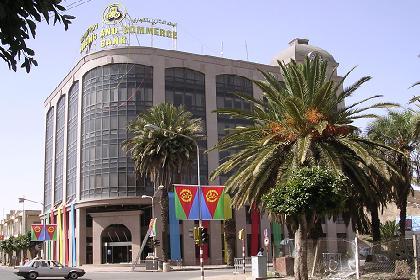
New headquarters for the Housing and Commerce Bank of Eritrea in Asmara, EritreaDespite growing foreign investments in Eritrea's industrial sector, decreasing remittances, slavery-like working conditions, a huge brain drain, and a misguided currency reform endanger wealth production and allocation in the state formerly seeking economic self-reliance.

Mary Harper, Africa editor of the BBC, argues that recent economic policies of the Eritrean government have an already poor population now getting into serious difficulty in working for their living. She identifies several reasons for this which are investigated in this article with further evidence.

First, national service forces female as well as male Eritreans to indefinite service on low pay, despite recent increases. Eritrea's national service has been criticised by a UN Commission of Inquiry and independent NGOs, for its arbitrary duration that can last for decades and often features mental, physical and sexual abuse by supervisors and slavery-like work. Some 5 000 people are said to flee Eritrea every month, most of whom name national service as the main reason.

Secondly, the cost of living for many people in Eritrea exceeds their usual incomes, forcing them to work in two or even three jobs, even if when they are still obliged to do their duties for national service. Housing and living costs in Eritrea, especially in the capital Asmara, were already unaffordable without additional jobs in 2010, if one was a national service conscript receiving less than $50/month. Even with a possible increase to $300/month as Hagos Ghebrehiwet, the economic advisor to the Eritrean President, announced to Harper, it is not plausible that conscripts could afford to cover their living costs only from national service income. The result is that thousands flee the country every month draining the country of productive workers. Although a third of Eritrea's GDP has been derived from remittances of Eritreans living abroad, this now appears to be shrinking as increased preference is given to help friends and relatives leave the country.

Thirdly, the recent currency reform allegedly aimed at hitting smugglers, limits access to finance which is severely harming business people, shopkeepers and hoteliers. The currency reform of November 2015 restricts the withdrawals that Eritreans are allowed to take from their bank accounts to 20,000 Nakfa and consequently the amount of money they can invest, e.g. in their businesses. Officially 15 Nakfa equal $1, but effectively it takes 50 to 58 Nakfa to change $1 on the black markets, so the restriction of withdrawal will severely affect the purchase power of Eritrean people.

Lastly, Harper says that the adjustment of the economy to receive foreign investments in the mining sector might increase Eritrea's GDP but without actually improving job supply. While it is true that during the last years, foreign investment in the mining sector has contributed to an increase of Eritrea's industry and so to its GDP, Harper correctly argues that the resulting gains only affect a small minority of the Eritrean people. Around 80% of Eritreans work in the agricultural sector but only contribute with 12.3% to the GDP. The growing industrial share of GDP has not resulted in industrial job growth. Furthermore, the budget deficit is understood to remain enormous although this can only be estimated as the government has never published a comprehensable budget overview.

All in all, there is strong evidence for Harper's claim that Eritrea's economic model has run out of steam at the expenses of the majority of the population. Yet, there are no signs that the Eritrean government recognises this potentially disastrous development. Even with the EU's development cooperation package, there are few reasons to believe that the root causes of mass flight from the country are properly addressed.

Source=http://www.eepa.be/wcm/320-eepa-news-and-activities/4005-eritrea-faces-serious-economic-problems-possibly-indicating-sustainable-decline.html

Memo Submitted to.                                                                                                                             Date 2016-07-11

Swedish Government

Swedish Parliament

Human rights Institutes

Dear Madams/Sirs,

We, the undersigned representatives of Eritrean political and civil society organizations and community members residing in Sweden, have jointly decided to submit to you this urgent message regarding the latest resolutions of United Nations Human Rights Council based on the reports of the Commission of Inquiry on human rightss violations due to this extremely critical situation in our country of origin, Eritrea. We submit this appeal that seeks your most immediate attention and action against:

- All illegal activities including the Festivals held every year in Stockholm of the PFDJ in Sweden handled by the young PFDJ (YPFDJ), a youth Diaspora - of the ruling party which was formed and operates under the patronage ofYemane Gebreab, the adviser toIsaias Afwerki, the president of the Eritrean regime.

- We urge the Swedish Parliament and Government to  investigate the role of the Eritrean official emissaries in Sweden as well as in the European Union. It also requests the Governemnt of Sweden  to investigate of the activities of all affiliated associations / Ideella föreningar of the PFDJ that operate as quasi-community organizations.

We also urge that the Swedish Government/ Immigation Department also curtails access of the PFDJ affiliate entities from accessing centers where asylum seekers stay. In financial aspects, this means that subsidies provided to the affiliated organizations must be stopped.

The European Union resolution to be  granted a 200 million Euro to Eritrea should be reconsidered and must not be given without strict conditions, in this case Swden as a member of the EU must put pressure to stop these grants.

We urge the Swedish Governmnt and Parliament to investigate asylum seekers of the Eritrean dictators supporters. There are thousands who sought asylum affiliated with Government of Eritrea running illegal financial transactions and spionage.”

Excellencies,

As you know, recently the UN Commission of Inquiry on the human rights situation in Eritrea has recommended to the Security Council to refer Eritrean officials to the persecutor of the International Criminal Court.


With this in mind , we would like to recommend the Swedish Government and Parliament based on this referal ask the PFDJ delegation visiting the Sweden on the occasion of the PFDJ Festival that will be held in Stockholm from 28/7- 31/7-2016


Trusting that you will give due attention and appropriate action on the above, we remain,

Respectfully yours,

Political and civil society organizations in Sweden