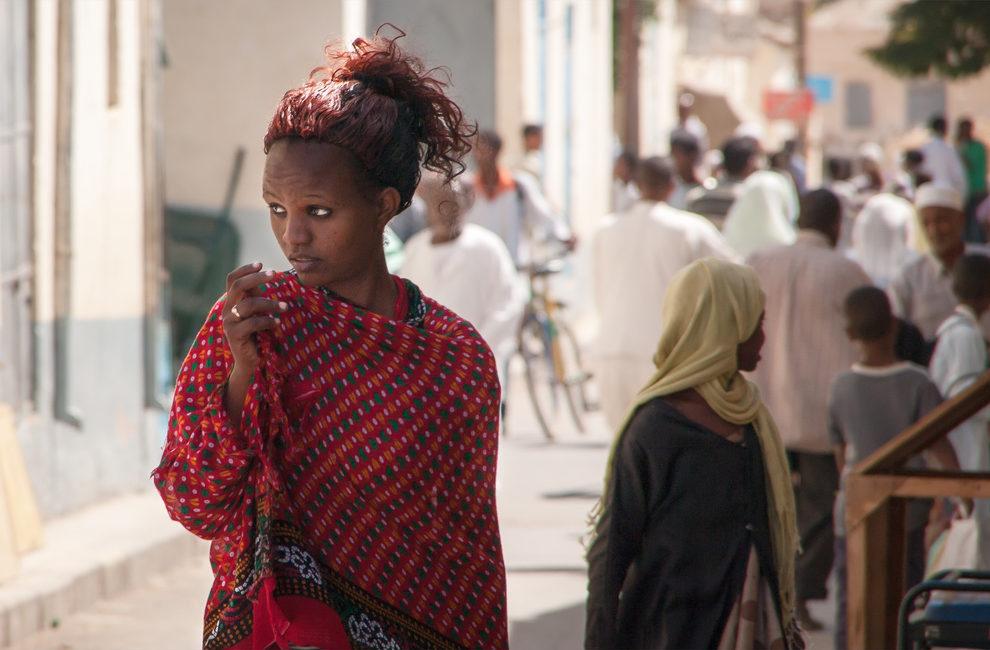
Adi Harush refugee camp EthiopiaSource: Regional Mixed Migration Secretariat (RMMS) summary for May 2018

There are approximately 169,252 Eritrean refugees living in Ethiopia who make up 18.4% of the total refugee population in Ethiopia. The number of Eritrean refugees who have arrived in Ethiopia in 2018 stood at 4,055 at May 31st.

In the same period, Kenya was host to 1,439 Eritrean refugees and asylum seekers while Somalia was hosting 90 persons. Egypt hosted 13,748 Eritrean refugees and asylum seekers as at 30thApril 2018.

Note: this does not include Eritrean refugees in Sudan. RMMS reported that  Sudan hosted 101,751 Eritreans in May 2016.

Deaths at sea

Between January and 15thMay 2018, 1,810 Eritreans migrants had arrived in Italy by sea. The Missing Migrant Project had recorded 62 deaths of migrants from the Horn of Africa in the same period.

Source=https://eritreahub.org/latest-eritrean-refugees-in-the-region-deaths-at-sea

probe into UNHCR fraud

Friday, 27 July 2018 10:43 Written by
Source: IRIN
23 July 2018
 
Sally Hayden

Refugees have told IRIN that since the investigations began, they’ve been intimidated and harassed by some Sudanese staff at the UNHCR office in Khartoum, as well as by state security agents and officials of the Sudanese government’s Commission of Refugees. Refugees say they have been called on the phone or asked to meet with these officials and then been pressured not to testify on pain of having their cases for resettlement closed or losing access to other assistance. The Sudanese Commissioner of Refugees did not respond to multiple requests for comment.

On 15 May, IRIN published a reportbased on interviews with more than a dozen refugees and a former UNHCR staff member. They alleged that decisions on which refugees would be permanently resettled to a third country were often made on the basis of bribes rather than standard eligibility criteria. Two days later, UNHCRsuspended resettlementfrom Sudan and confirmed that in February and March it had launched investigations into alleged corruption, and would soon deploy an anti-fraud team.

In a statement announcing the suspension, UNHCR encouraged anyone with information to contact its Inspector General’s Office(IGO), an oversight body that investigates complaints of misconduct, “without delay”.

Over the past 10 weeks, an IGO investigator has contacted refugees and asked them to do phone or Skype interviews. In an email seen by IRIN, “potential witnesses” were told their interviews could be recorded and details could be disclosed on a “need to know” basis with both the subject of the investigation and those involved in taking disciplinary action. The email also stated that they would be asked to swear an oath to tell the truth and shouldn’t discuss the investigation with anyone without prior IGO approval.

But refugees told IRIN they didn’t believe the investigation process offered sufficient confidentiality, and expressed concern that the UN’s refugee agency could provide little help if they were retaliated against. They said they didn’t believe they could come forward safely because of ties between some UNHCR staff and the Sudanese state, and feared reprisals from corrupt Sudanese and UN officials who may be exposed by the investigation.

“Refugees are afraid to speak because those at UNHCR have connections with the [Sudanese] security and can do whatever,” one refugee said.

In an emailed response, UNHCR said it is concerned by refugees’ allegations to IRIN of harassment by local UNHCR Khartoum staff and Sudanese officials. “We take these allegations very seriously,” the email stated. UNHCR encouraged refugees and others to report such behaviour to the IGO.

The IGOreceives hundredsof complaints around misconduct every year, including allegations of fraud in the resettlement and refugee status determination processes. When the IGO launches an investigation, they interview witnesses, the people accused of wrongdoing, and may gather documentary and other forms of evidence, according to investigation guidelines published in 2012.

Protection and privacy

Resettlement is a complicated process taking anywhere from several days (in emergency cases) to several years.

“Refugees are afraid to speak because those at UNHCR have connections with the [Sudanese] security and can do whatever.”

As IRIN reported in May, refugees in Khartoum allege that middlemen and local UNHCR staff with close ties to the refugee community have been requesting bribes to speed up and corrupt the registration and resettlement process. The going rate to do that for unregistered asylum seekers in Khartoum was about $15,000, refugees said. Resettling a whole family boosted the price to $35,000-$40,000 – money usually raised by relatives abroad. Around 1.2 million refugees are now in Sudan, and more than 2,000 people were resettled from there in the year ending September 2017, according to UNHCR.

In Khartoum, many refugees and migrants live in a constant state of concern over security and safety, analysts and researchers report. “In Sudan, migrants are vulnerable to a litany of abuses,” Human Rights Watch Sudan researcher Jehanne Henry, now the associate director of the Africa division, wrote last year. “Many live in legal limbo; can be rounded up and arrested at any time and summarily tried for immigration violations; and can be jailed, fined, and deported without due process or transparency.”

They face endemic abuse and harassmentfrom the Sudanese police, who regularly arrest them to solicit bribes and are accused of physical violence and sexual assault. Just last week, a video emerged online allegedly showing an undercover police officer raping a refugee woman in a Khartoum street, provoking debate around the sexual abuse of refugees by police officers.

Amid this atmosphere, refugees are anxious and constantly worried about their own safety. This is compounded by their confusion over who is actually carrying out the UNHCR investigations. Several told IRIN that UNHCR officials in Sudan not affiliated with the IGO, as well as some international UNHCR staff, had asked them to visit the Khartoum office to be interviewed. This scenario worried the refugees, who said they would be at risk because the very people they are making allegations against would see them. They were also concerned that translators might feed details of their testimony to the accused personnel.

“I thought it was going to be confidential,” said one refugee, after taking part in an interview in the UNHCR compound in Khartoum. “I don’t like the idea of going to that office,” the refugee said, adding that those accused were not good people and had a “network of people in key areas”.

“There are many refugees who [have] witnessed the corruption but are afraid to [say] it,” the refugee said. “The consequences [of coming forward] will be life-threatening.”

Another refugee recounted an incident in the reception of the UNHCR office in May in which Sudanese staff involved in the resettlement process warned refugees not to share any information about their cases with a visiting international team who were asking about the corruption allegations. “The local staff spoke to the refugees in Arabic, saying ‘don’t tell them’,” the refugee explained, adding that the international staff who were present did not understand Arabic.

UNHCR spokesman Babar Baloch said last month that protection is provided for witnesses in certain cases. “Witness protection is a top priority, and where serious safety concerns arise UNHCR has mechanisms in place to respond,’’ he said. “However, as you will understand, for obvious reasons, we won’t be able to discuss details publicly.”

UNHCR did relocateseveral witnesses during a similar investigation surrounding Kenya’s Kakuma camp in 2001. And IRIN was told by a UNHCR official who is not based in Khartoum, and who requested anonymity, that some refugees whose testimony was deemed sensitive have been moved elsewhere for their safety during other investigations, including another one in Kakuma in 2016-2017.

Yet two refugees in Khartoum who are potential witnesses to the Khartoum investigations told IRIN their direct pleas to the IGO and UNHCR for protection, including to be moved to a safe place, had been declined or ignored. Both told IRIN they fear for their lives.

“What they should be doing is resettling them,” a current UNHCR resettlement officer, who has witnessed IGO investigations elsewhere in East Africa and requested anonymity, said. “It’s a perfect resettlement case.” Without emergency resettlement or the option of witnesses entering a safe house, the officer said: “No one talks. No one will tell them what’s happening. So it just keeps happening.”

Fear of the Sudanese state

UNHCR has previously highlighted the concerns it faces around protection during investigations. A March 2018 overview of the IGO’s workstated that “lessons learned from key investigations” included that “the support that UNHCR can provide to witnesses who face security risks when they are involved in investigations is limited” and “the primary responsibility for witness protection lies with the host State.”

“No one talks. No one will tell them what’s happening. So it just keeps happening.”

Several refugees who said they were afraid to take part in the Khartoum investigation said they knew they couldn’t turn to Sudanese officials if testifying led to problems. They referred to an incident in April 2017 when dozens of refugees protested at the UNHCR Khartoum compound to draw attention to their allegations of corruption in the resettlement process. Six refugees who were present told IRIN that UNHCR staff had called the police, who set upon the protesters, leaving one woman with a broken leg.

When asked about the incident, UNHCR Sudan spokesman Steven O’Brien initially denied the police were called. Later, when provided with a video that appeared to show police inside the UNHCR compound on the day of the protest, UNHCR spokesman Baloch clarified that police officers had been present but said there was “no evidence of force being used”.

It is unclear how many people have voluntarily come forward to participate in the Khartoum probe, and UNHCR does not comment on current investigations. However, some refugees told IRIN they have long been too afraid to report exploitation and would not participate if asked, particularly out of fear of losing the protections and services associated with refugee status.

“We have never dared to complain because the UNHCR refugee card is the only thing that protects us from Sudanese officials,” one Eritrean woman said. Several refugees told IRIN they feared reprisals could take the form of their files with UNHCR or the Sudanese Commission on Refugees being closed or “lost”, which would mean losing their right to legal protection and the services that go along with it.

The 2017 human rights reportfrom the US State Department notes that refugees and asylum seekers in Sudan are “vulnerable to arbitrary arrest and harassment” in urban areas for incorrect or missing identity cards and authorisation documents.

“We fear retribution and jail, because if we’re removed from the protection of the UNHCR, we have no protection from the Sudanese government,” the Eritrean refugee explained. “So, I would love to file a complaint but fear the consequences of doing so. I feel like nobody at the UNHCR really cares about what we go through.”

A process on hold

As the investigation continues, the impact of the suspended programme is unclear, beyond the fact that hundreds of resettlements have been delayed for at least several months. Around 170 refugees were resettled from Sudan each month in the year ending September 2017, according to UNHCR.

Speaking on condition of anonymity due to the sensitivity of the topic, several former UN staff in Khartoum and elsewhere said they were worried that the suspended programme might put refugees waiting for resettlement at risk.

“So, I would love to file a complaint but fear the consequences of doing so. I feel like nobody at the UNHCR really cares about what we go through.”

“Sometimes these investigations take months and months and months to get to the bottom [of],” the former Sudan head of another UN agency told IRIN. “If people in urgent need of resettlement are sitting around for months, [UNHCR is] certainly not supporting their protection.”

Since mid-May, as the investigation has gone on, refugees and former UNHCR staff in Sudan interviewed over the past two months by IRIN have gone from being hopeful about the prospect of change to worrying that the situation may get worse.

“Maybe, once the media is gone, they will keep doing it,” a former UNHCR Sudan staff member said, referring to the alleged corrupt practices. “The situation is complicated in Sudan.”

Source=https://eritreahub.org/refugees-in-sudan-intimidated-during-probe-into-unhcr-fraud

Hey, all you Abyssinians out there.  While you are wasting time squabbling with each other and not talking to each other, the governments of the Arabian Peninsula are eating your lunch.

Have you noticed that warships from the United Arab Emirates are operating out of the port of Asab 24/7?  Their interest is in Yemen, not in Eritrea or Ethiopia.  There are reports that Saudi Arabia has taken a 50-year lease on Asab.  If that is true, the next step will be Sharia Law in the Horn of Africa big time.

I think it is time for Abyssinians to take back control of the west bank of the Red Sea before it is too late. 

One way to accomplish this is for Eritrea and Ethiopia to finally end the war of 1998-2000 and normalize relations. It can be done as a win-win.

Eritrea and Ethiopia should send delegations to a neutral venue, like Geneva.   With the two delegations present, the following agreements will be signed:

  • Badme will be returned to Eritrean control pursuant to the Algerian arbitration agreement.
  • Immediately after the symbolic return of Badme to Eritrean control in a brief ceremony in the morning, that afternoon, the two delegations will negotiate the following agreements:
  • Each government will guarantee that its territory will not be allowed to be used by elements hostile to the other government as a base for destabilization of the other government.
  • Pre-war economic relations will be restored to the status quo ante, including a dedicated duty-free Ethiopian section of Asab Port under a 50-year lease at an indexed rental.
  • The IMF will be requested to establish a currency exchange daily settlement regime between the Birrh and the Nakfa. 
  • There will be free movement of persons between the two countries, including the right to work and establish businesses.
  • There will be embassies established in both countries with an exchange of ambassadors.
  • The border will be totally demilitarized. 
  • Merchandise produced in each country will not be subject to trade duties in the movement between the two countries. The two countries will have a common external tariff.
  • Establishment of security control and the exploitation of resources in the Red Sea will be joint.

Upon the signature of a final normalization agreement between Eritrea and Ethiopia, the following will take place:

  • The United Nations Security Council will lift sanctions against Eritrea.
  • Eritrea and Ethiopia will jointly negotiate Red Sea security agreements with Arab countries bordering on the water way.
  • Eritrea and Ethiopia will jointly guarantee the security and neutrality of the State of Djibouti. 
  • Eritrea and Ethiopia will agree to exchange intelligence about terrorist activity in the Horn of Africa.

The foregoing is a list of ideas that are out on the table. It is imperative that Ethiopia and Eritrea begin to normalize. Otherwise, the countries east of the Red Sea will make major inroads west of the Red Sea to the detriment of both countries as well as to American interests.


Source=http://www.cohenonafrica.com/homepage/2015/12/28/the-red-sea-is-slipping-into-total-arab-control

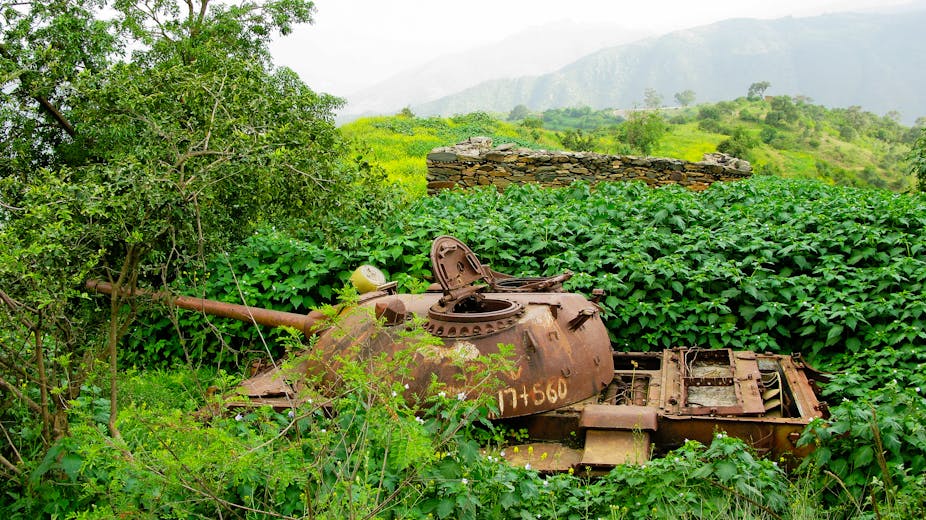
An abandoned tank by the roadside in Eritrea. Shutterstock

July 19, 2018 2.39pm SAST

The end of hostilities between Ethiopia and Eritrea has been met with relief in the region as well as globally. But what does it mean for Eritrea, which has been dubbed the North Korea of Africa. The Conversation Africa’s Julius Maina spoke to Martin Plaut about the implications for the small and reclusive state.

How did Eritrea earn its reputation as a reclusive state?

Isaias Afwerki, the Eritrean president, has operated on the presumption that no-one would come to Eritrea’s aid after it launched its armed struggle for independence from Ethiopia in 1961. It was never entirely true, but they certainly didn’t have the support of any major power.

When Eritrea gained its independence in 1993 he saw no reason to alter his view. As a result, major international aid agencies were made unwelcome. Even the United Nations has found it difficult to work in the country.

After 2001, when the president cracked down on all opposition – including from within his own party – all major news organisations, including the BBC, Reuters and AFP – were banned from having offices in the country. International journalists have only been allowed to visit sporadically. This has left Eritrea under-reported.

Isaias is moody and reclusive by nature. Since the regime is a dictatorship which has never allowed elections of any kind, the country reflects the politics of its leader.

The country has been named as a sponsor of regional terrorism. To what extent is this still the case?

Following Eritrea’s bitter border war with Ethiopia between 1998 and 2000, the government in Asmara became a sponsor of the Somali Islamist group, Al-Shabaab, and a number of Ethiopian rebel groups . It did so to undermine the Ethiopian government, which was fighting a war in Somalia against the Islamists. Eritrea’s support for Ethiopian rebel groups had a similar aim in mind.

These activities – as well as a border clash with Djibouti – led to the UN Security Council imposing an arms embargo against Eritrea in 2009. The embargo didn’t include economic sanctions.

UN appointed experts monitored the arms and logistical support Eritrea provided to Al-Shabaab in great detail. In recent years they’ve reported back that they have no evidence of current Eritrean backing for Al-Shabaab.

In the last few weeks the UN Secretary General, Antonio Guterres, has said he thinks the sanctions regime will become obsolete, since Eritrea and Ethiopia have resolved their differences.

How will recent events affect politics and commerce in the Horn?

The prospects for the Horn could be transformed if the Ethiopia-Eritrea rapprochement holds and their border dispute is truly resolved.

The closure of their mutual frontier for the past two decades has had a terrible effect on people all along the 1,000 km long border. Family ties and trade patterns were severely disrupted.

The people of the two countries have never been at loggerheads: there is little real animosity between them. The divisions have been between the ruling parties of both countries.

With these apparently resolved, life in the Horn can resume as normal. The Eritrean ports of Massawa and Assab will hum with life once more, as Ethiopian trade flows through them. And the potash deposits on their border can be developed. Since Ethiopia is currently Africa’s fastest growing economy this could ease bottlenecks such as international investment in Eritrea which will no longer be viewed as a war-risk. And instead of competing to fund and support rebel movements in each other’s countries, Ethiopia and Eritrea can combine to tackle the real enemy: poverty.

What will the impact be on Eritrean society?

This is the most difficult question and predictions are fraught with difficulty. Having been such a closed dictatorship it is impossible to say with any certainty how the country will be transformed.

On the one hand, Isaias could allow democracy to emerge, since he no longer has a foreign enemy on his doorstep. The constitution, which was ratified by the National Assembly, could be implemented. Free and fair elections could be held and a multi-party system allowed to emerge. The president might even decide to retire now that peace has been achieved – he is 72 years old.

This is all possible. But it’s not very likely. The president is extremely cautious and believes he is indispensable to the country: without him it will lose its way. He is more likely to move only gradually towards allowing limited freedoms. This could include ending indefinite conscription, since the rationale for this has ended. Such an approach would be consistent with his past behaviour. But it might result in growing frustration from citizens who have accepted economic hardship and a lack of democracy during a time of war, but might do so no longer. What forces this might unleash and how the citizens will react, only time will tell.

How do these developments affect Eritrea’s refugee outflow?

The end of hostilities should mean that Eritrea’s indefinite National Service is ended. National Service (or conscription) is required of all citizens between 18 and 40 years old. In theory this lasts for no longer than 18 months. Yet many Eritreans have served for 20 years and more. Pay is minimal and conditions harsh: for women there is the threat of rape or sexual abuse. This has been – by a long shot – the main driver of the refugee exodus that has seen up to 5,000 people leaving the country every month.

Freed from conscription, some servicemen and women will return to their farms or seek employment in towns. One possible consequence is that unemployment could become serious, unless inward investment takes up the slack.

If the border with Ethiopia is opened up again thousands of people in refugee camps in Ethiopia might return home. The refugee outflow might even be reversed. This is an optimistic prognosis. More likely, refugees who have risked everything to reach safety will remain in the camps until the outcome of the dramatic changes can be assessed and the transformation is made permanent.

Eritrea’s refugee outflow will only end when both prosperity and freedom become established facts. Until then it is likely that some will continue to seek a better life abroad, even if in smaller numbers.

Source=https://theconversation.com/what-peace-will-mean-for-eritrea-africas-north-korea-100063


The Eritrean dictator, Isaias Afeworki, has the other day appointed Semere Russom as his Ambassador in the Ethiopian capital, Addis Ababa, where many Eritreans opposed to the repressive regime in Asmara have taken refuge since a long time. This is a sincere warning to them and other Eritreans who intend to visit Addis Ababa in the future.
 
Semere Russom was dictator Isaias Afeworki's envoy in the Sudan for many years since the mid-1970s. Prominent political and military leaders of the ELF were among the many victims inside the Sudan of Semere and his boss, Isaias Afeworki, in the years before and after independence. For example Yemane Teklegiorgis, a veteran EPLF fighter and member of its security outfit (Halewa Sewra) was with Semere Russom the day Haile Gharza was murdered inside Khartoum in 1984. Yemane, now an author of a book on those and similar grisly killings organized by Semere Russom in the Sudan, will hopefully retell the story himself as he already did in writings and his bold interviews with Eritrean opposition mass media.
Semere Russom 1Among Semere's ELF victims were: Haile Gharza, Saeed Saleh; Woldedawit Temesghen; Idris Hangela, and Mahmoud Hasseb
 
But Haile Gharza was not the only victim of Semere Russom and his master, Isaias Afeworki. Earlier on 5 June, 1983, Saeed Saleh was murdered in Kassala. Woldedawit Temesghen fell on 20 July 1985  followed by the murder of Idris Ibrahim Hangala on 20 September 1985; Mahmoud Hasseb on 3 September 1989.
 
Even the former leader of the ELF army, Abdalla Idris, was targeted personally by Semere Russom in Khartoum although the targeted figure could skillfully escape death.
Semere Russom 2   
Other assassination/kidnap victms: Michael Ghaber; W/Mariam Bahlibi; Teklebrhan G/Tsadiq, Mohammed Ali Ibrahim.
 
Semere Russom and those who followed in his footsteps in the Sudan also continued the killings and kidnappings  from the Sudan.  Among the earliest victims were: Michael Ghaber who was targeted for killing by two identified assassins in 1989, and later killed in a mysterious "accident" on 25 May, 1922.  Earlier to Michael Ghaber's death/murder,  two top leadership members of the ELF-RC, Woldemariam Bahlibi and Teklebrhan Ghebdretsadiq (Wedi Bashai) were kidnapped from Kassala on 26 April 1992 and their whereabouts is not known to this day. Tens of other leading freedom fighters were assassinated kidnapped by the likes of Semere Russom, among them the EPDP leadership member Mohammed Ali Ibrahim, who was kidnapped from Kassala on 12 February 2012.
 
"Ambassador" Semere Russom's mission in Addis Ababa as of this week will be organizing work for the security agents of the Asmara regime who reportedly  numbered not less than 230 as of the date of dictator Isaias Afeworki's visit to Addis Ababa between 14-16 July 2018. Semere Russom was not only an enemy of rival freedom fighters but also was anti-Eritrean struggle for freedom until the 1970s.

Justice Minister Ayelet Shaked makes promise after new batch of Eritrean army recruits say they expect to serve 18 months

Source: Haaretz

Justice Minister Ayelet Shaked speaking to members of Ethiopia’s Jewish community during a visit to a synagogue in Addis Ababa, Ethiopia, April 22, 2018.Mulugeta Ayene/AP


Israel will begin deporting Eritreans back to their homeland the moment it ends mandatory military conscription of indefinite duration, Justice Minister Ayelet Shaked said Tuesday.

Reuters had reported earlier Tuesday that the latest batch of recruits drafted into the Eritrean army had informed relatives they were told their service would end in 18 months.

Speaking at a gathering of her Habayit Hayehudi party in Tel Aviv, Shaked said the government was closely monitoring the implementation of the peace agreement signed by Eritrea and Ethiopia earlier this month, which has raised hopes that Eritrea will end mandatory conscription of indefinite duration.

“If, following this agreement, the conscription requirement is canceled, Israel could return the infiltrators to Eritrea – and that’s great news for residents of south Tel Aviv,” Shaked said, referring to the area in Israel with the highest concentration of African asylum seekers.

But sources involved in the issue said that even if the Eritrean army announces an end to indefinite army conscription, this is still just an initial promise – which is a far cry from the actual end of forced conscription in Eritrea.

In 1995, two years after declaring independence from Ethiopia, Eritrea instituted mandatory 18-month military service for everyone between the ages of 18 and 50, with the goal of furthering state-building after its 30-year war for independence. This service was supposed to consist of six months of military training, followed by a year of working on development projects.

A man walking past the ruins of a building in the port city of Massawa, Eritrea, July 22, 2018.A man walking past the ruins of a building in the port city of Massawa, Eritrea, July 22, 2018.\ TIKSA NEGERI/ REUTERS


But the Eritrean government has maintained unlimited military service ever since a two-year border war broke out with Ethiopia in 1998. The dispute dragged on despite the signing of a cease-fire agreement in 2000.


Tens of thousands have ended up in Europe, making Eritreans one of the main constituencies among refugees and migrants on the Continent.

Relatives of the new recruits said they were informed of the new 18-month limit at a graduation ceremony for conscripts on July 13.

The peace deal between Ethiopia and Eritrea has led to warming ties, which have included reciprocal visits by the countries’ leaders, the opening of embassies in each other’s capitals and the restoration of telephone service between the countries.

Eritrean Information Minister Yemane Ghebremeskel did not deny the reports but said there had been no formal announcement, noting it was “early days” in the rapprochement with Ethiopia. “Policy announcements of this significance are invariably made through our official outlets, and that has not been done so far,” he told Reuters.

Earlier this month, Ethiopian Prime Minister Abiy Ahmed and the Eritrean leader signed a historic deal in the Eritrean capital of Asmara, declaring an end to their “state of war,” which was one of the longest military stalemates in Africa.

The neighbors agreed to open embassies, develop ports and resume flights – concrete measures that have swept away two decades of hostility in a matter of weeks.

The Asmara government has long insisted that conscription is vital for national security, saying it fears attack by Ethiopia.

The president said at the ceremony earlier this month it had “special significance” because it was occurring after Eritrea and Ethiopia had made peace.

In Asmara, some people told Reuters they were awaiting official announcements declaring an end to their duty.

“I have been in service for the last 20 years and am proud of the role I played,” one resident said. “But hopefully we will now be friends with our Ethiopian brothers, rather than enemies, and I hope to move on with my life

Source=https://eritreahub.org/israel-threatens-to-deport-eritrean-refugees-as-soon-as-indefinite-conscription-ends

Asmara’s feud with Ethiopia’s had a huge bearing on Eritreans in the country and diaspora. Now there’s peace, we have a lot of questions.

Eritrea peace: What will peace in Eritrea mean for ordinary citizens. Credit Andrea Moroni.

What will peace in Eritrea mean for ordinary citizens? Credit Andrea Moroni.

Like many Eritreans, the sudden warming of relations between the Eritrean and Ethiopian governments has filled me and my loved ones with both hope and fear. The no-war no-peace stalemate that defined the politics and identity of my country for 20 years is apparently over.

This newfound peace is undoubtedly a cause for celebration, and one that will transform politics across the region for years to come. Yet for many of us, the most pressing questions this new situation begs are far more immediate.

We are asking things like: Will my sister in school still be conscripted into compulsory military service next year? Will my cousin, who is looking for ways to be smuggled across the border, be allowed to leave legally instead? Will my aunt, who has criticised the Eritrean government from outside the country, be allowed back in? Will my uncle, languishing in jail for political reasons, finally be released?

[Isaias out of character: Why Eritreans are getting nervous]

[Ethiopia-Eritrea peace: Some unanswered questions]

Lives on hold

For two decades, Eritrea has been one of the world’s most secretive and isolated countries. To begin with, it has been extremely difficult to get in and out. The first time I applied for a visa to enter as a tourist, I was met with puzzled laughter at the consulate. I was only able to get a visa because I had some contacts that could pull strings in the capital Asmara.

Getting out of Eritrea is much harder and much more dangerous. Very few are permitted to exit by the government, and so most who want to leave rely on human-smugglers and risk being arrested or kidnapped for ransom. Everyone knows someone who has embarked on these uncertain and treacherous journeys. Thousands consider the conditions in the Eritrea to be so dire as to do so every single month.

Life in Eritrea is restricted and tough. The country is poor and the economy extremely closed. People are not allowed to access non-state media. There is practically no Internet or access to smart phones. And there has never been a single election. Asmara’s defining features – the crumbling, modernist architecture; wide, palm-lined avenues; Italian-style pastry shops; and classic 60s Volkswagen beetles – are all reminders of a vibrancy that has long ceased to exist.

Worse still, all young people in Eritrea are required to undergo compulsory national service. Their passports, university diplomas and lives are put on hold as they undergo military training, after which they may be sent off to labour in any outpost that the government sees fit.

At the moment, one of my relatives spends his days painting arrows and divider lines on the few one-lane roads of Asmara for virtually zero pay. Another, who was finally released from national service after over a decade, is still required to guard a government building from 10pm to 3am once a week. National service is indefinite. In his words, this serves “as a reminder that the government has power over me”.

Divided families

For 20 years, President Isaias Afwerki, who effectuates total control, has used the pretext of Ethiopian hostility to entrench his totalitarian rule and shut Eritreans off from the outside world. This has incurred huge political and economic costs, but the human costs of this enforced isolation have been just as high. They can be measured in every Eritrean family, each of which has its own stories to tell.

I had an aunt, for example, who lived in Addis Ababa. When she received a diagnosis of terminal cancer, her relatives in the US and Canada could visit her to say goodbye, but her loved ones just over the border in Eritrea were not allowed.

I have another friend nicknamed “Baby”. When the 1998-2000 border war began, he was in Eritrea with his mother. The rest of the family was visiting Ethiopia. With transit no longer permitted, they were suddenly split in two. In an instance, the tight-knit unit was unable to reunite and could only communicate with great difficulty. My friend was called Baby, because that’s what he was the last time the rest of the family saw him.

The separation between Eritrea and Ethiopia has never been of two nations, but of two populations made up of thousands of families. That’s why headlines such as the New York Times’ “After 20 Years of Silence, Strangers in Ethiopia and Eritrea Call to Say Hello” fail to capture an important element of Ethiopian-Eritrean relations. We are not strangers.

What now for us?

With war declared over, the status quo of the past two decades will fundamentally change. Asmara’s apparatus of control will necessarily shift, marking the end of Eritrea as we (don’t) know it. But this brings us back to the question of what will happen to the Eritreans’ lives both in the country and in the diaspora.

Now there is no longer an apparent threat of Ethiopian attack, will military conscription end? Now that flights are open to Eritrea, who will be allowed in? My dad, having written critically of the regime in the past, has not dared enter the country for the past ten years. Will there be a place for him and other dissidents in this new opening?

What about the thousands who have fled? Several of my family members have sacrificed the prime years of lives in refugee camps and transit countries for the chance to begin anew elsewhere. Will they be able to keep these lives that they’ve worked for?

Some Eritreans remain sceptical about Asmara’s genuine capacity to act differently. “Having seen the injustice in my country, I don’t think anything will change without a change in leadership,” a compatriot told me. That’s not the feeling of most Eritreans, but our new hope remains tinged with fear and uncertainty, our long-held fear and uncertainty now tinged with hope.

Source=http://africanarguments.org/2018/07/23/eritrea-peace-history-aside-mean-loved-ones/

Creeping paranoia in Djiboutian diplomatic circles

Saturday, 21 July 2018 15:20 Written by

Postby Waachis » Fri Jul 20, 2018 2:45 pm

Creeping paranoia in Djiboutian diplomatic circles
 
THE INDIAN OCEAN NEWSLETTER ISSUE 1478 DATED 19/07/2018
Image result for Mahmoud Ali YoussoufIn a missive addressed to his ambassadors which The Indian Ocean Newsletter has obtained a copy of, the Djiboutian foreign minister Mahmoud Ali Youssouf has expressed himself in very undiplomatic terms, reflecting the anxiety of the Djiboutian authorities in the face of the current rapprochement between Addis Ababa and Asmara. The minister is of the view that the Ethiopian prime minister Abiy Ahmed Ali is guilty of 'reckless haste' and is using his country's status as a non-permanent member of the United Nations Security Council to secure the lifting of sanctions on Eritrea, without giving due thought to the negative impact this may have on Djibouti...
 
After this diatribe against the rapprochement between Ethiopia and Eritrea and the policies of the Ethiopian prime minister, Mahmoud Ali Youssouf goes on to express his concern at 'the interference and meddling of the United Arab Emirates in this reconfiguring of alliances in the sub-region'. He describes this Gulf state as 'the armed wing and bankroller of the strategy of the new US administration' and claims that the crown prince of Abu Dhabi, Mohammed bin Zayed al-Nahyan (MbZ), has pledged 'billions of dollars in deposits and investments' in exchange for Ethiopia extending the hand of friendship to Asmara.
 
He then seizes the opportunity to criticise the Frud arme, 'hosted and supported by Eritrea', a country which will soon be seeing Ethiopian businesses setting up shop and operating out of the port of Assab rather than the port of Djibouti. He therefore recommends 'a clear and unambiguous statement to Ethiopia of our position and our displeasure'.
 
The end of this memo reads almost like a threat to Ethiopia, 'this country [which] has not yet left its turbulent times behind' and where 'the risk of implosion is not to be underestimated [...] given[the forthcoming] operations to harness the oil and gas resources of the Ogaden'.
 

The Global Slavery Index 2018

Friday, 20 July 2018 06:28 Written by
Report

from Walk Free Foundation

Published on 19 Jul 2018 —
 

Executive Summary

Depriving someone of their freedom is a terrible violation. Modern slavery is a destructive, personal crime and an abuse of human rights. It is a widespread and profitable criminal industry but despite this it is largely invisible, in part because it disproportionately affects the most marginalised. This is why measuring this problem is so crucial in exposing and ultimately resolving it. The information contained within the Global Slavery Index is critical in these efforts.

The 2018 Global Slavery Index measures the extent of modern slavery country by country, and the steps governments are taking to respond to this issue to objectively measure progress toward ending modern slavery. The Index draws together findings from across estimates of prevalence, measurement of vulnerability, and assessment of government responses, alongside an analysis of trade flows and data on specific products. When considered as a set, the data provide a complex and insightful picture of the ways modern slavery is impacting countries around the world. This enables us to refine our thinking on how to better respond to modern slavery, and also how to predict and prevent modern slavery in future.

As reported in the recent Global Estimates of Modern Slavery, published by the International Labour Organization and the Walk Free Foundation, in partnership with the International Organization for Migration, an estimated 40.3 million people were living in modern slavery in 2016. In other words, on any given day in 2016, there were more than 40 million people – about 70 percent of whom are women and girls – who were being forced to work against their will under threat or who were living in a forced marriage. In the past five years, 89 million people experienced some form of modern slavery for periods of time ranging from a few days to the whole five years. These estimates are conservative, given the gaps in existing data in key regions such as the Arab States and also exclusions of critical forms of modern slavery such as recruitment of children by armed groups and organ trafficking due to lack of data. From this starting point, the 2018 Global Slavery Index uses predictive modelling, based on data from nationally representative surveys and the Walk Free Foundation Vulnerability Model, to estimate the prevalence of modern slavery country by country.

The contributing factors

Findings from the 2018 Global Slavery Index highlight the connection between modern slavery and two major external drivers - highly repressive regimes, in which populations are put to work to prop up the government, and conflict situations which result in the breakdown of rule of law, social structures, and existing systems of protection.

The country with the highest estimated prevalence is North Korea. In North Korea, one in 10 people are in modern slavery with the clear majority forced to work by the state. As a UN Commission of Inquiry has observed, violations of human rights in North Korea are not mere excesses of the state, they are an essential component of the political system. This is reflected in the research on North Korea undertaken through interviews with defectors for this Global Slavery Index. North Korea is followed closely by Eritrea, a repressive regime that abuses its conscription system to hold its citizens in forced labour for decades. These countries have some of the weakest responses to modern slavery and the highest risk.

The 10 countries with highest prevalence of modern slavery globally, along with North Korea and Eritrea, are Burundi, the Central African Republic, Afghanistan, Mauritania, South Sudan, Pakistan, Cambodia, and Iran. Most of these countries are marked by conflict, with breakdowns in rule of law, displacement and a lack of physical security (Eritrea, Burundi, the Central African Republic, Afghanistan, South Sudan and Pakistan). Three of the 10 countries with the highest prevalence stand out as having state-imposed forced labour (North Korea, Eritrea and Burundi). Indeed, North Korea, Eritrea, Burundi, the Central African Republic, Afghanistan, South Sudan and Iran are the subject of various UN Security Council resolutions reflecting the severity and extremity of the situations there.

A global issue

One of the most important findings of the 2018 Global Slavery Index is that the prevalence of modern slavery in high-GDP countries is higher than previously understood, underscoring the responsibilities of these countries. Through collaboration, the number of data sources which inform the Index has increased. This has allowed the Index to more consistently measure prevalence in countries where exploitation has taken place. More surveys in sending countries has resulted in more data about receiving countries, most of which are highly developed.
 
Following these changes, an interesting pattern emerges: the prevalence estimates for the United States, Australia, the United Kingdom, France, Germany, the Netherlands, and several other European nations are higher than previously understood. Given these are also the countries taking the most action to respond to modern slavery, this does not mean these initiatives are in vain. It does, however, underscore that even in countries with seemingly strong laws and systems, there are critical gaps in protections for groups such as irregular migrants, the homeless, workers in the shadow or gig economy, and certain minorities. These gaps, which are being actively exploited by criminals, need urgent attention from governments.

The realities of global trade and commerce make it inevitable the products and proceeds of modern slavery will cross borders. Accordingly, for the first time we examine the issue of modern slavery not only from the perspective of where the crime is perpetrated but also where the products of the crime are sold and consumed, with a specific focus on the G20 countries. The resulting analysis presents a stark contrast of risk and responsibility, with G20 countries importing risk on a scale not matched by their responses.

Citizens of most G20 countries enjoy relatively low levels of vulnerability to the crime of modern slavery within their borders, and many aspects of their governments’ responses to it are comparatively strong. Nonetheless, businesses and governments in G20 countries are importing products that are at risk of modern slavery on a significant scale. Looking only at the “top five” at-risk products in each country identified by our analysis, G20 countries are collectively importing US$354 billion worth of at-risk products annually.

Of greatest concern is the continuing trade in coal from North Korea, alongside other products that are subject to UN Security Council sanctions. However, most of the at-risk products examined for this report are not subject to existing sanctions. Rather, information about risk of modern slavery can be found in research and media reports, and occasionally court cases. G20 countries are only just beginning to respond to this risk, through a growing focus on modern slavery in the supply chains of business and government, but existing efforts are not nearly enough. The Government Response Index reveals that more than half of the G20 countries are yet to formally enact laws, policies or practices aimed at stopping business and government sourcing goods and services produced by forced labour (Argentina, Australia, Canada, India, Indonesia, Japan, Mexico, Russia, South Africa, Saudi Arabia, South Korea, and Turkey). The exceptions are China, Brazil, France, Germany, Italy, UK, and the United States, each of which has begun to take some steps in this regard. Australia has announced it will introduce supply chain transparency laws in the second half of 2018.

Government responses

While much more needs to be done to prevent and respond to modern slavery, the Government Response Index suggests that national legal, policy, and programmatic responses to modern slavery are improving, with an upward trend overall in ratings for government responses. Globally, governments are taking more action to strengthen legislation and establish coordination and accountability mechanisms. Protection measures are being strengthened, with improvements in access to justice for adults and children in some countries. Nonetheless, in every country, there are enormous gaps between the estimated size of modern slavery and the small number of victims that are identified. This suggests efforts that exist on paper are not being implemented effectively. Furthermore, in many countries, critical gaps in services remain, with 50 percent of countries excluding either migrants, men, or children from accessing services. Not only are certain groups of victims not being identified, even when they are detected they are not able to access support and other services.

Moreover, high-GDP countries such as Qatar, Singapore, Kuwait, Brunei and Hong Kong are doing very little to respond despite their wealth and resources, while low-GDP countries such as Georgia, Moldova, Senegal, Sierra Leone and Mozambique are responding strongly.

Government engagement with business on modern slavery has increased dramatically since the 2016 Global Slavery Index. In 2018, 36 countries are taking steps to address forced labour in business or public supply chains, compared to only four countries in 2016. However, these steps are often to establish the bare minimum of reporting requirements; individual governments can do much more than they are doing to proactively engage with business to prevent forced labour in supply chains and in public procurement.

Progress, but challenges remain

The 2018 edition of the Global Slavery Index introduces new ways to look at an existing problem, drawing on a growing data set and increasingly sophisticated analysis. This deepens our understanding of the different contexts where modern slavery is likely to flourish and helps us predict the next flashpoint. For example, it is clear that if the international community does nothing to address the enormous risks resulting from the mass displacement of hundreds of thousands of Rohingya people to temporary camps in Bangladesh, this will be the next population of deeply exploited and abused people – further compounding and reinforcing what is already a deeply entrenched conflict. It is equally clear that businesses and governments continuing to trade with highly repressive regimes such as North Korea and Eritrea are contributing to the maintenance of forced labour.

The research also highlights the responsibilities held by both low-GDP and high-GDP countries. All governments have committed to work together to achieve Sustainable Development Goal 8.7 on eradicating modern slavery. In this regard, high-GDP countries cannot simply rely on doing more of the same – there is an urgent need to prioritise prevention, through a focus on discrimination and safe migration. Equally, high-GDP countries have an obligation to take serious and urgent steps to address the risks they are importing. They owe this obligation both to consumers in their own countries and to victims along the supply chain, where products are being harvested, packed and shipped.

This edition of the Global Slavery Index introduces important improvements to the ways prevalence of modern slavery is measured. Building on the collaborative work undertaken with the ILO and IOM on the Global Estimates of Modern Slavery, the Global Slavery Index results reflect changes to scope, methodology, and expanded data sources. The estimates are presented as a stock (or point in time) calculation rather than a flow (total over a period of time), include state imposed forced labour, and better estimates of sexual exploitation, and children in modern slavery. Further, we were able to count exploitation where it occurred more consistently due to a considerably larger number of national surveys.

As a result of these advancements, the national prevalence estimates are not comparable with previous editions of the Global Slavery Index. Nonetheless, the strengthened methodology reflects stronger data, increased levels of data, and more systematic coverage of different forms of modern slavery. As such, while comparability from previous years is lost, the changes are justified by the need to continually improve our knowledge base.

Recommendations

1. Governments and businesses prioritise human rights in decision making when engaging with repressive regimes.
Deliver on financial and trade restrictions imposed by the UN Security Council, such as those in place against North Korea.
Conduct due diligence and transparency of business operations, to ensure that any trade, business or investment is not contributing to or benefiting from modern slavery (or other human rights abuses).
Establish active efforts to drive positive social change through economic and business relationships

2. Governments proactively anticipate and respond to modern slavery in conflict situations.
Create protective systems to identify and assist victims, and at-risk populations both during conflict and in postconflict settings (including in neighbouring countries).
Collect and preserve evidence to ensure perpetrators can be punished.
Prioritise international cooperation to investigate and prosecute perpetrators

3. Governments improve modern slavery responses at home.
Improve prevention, including through prioritising safe migration and steps to combat deep discrimination, whether against ethnic minorities, women and girls or migrants.
Close the gap between the estimated size of modern slavery and the small numbers of victims that are detected and assisted, through implementing laws to identify victims. If laws are not working, the question should be asked why, so barriers can be found and overcome.
Ensure labour laws protect all workers, including migrant workers, temporary and casual workers, and all people working in the informal economy.
Ensure all victims can access services, support and justice, whether they are male, female, children, foreigners or nationals and regardless of migration status.

4. G20 governments and businesses address modern slavery in supply chains.
Conduct due diligence and transparency in public procurement to guarantee public funds are not inadvertently supporting modern slavery.
Conduct due diligence and transparency in private supply chains, using legislation that is harmonized across countries.
Ensure the ethical recruitment of migrant workers, including through prohibiting charging workers fees to secure work and withholding identification documents.

5. Governments prioritise responses to violations against women and girls.
Eliminate all forms of violence against women and girls.
Eliminate harmful practices such as child, early and forced marriage and female genital mutilation.
End abuse and exploitation of children.
Facilitate safe, orderly and responsible migration.

Country level recommendations can be found in the country studies under findings. Regional level recommendations can be found in the forthcoming regional reports.
 
Read the full report here
 
 
Reuters Staff
 
ASMARA (Reuters) - Eritrea has pulled troops back from the heavily militarized border with Ethiopia as a “gesture of reconciliation” with its giant neighbor and long-time foe, the pro-government Eritrean Press agency said on its Facebook page.

“It is imperative for all those who care about the long-term stability and economic viability of the region to do everything they can to help the two countries move beyond the senseless war that wrought so much suffering on both people,” the agency said.
 
Reporting by Omar Mohammed and Ed Cropley; Editing by James Macharia
Our Standards:The Thomson Reuters Trust Principles.