The leaders of Somalia, Ethiopia and Eritrea have agreed to initiate dialogue as they seek to resolve a border dispute between the latter and Djibouti, according to Abdinur Mohamed, the communications director in the office of the Somali president.


Djibouti in July petitionedthe United Nation’s security council, asking the body to ‘facilitate an agreement between them upon a mutually acceptable means of peaceful dispute settlement’.

The disputed land in question is the Dumeira mountain and Dumeira island which Djibouti claims is being illegally occupied by Eritrea.

Both Somalia and Ethiopia have been actively working to achieve the normalisation of relations between Djibouti and Eritrea.

Takeda Alemu, Ethiopia’s ambassador to the United Nations told the security council in July, that Addis Ababa had conducted fruitful and useful discussionswith the Djibouti foreign minister.

Somalia’s president, Mohamed Abdullahi Mohamed Farmaajo, also travelled to Djiboutiin August to discuss his own country’s normalisation of relations with Eritrea after he was criticised for calling on the United Nations to lift sanctions on Eritrea.

An arms embargo imposed on Eritrea since 2009 was chiefly to do with its alleged support for Somali insurgent group Al-Shabaab but also because of its agression against Djibouti and refusal to enter any form of mediation over the disputed regions.

Calls for the 2009 Eritrean sanctions to be lifted has been strong in recent months following the peace deal between the country and Ethiopia.

The Djibouti – Eritrea standoff is seen by most political and security analysts as the final rift needed to be solved to restore durable peace to the Horn of Africa region.

Source=https://eritreahub.org/ethiopia-and-somalia-urge-eritrea-to-end-border-dispute-with-djibouti

The leaders of Somalia, Ethiopia and Eritrea have agreed to initiate dialogue as they seek to resolve a border dispute between the latter and Djibouti, according to Abdinur Mohamed, the communications director in the office of the Somali president.


Djibouti in July petitionedthe United Nation’s security council, asking the body to ‘facilitate an agreement between them upon a mutually acceptable means of peaceful dispute settlement’.

The disputed land in question is the Dumeira mountain and Dumeira island which Djibouti claims is being illegally occupied by Eritrea.

Both Somalia and Ethiopia have been actively working to achieve the normalisation of relations between Djibouti and Eritrea.

Takeda Alemu, Ethiopia’s ambassador to the United Nations told the security council in July, that Addis Ababa had conducted fruitful and useful discussionswith the Djibouti foreign minister.

Somalia’s president, Mohamed Abdullahi Mohamed Farmaajo, also travelled to Djiboutiin August to discuss his own country’s normalisation of relations with Eritrea after he was criticised for calling on the United Nations to lift sanctions on Eritrea.

An arms embargo imposed on Eritrea since 2009 was chiefly to do with its alleged support for Somali insurgent group Al-Shabaab but also because of its agression against Djibouti and refusal to enter any form of mediation over the disputed regions.

Calls for the 2009 Eritrean sanctions to be lifted has been strong in recent months following the peace deal between the country and Ethiopia.

The Djibouti – Eritrea standoff is seen by most political and security analysts as the final rift needed to be solved to restore durable peace to the Horn of Africa region.

The leaders of Somalia, Ethiopia and Eritrea have agreed to initiate dialogue as they seek to resolve a border dispute between the latter and Djibouti, according to Abdinur Mohamed, the communications director in the office of the Somali president.


Djibouti in July petitionedthe United Nation’s security council, asking the body to ‘facilitate an agreement between them upon a mutually acceptable means of peaceful dispute settlement’.

The disputed land in question is the Dumeira mountain and Dumeira island which Djibouti claims is being illegally occupied by Eritrea.

Both Somalia and Ethiopia have been actively working to achieve the normalisation of relations between Djibouti and Eritrea.

Takeda Alemu, Ethiopia’s ambassador to the United Nations told the security council in July, that Addis Ababa had conducted fruitful and useful discussionswith the Djibouti foreign minister.

Somalia’s president, Mohamed Abdullahi Mohamed Farmaajo, also travelled to Djiboutiin August to discuss his own country’s normalisation of relations with Eritrea after he was criticised for calling on the United Nations to lift sanctions on Eritrea.

An arms embargo imposed on Eritrea since 2009 was chiefly to do with its alleged support for Somali insurgent group Al-Shabaab but also because of its agression against Djibouti and refusal to enter any form of mediation over the disputed regions.

Calls for the 2009 Eritrean sanctions to be lifted has been strong in recent months following the peace deal between the country and Ethiopia.

The Djibouti – Eritrea standoff is seen by most political and security analysts as the final rift needed to be solved to restore durable peace to the Horn of Africa region.

The leaders of Somalia, Ethiopia and Eritrea have agreed to initiate dialogue as they seek to resolve a border dispute between the latter and Djibouti, according to Abdinur Mohamed, the communications director in the office of the Somali president.


Djibouti in July petitionedthe United Nation’s security council, asking the body to ‘facilitate an agreement between them upon a mutually acceptable means of peaceful dispute settlement’.

The disputed land in question is the Dumeira mountain and Dumeira island which Djibouti claims is being illegally occupied by Eritrea.

Both Somalia and Ethiopia have been actively working to achieve the normalisation of relations between Djibouti and Eritrea.

Takeda Alemu, Ethiopia’s ambassador to the United Nations told the security council in July, that Addis Ababa had conducted fruitful and useful discussionswith the Djibouti foreign minister.

Somalia’s president, Mohamed Abdullahi Mohamed Farmaajo, also travelled to Djiboutiin August to discuss his own country’s normalisation of relations with Eritrea after he was criticised for calling on the United Nations to lift sanctions on Eritrea.

An arms embargo imposed on Eritrea since 2009 was chiefly to do with its alleged support for Somali insurgent group Al-Shabaab but also because of its agression against Djibouti and refusal to enter any form of mediation over the disputed regions.

Calls for the 2009 Eritrean sanctions to be lifted has been strong in recent months following the peace deal between the country and Ethiopia.

The Djibouti – Eritrea standoff is seen by most political and security analysts as the final rift needed to be solved to restore durable peace to the Horn of Africa region.

The leaders of Somalia, Ethiopia and Eritrea have agreed to initiate dialogue as they seek to resolve a border dispute between the latter and Djibouti, according to Abdinur Mohamed, the communications director in the office of the Somali president.


Djibouti in July petitionedthe United Nation’s security council, asking the body to ‘facilitate an agreement between them upon a mutually acceptable means of peaceful dispute settlement’.

The disputed land in question is the Dumeira mountain and Dumeira island which Djibouti claims is being illegally occupied by Eritrea.

Both Somalia and Ethiopia have been actively working to achieve the normalisation of relations between Djibouti and Eritrea.

Takeda Alemu, Ethiopia’s ambassador to the United Nations told the security council in July, that Addis Ababa had conducted fruitful and useful discussionswith the Djibouti foreign minister.

Somalia’s president, Mohamed Abdullahi Mohamed Farmaajo, also travelled to Djiboutiin August to discuss his own country’s normalisation of relations with Eritrea after he was criticised for calling on the United Nations to lift sanctions on Eritrea.

An arms embargo imposed on Eritrea since 2009 was chiefly to do with its alleged support for Somali insurgent group Al-Shabaab but also because of its agression against Djibouti and refusal to enter any form of mediation over the disputed regions.

Calls for the 2009 Eritrean sanctions to be lifted has been strong in recent months following the peace deal between the country and Ethiopia.

The Djibouti – Eritrea standoff is seen by most political and security analysts as the final rift needed to be solved to restore durable peace to the Horn of Africa region.

The leaders of Somalia, Ethiopia and Eritrea have agreed to initiate dialogue as they seek to resolve a border dispute between the latter and Djibouti, according to Abdinur Mohamed, the communications director in the office of the Somali president.


Djibouti in July petitionedthe United Nation’s security council, asking the body to ‘facilitate an agreement between them upon a mutually acceptable means of peaceful dispute settlement’.

The disputed land in question is the Dumeira mountain and Dumeira island which Djibouti claims is being illegally occupied by Eritrea.

Both Somalia and Ethiopia have been actively working to achieve the normalisation of relations between Djibouti and Eritrea.

Takeda Alemu, Ethiopia’s ambassador to the United Nations told the security council in July, that Addis Ababa had conducted fruitful and useful discussionswith the Djibouti foreign minister.

Somalia’s president, Mohamed Abdullahi Mohamed Farmaajo, also travelled to Djiboutiin August to discuss his own country’s normalisation of relations with Eritrea after he was criticised for calling on the United Nations to lift sanctions on Eritrea.

An arms embargo imposed on Eritrea since 2009 was chiefly to do with its alleged support for Somali insurgent group Al-Shabaab but also because of its agression against Djibouti and refusal to enter any form of mediation over the disputed regions.

Calls for the 2009 Eritrean sanctions to be lifted has been strong in recent months following the peace deal between the country and Ethiopia.

The Djibouti – Eritrea standoff is seen by most political and security analysts as the final rift needed to be solved to restore durable peace to the Horn of Africa region.

Nevsun Finds a White Knight in Zijin With $1.41 Billion Deal

 
Source: Bloomberg
  • Miners are chasing copper supply on outlook for tight market

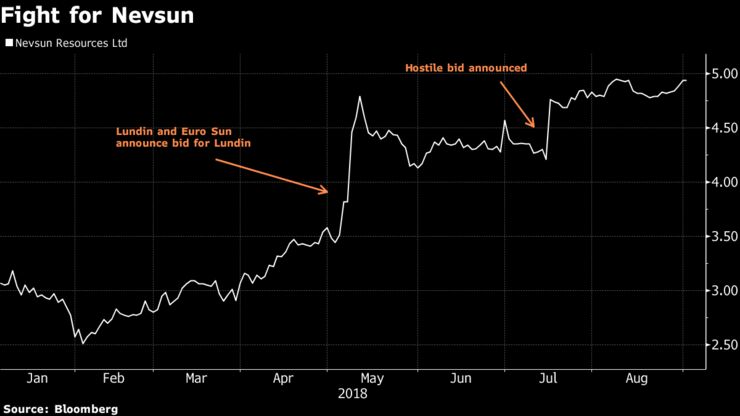
Zijin Mining Group Co. agreed to buy Nevsun Resources Ltd. for $1.41 billion to add copper assets in Serbia and Eritrea and enable the Canadian firm to ward off a hostile bid from rival Lundin Mining Corp.

Zijin, a Chinese gold and base metals producer, will pay C$6 per share in cash, trumping Lundin’s C$4.75 a share bid launched in July, the companies said Wednesday. Nevsun rejected repeated overtures from Lundin this year, saying that its offers undervalued the company and its assets.

Lundin Launches Hostile Bid After Nevsun Rebuffs Advances

The fight for Nevsun highlights how miners are scrambling to acquire copper reserves amid forecasts that supply of the metal used to make cables and wires will be tight in coming years on increasing demand for power generation and new energy vehicles. The company’s prized Timok copper-gold deposit is among just a handful of projects that aren’t already controlled by a big miner.

Lundin Chief Executive Officer Paul Conibear argued that his company was better positioned to provide the financing needed to develop Timok, as well as Nevsun’s Bisha mine in Eritrea. However, Nevsun CEO Peter Kukielski said last month the company had received interest from several companies and expected to find a better offer. Vancouver-based Nevsun’s board had spurned a joint offer made public in May by Lundin and Euro Sun Mining Inc. as “complicated” in structure and too low.

The deal also comes days after Zijin won a tender to buy Serbia’s state-owned RTB Bor. It offered to invest almost $1.5 billion in the country’s biggest mining and smelting company over six years, according to the energy and mining minister last week.

China’s Zijin Wins Serb Copper Miner Pledging $1.5 Billion

While mining companies are bullish on the longer-term prospects for copper, the price has slumped almost 20 percent in London this year as a strengthening dollar, escalating trade disputes and emerging market turmoil damped the outlook for demand.


The Zijin offer is a 57 percent premium to Nevsun’s closing price on May 7, the day before Lundin first publicly announced its intention to acquire the company. It is not subject to any financing conditions.

— With assistance by James Poole

Source=https://eritreahub.org/china-invests-in-eritreas-mining-buying-nevsun-to-obtain-bisha-mine

Russia In Talks With Eritrea To Set Up ‘Logistics Center’ On Red Sea Coast

September 01, 2018 01:20 GMT

Russian Foreign Minister Sergei Lavrov (file photo)


Russia is in talks with Eritrea to set up a logistics center at one of the North African country’s seaports, Russian news agencies cited Foreign Minister Sergei Lavrov as saying on August 31.

Eritrea occupies a strategically significant location on the Red Sea across from the Arabian Peninsula on a major shipping route between Europe and Asia.

Lavrov did not specify where the center would be located, but he said the project would be aimed at developing bilateral trade in agriculture and mining as well as helping Eritrea develop its transportation and energy infrastructure.

“A negotiation process is under way regarding the creation of a logistics center at one of the ports in Eritrea to boost our bilateral trade,” Lavrov was quoted as saying by Interfax, after talks with his Eritrean counterpart Osman Saleh in the Russia resort city of Sochi.

Lavrov said the center will advance “promising joint projects involving shipments to Eritrea of specific transport agricultural equipment,” as well as help Russian businesses establish contacts in the country, Interfax reported.

The Kremlin will be encouraging Russian companies to take part in African projects, including building regional transportation corridors and cross-border pipelines, he said, adding that the Eritrea region presents “excellent opportunities” for “economic integration” with Russia.

Russia has been pursuing closer ties with a number of African countries in recent months, including signing a military cooperation with the Central African Republic and developing closer military relations with Egypt.

The negotiations with Eritrea also come as Moscow is beefing up its naval presence in the nearby Mediterranean Sea, where Russian forces are backing Syria’s government in a seven-year civil war against Sunni rebels.

Based on reporting by Reuters and Interfax

Source: Shabait

Senior delegation on working visit to Russia

Asmara, 31 August 2018- Senior Eritrean delegation composed of Mr. Osman Saleh, Minister of Foreign Affairs and Presidential Advisor Mr. Yemane Gebrab is on a three-day working visit to the Russian Federation.

The delegation met and held talks today, 31 August in Sochi with the Russian Federation Minister of Foreign Affairs, Mr. Sergey Lavrov on the development of mutual relations and on issues of interest to both countries.


Eritrea Ethiopia flags

1 Comment

Eritrea-Ethiopia: A Confederation We Didn’t Vote On


Opening a dialogue with the Eritrean opposition is not “an issue at all for the people of this country.” Yemane Gebreab, presidential adviser
 
Eritrea’s rapprochement with Ethiopia may have removed the threat of conflict, but it poses a new challenge for the one-party Red Sea state that’s long prioritized a war-footing with its giant neighbor over democracy.
 

After decades of conflict and tension, the calm is a novelty for the nation that sits on a key shipping route to the Suez Canal and has known only five years of official peace since seceding from Ethiopia in 1993. After the two fought a 1998-2000 war, Eritrea stifled dissent and indefinitely suspended time-limits on national service, spurring tens of thousands of people to flee to neighboring countries and Europe.

Now, as Ethiopia’s leader promises multiparty democracy, a top Eritrean official says President Isaias Afwerki’s government will “have to respond and provide options for people to consider.”

Yemane Gebreab

Photographer: Fabrice Coffrini/AFP via Getty Images

“We want to create a situation of political participation of our population and we want to devise ways of doing that so people can have a say in how their country and their government is run,” presidential adviser Yemane Gebreab said in an interview in the capital, Asmara.

The ruling party is working on “political structures, forums, discussions” where “people could have an input — a say in their lives — in the administration of their country,” he said, without elaborating or providing a timeline.

Slow Process

Reform in Eritrea — home to an estimated 3.2 million people, according to its National Development Ministry — may prove slow for a country that lacks a working constitution, free press or independent civil society and has long been lambasted for its human-rights record by the United Nations and advocacy groups.

The government has said it’s planning political changes before: Yemane spoke of “an inclusive participatory process” in nation-building during a 2015 discussion forum in Vienna, and Isaias announced late 2014 that Eritrea was drafting a new constitution.

As recently as 2015, the UN listed Eritreans as the fourth-biggest group risking their lives to cross the Mediterranean, adding to Europe’s refugee crisis. Eritrea describes those fleeing as economic migrants, seeking salaries higher than the roughly $120-$270 per month paid in the army and civil service before automatic deductions for items such as housing.

Eritrea Port

Photogrpaher: MAHEDER HAILESELASSIE TADESE/AFP/Getty Images

“People are expecting some kind of democratic opening,” said Meron Estefanos, an Eritrean journalist and human-rights activist based in Sweden. “The hopes for change are very high.”

Eritrea, which is roughly the size of the U.S. state of Pennsylvania, has been under UN sanctions since 2009 because of allegations it supports Islamist militants in Somalia — a charge it argues is politically motivated. Ethiopia recently called for the embargo to be lifted.

Mining, Pipeline

The economy has been mostly isolated too, although Nevsun Resources Ltd.of Canada and China’s Shanghai Sfeco Group have mining operations with the state that are producing gold, copper and zinc, according to the Energy & Mines Ministry.

The new friendship with landlocked Ethiopia — which has Africa’s fastest-growing economy and a population of more than 100 million people — raises the prospect of it again using Eritrea’s ports. An oil pipelinebetween the nations is planned.

Multiparty elections planned in Eritrea’s neighbor may be a step “that works for Ethiopia,” adviser Yemane said. “We’re focusing on creating the ground here whereby all citizens can enjoy their rights. We want to free ourselves from prescriptions of dogmas. We want to craft a political situation that works for us here in Eritrea, that responds to the aspirations of our people.”

Abiy Ahmed, left, and Isaias Afwerki celebrate the reopening of the Embassy of Eritrea in Ethiopia in Addis Ababa.

Information Minister Yemane Gebremeskel said work will begin on the constitution soon.

The drafting process “was interrupted because of war, not because the government didn’t want a constitution,” he said. “It will be worked out, though unlikely before the end of the year with many priorities amid the dawn of peace.”

‘Wonderful Opportunity’

Adviser Yemane said the focus will be on economic, social and cultural development that was “held back for 20 years” and that peace gives “a wonderful opportunity.”

No one underestimates the challenges. Eritrea’s ruling People’s Front for Democracy and Justice is under the firm control of Isaias, the 72-year-old ex-rebel leader. Former high-level officials who’ve criticized his rule have been imprisoned and held incommunicado, according to New York-based Human Rights Watch.

A UN Commission of Inquiry on Human Rights in Eritrea in 2016 accused officialsof committing crimes against humanity, including enslavement, rape and murder over the previous quarter-century. Eritrea’s government rejected the report, saying it had “no solid evidence.” A 2017 study at the University of Leiden described a “complex regional system involving government officials, military personnel and criminal gangs” used to smuggle Eritreans abroad.

People walk in the streets of the Eritrean capital of Asmara.


No Rebel Dialogue

While Ethiopia’s political opening has included the government reaching out to opposition groups — including those it previously designated terrorists and were based in Eritrea — its neighbor hasn’t made similar overtures.

The presidential adviser says dialogue with Eritrean rebels hosted by Ethiopia isn’t “an issue at all for the people of this country.”

Eritrean opposition in the diaspora are planning to protest at the UN in Geneva later this month against the “undeserved sympathy” Asmara is getting from “regional and global actors” even as the human-rights and political situations remain unchanged, according to Harnnet, an opposition website.

If there is real change, then says Michael Woldemariam, assistant professor of international relations at Boston University, “the potential economic dividends for the Eritrean people are huge.”

“The movement of resources away from national defense to more productive economic activities will have a positive impact,” he said. “If combined with economic and political reforms, the possibilities for the country are limitless.”

Source=https://eritreahub.org/war-is-over-now-comes-the-hard-part-for-eritrea

EPDP Magazines