

Source: Eritrea digest
“In short, the issues we have with Eritrea remain: it is still holding US Embassy employees prisoners; it still won’t account for US citizens including Ciham Ali, and it is reputed to have 10,000 prisoners”
Source: Eritrea digest
“In short, the issues we have with Eritrea remain: it is still holding US Embassy employees prisoners; it still won’t account for US citizens including Ciham Ali, and it is reputed to have 10,000 prisoners”

New United Nations High Commissioner for Human Rights Michelle Bachelet has expressed excitement at the Eritrea – Ethiopia peace deal which she says must be a foundation for protection of human rights in both countries.
Bachelet said her outfit looked forward to the abolition of national service by Eritrea in the wake of peace and that Ethiopia will also scale up efforts to cure an acute internal humanitarian crisis.
She said her office stood ready to support any such efforts aimed at deepening the protection of human rights in both countries.
The Office stands ready to support both countries in protecting human rights. We particularly look forward to seeing an end to indefinite conscription into the Eritrean military.
Bachelet’s comments were part of her opening statement at the 39th session of the Human Rights Council on 10 September 2018. Her predecessor, Zeid Ra’ad al Hussein had in several statements bemoaned the falling human rights situation in both countries and tasked both governments to pursue concrete resolutions.
Ethiopia since April 2018 has been on a wave of speedy democratic reforms led by Prime Minister Abiy Ahmed. Political prisoners have been released en masse, laws are being scrapped and amended to open the democratic playing field especially ahead of polls in 2020.
Over in Eritrea, the government has given the strongest hint yet that an indefinite national service justified by threat of aggression from Ethiopia will soon be reshaped. A UN rapporteur has said the conscription amounted to slavery and crimes against humanity.
Asmara’s bad human rights record has included reports of how political opponents and journalists have been jailed. In some instances religious activists have also been detained according to rights groups.
Post the July 9, 2018 peace deal reached between Abiy and Eritrean leader Isaias Afwerki, political and human rights watchers are looking on as to how fast and when Asmara will roll out a democratic structure.
The Joint Declaration of Peace and Friendship signed in July between Eritrea and Ethiopia offers hope for an end to the decades-long stalemate between the two countries, which has had very severe impact on the people on both sides of the border.
The Office stands ready to support both countries in protecting human rights. We particularly look forward to seeing an end to indefinite conscription into the Eritrean military.
In Ethiopia, the Office has recently visited regions affected by intercommunal violence between the Gedeos and the Gujies communities, where recent clashes have reportedly forced over a million people to flee their homes.
We welcome initial steps taken by the Government and urge a thorough, impartial and independent investigation into the human rights violations which allegedly occurred, with full accountability for the perpetrators.
WASHINGTON (Reuters) - The top U.S. diplomat for Africa welcomed a rapprochement between Ethiopia and Eritrea ending two decades of hostility but said concerns over Eritrea’s human rights record hindered cooperation with Washington.
 FILE PHOTO: Eritrea's President Isaias Afwerki and Ethiopia's Prime Minister, Abiy Ahmed arrive for an inauguration ceremony marking the reopening of the Eritrean embassy in Addis Ababa, Ethiopia July 16, 2018. REUTERS/Tiksa Negeri//File Photo
The leaders of Ethiopia and Eritrea re-opened crossing points on their shared border for the first time in 20 years on Tuesday, raising hopes of reduced tensions in the region.
Tibor Nagy, the U.S. State Department’s assistant secretary for Africa, told a congressional hearing on Wednesday that the United States had “deliberately engaged” with Eritrea in recent months but it was too soon to talk about lifting United Nations sanctions imposed in 2009, which accused it of supporting Islamist militants in Somalia. Eritrea denied the charge.
Among concerns that the United States had raised with Eritrea was the detention of U.S. embassy local staff and several Americans for what Nagy called politically-motivated reasons.
The United States also wanted a full explanation from Eritrea over past weapons purchases from North Korea highlighted in a U.N. report, said Nagy, without elaborating.
He said the jailing of religious and political prisoners and indefinite, obligatory national service, as well as a tightly-controlled system of government were also a worry.
“Eritrea cannot assume that by saying wonderful things and opening good relations with the neighbors that will automatically lead to sanctions relief,” said Nagy, a former U.S. ambassador to Ethiopia.
“There have to be concrete actions taken and we will remain very engaged and say things that may not always be popular but have to be said,” he added.
Eritrea has long dismissed accusations of human rights abuses by the U.N., including alleged extrajudicial killings and torture, as “totally unfounded and without merit.”
The U.N. imposed sanctions on Eritrea in 2009, backed by 13 of the 15 members of the U.N. Security Council. The sanctions included an arms embargo, travel restrictions and asset freezes for some of the country’s top officials.
But warming ties between Eritrea and Ethiopia this year and sweeping reforms by Ethiopia’s new Prime Minister Abiy Ahmed have reshaped the political landscape in the Horn of Africa.
Abiy’s ruling coalition has ended a state of emergency and released political prisoners, while also announcing plans to partially open up the economy to foreign investors.
In his boldest move, Abiy offered last month to make peace with Eritrea, 20 years after the neighbors started a border war that killed an estimated 80,000 people. Full-blown fighting ended by 2000, but their troops have faced off across their disputed frontier ever since.
“Up to now for the last 20-plus years Eritrea has used Ethiopia as an excuse to maintain what I would almost call a ‘fortress state’,” Nagy said. “With the opening of peace they really will no longer have a reason to do that.”
Reporting by Lesley Wroughton, Editing by Rosalba O'Brien
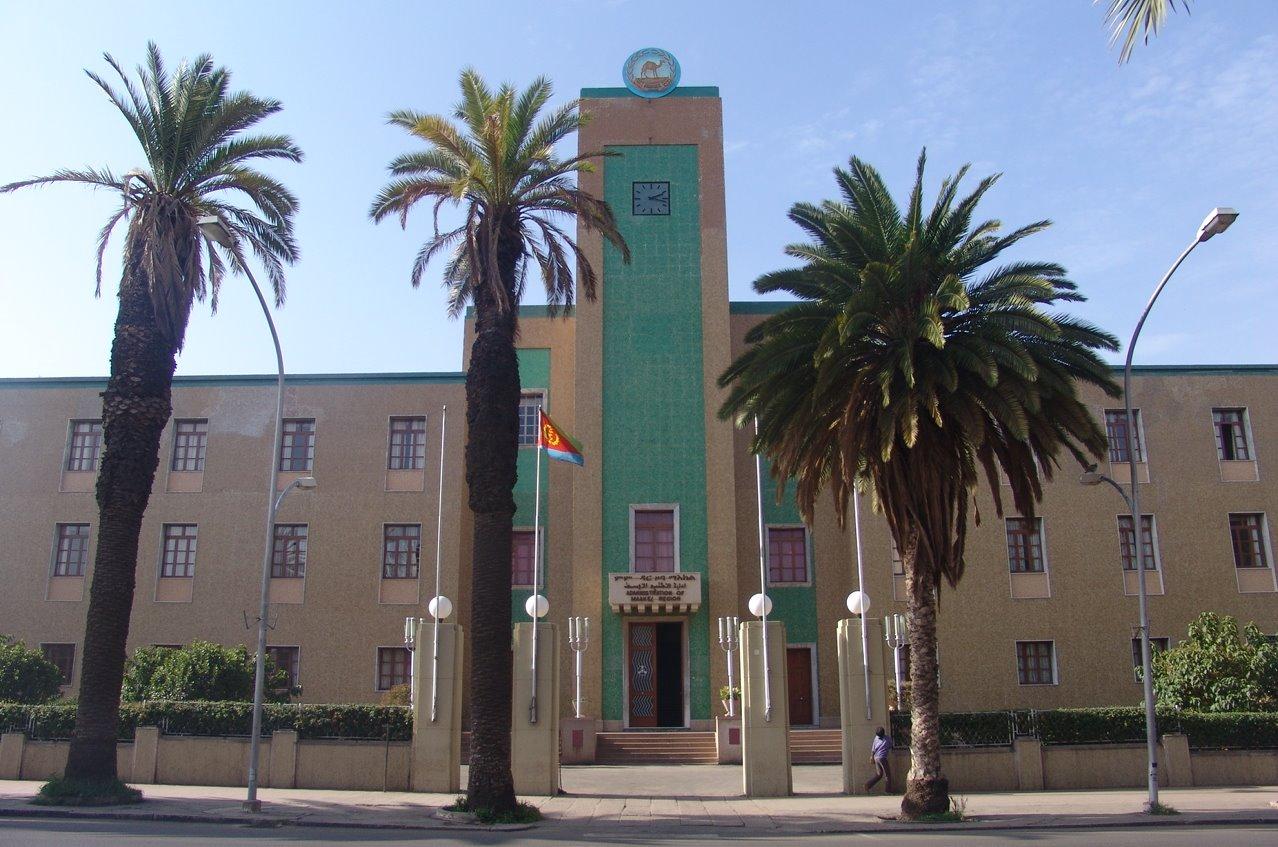
Eritrea’s government building in Asmara.
This is the fifth part of The Thin Red Line, an African Arguments series focusing on dynamics around the Red Sea.
Over the past few years, alliances and rivalries across the Horn of Africa have shifted significantly. This is perhaps nowhere clearer than in Eritrea, which has embodied the truism that counties have no permanent friends or permanent enemies, but only permanent interests.
Recently, those interests have led Asmara to make peace with Ethiopia after twenty years and improve its relations with others in the region. These breakthroughs have led to hopes that the government may soon enact long overdue reforms at home. After all, for two decades, its oppressive behaviour and economic woes have been blamed on hostility with Ethiopia and living a “bad neighbourhood”.
A closer look at the factors leading to Eritrea’s changing relations, however, dampen these expectations.
In the first few years of independence in the 1990s, Eritrea built its foreign ties on principles and loyalties. Though not always completely consistent, it shunned governments that had supported its rival liberation movement as well as monarchies or Islamist regimes deemed to be a threat.
Following the 1998-2000 border war with Ethiopia, these determinations quickly shifted. Tensions with neighbours Ethiopia, Djibouti and Sudan ratcheted up, while relations with the West took a turn for the worse. Under this growing international isolation and domestic pressure, foreign relations became more pragmatic. The goal became, first and foremost, about regime survival.
President Isaias Afwerki thus looked to cut deals with a range of other powers looking to extend their influence in the region. These partnerships range from China and Russia to Israel, Iran and Libya. From the mid-2000s, however, Qatar became particularly crucial to the maintenance of Afwerki’s increasingly repressive rule. The small Gulf nation provided essential and extensive financial and military assistance and became the Horn of Africa country’s most important economic partner.
In the early-2010s, this close relationship started to fray. Afwerki was reportedly angered by Qatar’s attempts to tame his recalcitrant behaviour and break Asmara’s long-running impasse with Ethiopia. He was additionally alarmed at the Gulf nation’s catalysing role in popular uprisings in the 2011 Arab Spring.
Eritrea therefore took the opportunity of increasing interest from Saudi Arabia and the United Arab Emirates (UAE) to shift its alliances. In 2015, it signed a security partnership agreement allowing the UAE to build a military base in Assab for its war-effort in Yemen. Afwerki’s new allies agreed to provide significant financial aid, build infrastructure in Eritrea, and increase fuel supplies to the country. Eritrea provided land, airspace and also reportedly deployed around 400 of its own troops to Yemen.
Saudi Arabia and the UAE quickly became essential partners as Eritrea switched allegiances. The extent of this change was clear in the 2017 Gulf crisis when the government threw its weight behind the Saudi-led camp in its attempts to isolate Qatar.
In the last couple of years, Asmara has also given the cold shoulder to this bloc’s regional rivals. It has cut off military and diplomatic relations with Iran, whose nuclear programme Afwerki had publicly defended in 2009, and snubbed Turkey in its attempts to extend its influence in the Horn. At the same time, Afwerki has visited Egypt, an affiliate of the Arab axis, on several occasions and supported Cairo in its diplomatic row with Ethiopia and Sudan regarding the Nile waters.
All these foreign policy changes have been significant for Eritrea. But perhaps the most momentous shift has been its rapprochement with Ethiopia after twenty years of hostility. Beginning this June, the two neighbours ended their long-standing stalemate and promised to open a new chapter of peace.
This understandably rocked the region. The conflict has cast a shadow over the Horn of Africa for two decades. Ethiopia has used the dispute to encourage others to isolate Eritrea. Meanwhile, Afwerki has used Ethiopian hostility as a pretext for widespread prohibitions on freedoms, the banning of the free press, and the imposition of indefinite military service at home.
Following the announcement of peace, and Ethiopia’s calls for the UN to lift sanctions on its neighbour, it was understandable that many were excited an opening up of Eritrea might be in the offing.
However, there are reasons to be sceptical this change is coming.
Firstly, this development is related to Eritrea’s broader relations across the Red Sea, and therefore the dynamics and interests these contain.
As documented in the Thin Red Line series, the Red Sea has regained its geopolitical significance recently with rival powers scrambling for strategic footprints on the sea’s western shores. Different competing blocs have built allegiances – bolstered by attractive economic deals – from Egypt down to Somalia, gaining leverage over many of their new partners. Some African countries, most notably Ethiopia, have been able to stay independent in the face of this attention, but others have struggled. Eritrea has clearly thrown in its lot with the Saudi bloc to which it is reliant and indebted.
These patrons, however, have little interest in Eritrea undergoing reforms, which might risk its internal instability. After all, the Gulf’s engagement is not based on principles but self-interest. For various reasons, a rapprochement between Addis Ababa and Asmara was deemed to serve these interests; Emirati leaders notably met with Ethiopia’s Prime Minister Abiy Ahmed and President Afwerki on several occasions in the run-up to the announcement of peace. But democratisation in Eritrea is unlikely to. In fact, the opposite may be true.
In this way, Eritrea and Ethiopia’s peace can be seen as part of wider Red Sea dynamics, rivalries and interests being projected onto the Horn, which are more likely to raise tensions in an already volatile region than encourage democratisation.
Secondly, the reality is that as long as Afwerki remains at the helm, it is difficult to see genuine reforms happening. For a whole generation, the president has suspended Eritrea’s democratisation and cracked down on any dissenters in order to maintain his rule.
Former foreign minister Petros Solomon, a member of the G-15 opposition who disappeared in 2001, once claimed that Afwerki’s foreign policy was erratic and that the ministry’s main job was simply to do damage control. But this underplays the underlying logic of the president’s approach to foreign relations, which has mostly been about his own survival. Previously, hostility with Ethiopia served this purpose. Under new circumstances, Afwerki has deemed that a UAE-brokered peace is advantageous. But the ultimate motivation is the same.
Eritrea’s lucrative alliances with powers across the Red Sea may have precipitated some sweeping changes in its foreign policy, but they have also bolstered the president’s position domestically. In fact, rather than pushing for change, they have given him a new lifeline. Afwerki’s new partnerships have allowed him to avoid the economic and political liberalisation that Western donors or continued misery might have demanded, and they have fortified his security and military base against direct threats or internal demands for reforms.
Source=https://africanarguments.org/2018/09/12/eritrea-why-change-abroad-change-home/
|
|
Unsubscribe to no longer receive posts from Eritrea Hub. Trouble clicking? Copy and paste this URL into your browser: |

Source: Exile
Diplomats and representatives of international aid organizations who were posted in Eritrea in the 1990s will remember Berhane Abrehe as the stern head of the Macro Policy and International Cooperation department. Mr. Abehe later served as finance minister until his mysterious fadeout in 2014. It is not uncommon in Eritrea, indeed rather the norm, for senior officials to be fired or simply sidelined, and for new ones to replace them, without any official announcement. It was soon revealed that Mr. Abrehe had for some time been at odds with the leader of the Eritrean regime, president Isaias Afwerki, over key aspects of economic policy and broader governance issues. He had, especially, made it clear that he could not be accountable for policies for which he had increasingly been only nominally in charge. Particularly at issue was revenues from the new gold operations and other mining activities, as well as a range of public enterprises, which are controlled, not by the Ministry of Finance, but the economic affairs office of the ruling PFDJ party, and hence, not subject to regular government oversight. The PFDJ economic affairs office is headed by Hagos (Kisha) Gebrehiwet, a member of the President’s inner circle.
In the last couple of weeks, Eritrean social media has been abuzz with news about a new two-part book that the former minister has authored, in which he severely criticises Isaias’ one-man rule. And just two days ago, Mr. Abrehe, who still lives in Asmara, released an audio message confirming his authorship of the book and reiterating his views on Isaias Afwerki and the general conditions of his country. He did not mince words!
Mr. Abrehe had messages for both the Eritrean public and Isaias Afwerki. Addressing Eritreans within the country and outside, he stated that the dire conditions they find themselves in because of Isaias’ repressive and dictatorial rule should change; and reminded them that only they can bring about that change.
He called on Mr. Afwerki to convene urgently the National Assembly [parliament] “for there are many important issues that we need to address” without delay. “You have no reason to dilly-dally anymore.” Even if several members of the legislature have died, and many others are behind bars or forced to flee the country, he told the President, it’s incumbent on you to do the only sensible thing and call all remaining members to meet immediately.
He further called on Isaias to stop, until proper National Assembly authorization is obtained, the ongoing non-transparent and haphazard diplomatic contacts, sanctioned by no authority but Isaias himself, and about which the Eritrean public has been kept in the dark, as well as the signing of hasty agreements that could potentially compromise Eritrea’s national strategic interests.
Mr. Abrehe also invited Isaias Afwerki to a public debate between them proposing a range of topics including the past, present and the prospects of Eritrea’s political, economic, social and cultural realities.
He reminded Mr. Afwerki that, once convened, the National Assembly is bound to take key decisions, including: 1. in a peaceful, legal and civilized manner remove Mr. Afwerki from his position as head of state and chairman of the National Assembly and replace him with a new leader; 2. holding of national parliamentary elections at the earliest possible time; and 3. pass other important and timely resolutions.
Mr. Abrehe concluded by reiterating that the owners of the coming change are Eritreans themselves, and not Isaias or any other individual or group; and those who would try to stop the coming wave will fail, as they would be faced with the wrath of the Eritrean youth.
Source=https://eritreahub.org/former-eritrean-minister-of-finance-challenges-isaias-afwerki-to-step-down
 Eritrean and Ethiopian commanders meet at Zalanbessa as defensive positions are removed ahead of New Year celebrations
Source: Human Rights Concern Eritrea
Following the recent rapprochement between Eritrea and Ethiopia dated 7 July 2018, a number of media commentators, diplomats and foreign government officials have expressed hope that the political situation in Eritrea would be normalised soon. Attention must be given to the system of arbitrary and indefinite national military service programme of the government of Eritrea.
The National Service programme is characterised by forced conscription, persistent human rights violations and slavery. It is the main reason behind Eritrean migrant exodus witnessed over the course of the last two decades. (See the findings of the UN Commission Of Inquiry).
The hope is that the programme would cease to be indefinite and that the period of service would be limited to 18 months. For Germany’s development minister, Gerd Mueller, who personally met President Isaias Afewerki on 24 August, his hopes go further and he predicts the introduction of “democratic structures” in Eritrea soon.
This far, there is no material evidence to justify the hopes expressed by media commentators and foreign government officials like Minister Gerd Mueller. Their hopes appear to be based merely on their personal encounters with Eritrean officials, or perhaps on the contents of the series of interviews made by Eritrean officials with international media outlets.
From long experience, Eritreans do not take statements made by Eritrean officials seriously, simply because of the constant inconsistencies and discrepancies between words and actions. Above all, the promises they make normally do not materialise.
Nevertheless, in so far as they appear to draw the attention of international media and foreign government officials, perhaps it is important to review the statements made by Eritrean officials over the course of the last four years.
Statements of Eritrean Officials
Concerning a transition to a constitutional governance in Eritrea, in May 2014, in an interview with local media, President Isaias Aferwerki announced the “death” of the 1997 constitution – a constitution that was ratified in 1997 but never implemented. Instead he promised the drafting of a brand-new constitution.
Two years later, in February 2016, a Presidential Adviser, Yemane Gebreab, informed the UN Commission of Inquiry that a committee was established to consider the drafting of a new constitution. Four years since this initial announcement, what happened to this “new” constitution? Or is there any “new” constitution at all?
With regard to the programme of national military service, in April 2015, in an interview with the Bruno Kreisky Forum for International Dialog, Yemane Gebreab stated that Eritrea would limit national service to 18 months, in line with the provisions of the 1995 decree. He also added that “the challenge is to be able to find jobs, skills, training and business opportunities when conscripts are released”, indicating that the problem is mostly an economic issue.
However, after one month, Yemane Gebreab’s assertions were contradicted by a Ministry of Foreign Affairs’ press statement released in June 2015, which made it clear that there are no plans to limit the period of National Service to 18 months, owing to Ethiopia’s refusal to abide by the decision of the Border Commission.
Similar assertions were made by the Information Minister, Yemane Gebremeskel, in February 2016, in an interview with Reuters in which he stated that there were no plans to limit national service, and that “demobilisation is predicated on removal of main threat”, that threat being Ethiopia’s refusal to withdraw its troops from Eritrean territories. In the same month, President Isaias made an announcement of salary increases to conscripts. It is important here to note the pattern – “we-will-limit, we-won’t-limit, and salary-increase”.
With peace declared between Eritrea and Ethiopia in July this year, similar statements are once again emerging from Eritrean officials, and following the same pattern observed in 2015/16.Immediately after President Isaias announced his impending visit to Ethiopia, it was reported that officials at Sawa military training camp informed new conscripts that National Service will be limited to 18 months. The news found its way to international media and produced some level of jubilation.
Information Minister Yemane Gebremeskel was aware of the reports, and he stated that “an official announcement has not been made so far”, suggesting that such an announcement would be imminent.
Later in August, Yemane Gebremeskel told Bloomberg that “work on the constitution would begin soon”, indicating that whatever the President and his Adviser had said about a “new” constitution thus far had been nothing but another empty public relations exercise.
On 25 August 2018, the Eritrean Foreign Minister, Osman Saleh Mohammed, met with the German minster, Gerd Mueller. Mohammed appeared so emboldened that after the meeting with Minister Mueller, he held an interview with the Germany radio service (Deutsche Welle). In the interview, he blandly stated that his government was not the cause of the Eritrean migrant exodus, as if the national service decree has been implemented in Eritrea by the German government! Implicitly indicating that the political situation of Eritrea is back to normalcy (or national service is limited to 18 months), he also called for Eritrean migrants to come back home.
A new addition to the “discourse” (a discourse normally carried out by the president, the Minsters of Information and Foreign Affairs, and the presidential adviser) is the Minister of Labour and Human Welfare, Mrs. Luul Gebreab. On 2 September, Mrs. Gebreab told Bloomberg that Eritrea will cut its army numbers and that the remaining conscripts “will concentrate on developmental work”. Like the excuses presented by Yemane Gebreab in 2015, she also stated that the government is studying the “economic effects of demobilization”, i.e. issues concerning to availability of employment for conscripts.
At the same time, Yemane Gebremeskel asserted (also to Bloomberg)that at the moment there is no prospect of returning to “statutory” terms of 18 months national service. Instead he raised the matter of reviewing and considering salary increases for conscripts. It is important to note that conscripts are normally deployed (with no more than nominal pay) in every sector where labour is needed – be it in the army, construction companies or civilian administration.
Bloomberg has learned that Eritrean officials maintain the position that “demobilisation depends on Ethiopia concluding its parts of the peace deal and withdrawing its troops from Eritrean territories”. This means that conscripts will not be free until such time as Ethiopia acts in a specific way. In this way, the officials are determined to convince everyone that the “Ethiopian threat” persists. With the issue of “salary increases” again raised, the repeated pattern of delay and excuse becomes complete.
The National Service: what is it?
For nearly three decades, Eritrea has indeed faced a human tragedy of epic proportions where thousands were subjected to a practice of slavery and servitude, many lost their lives in wars, and a significant proportion of its population was forced to flee the country at great cost to preserve their lives. Central to all of these tragedies is the programme of national military service, and as such it is quite normal to see the issue receiving constant international coverage.
However, there appears a flawed understanding of what exactly the programme is, especially among those who report it; a misconception that appears to exist among diplomats and government officials, such as Gerd Mueller, who therefore simply propagate unrealistic hopes.
The National Service programme started in 1994 with a different proclamation from that of 1995. The first proclamation (71/94) strictly limited the period of national service to 18 months. Supported by the then dominant narrative of “liberation struggle”, it was warmly accepted by the Eritrean society without any noticeable form of resistance. But by the end of 1995, that decree had been quietly rescinded and replaced by the infamous 1995 proclamation (82/95).
By incorporating a provision known as “special obligation” (Article 21(1)), the 1995 decree subjects every adult citizen to its draconian administration, where everyone is duty bound to “serve as a volunteer” for the whole of his/her adult life. To use a more precise definition, for Eritreans the decree effectively stripped their citizenship status from them and turned them into stateless slaves.
One can thus see that the process of building an institution of forced conscription and slavery started long before the “border war” with Ethiopia, with the quiet implementation of the 1995 decree. Slowly over the years, it ensured a Master-Slave relationship in which Eritreans have effectively become the personal property of the president that can be sent to different wars and whose labour can be exploited at a whim for the benefit of the president and his loyal lieutenants. Additionally, it provides the president with a political tool that ensures effective crowd control. (One has only to refer to the list of testimonies submitted to the UN Commission of Inquiry to learn how a certain lieutenants or administrative office-bearers personally benefit from having conscripts under their command).
Parallel with the institution of slavery, a culture of terror has also been established to silence any voices and/ or to curb any actions that appear to resist the system of institutionalised slavery. This system is propagated through a network of national security agents, and a franchise of torture and imprisonment of hundreds at concentration sites countrywide.
A whole list of abuses and crimes against humanity continue to be committed under such institutions of terror and slavery. The Eritrean migrant exodus which the world has witnessed over the last decades is fundamentally a result of such inhumane practices.
We now hear Eritrean officials and international commentators suggesting the return to “statutory” terms of 18-month national service. One wonders whether this means a return to the original 1994 decree or a partial implementation of the 1995 decree? Most importantly, is that truly a solution for the tragedy?
Again, there are persist statements which indicate the economic challenges the government is facing as far as demobilisation of conscripts is concerned. For the outside world, this presents an image of a caring government that is concerned about the future of the conscripts once they are free. But for those who are going or have gone through the institutions of slavery and terror, now only too well that the president and his military commanders are worried about the loss of personal, political and economic benefits as a result of the loss of slave or conscript labour.
One may be tempted to present question to Minister Gerd Mueller and others who are propagating hopes of democratic change in Eritrea: “Why would a Master opt to free his slaves when the consequence of doing so is a loss of personal political and economic benefits? Would appeasing such a slave-master, giving tax payers’ money to him, and providing material and political incentives to that Master, help to free the slaves? Wouldn’t it be much more appropriate to support and empower the slaves to free themselves, or to support those who are fleeing persecution as refugees in Europe and elsewhere?”
In the end, it is perhaps important to recognise that the pressing political issue in Eritrea is a question of citizenship status, which can only be addressed by the introduction of a truly democratic constitutional system that guarantees the enjoyment of citizenship rights. The first step is therefore to put such a constitution in place. To put it in simple terms, the slave must be upgraded to a citizen.
—
Human Rights Concern – Eritrea (HRCE)
Source=https://eritreahub.org/eritreas-promises-of-internal-reform-but-what-about-delivery
New post on Eritrea Hub |
|
There has been growing concern about the fate of refugees trapped in Libya. Now there is a call for action.

Here is a report from the Irish Times.
For refugees and migrants in Libyan detention centres, a phone marks the difference between life and death. They’re carefully hidden, topped up by contacts in other parts ofLibya, and charged in secret, wherever electricity can be found.
At no time has this been more obvious than since fighting broke out 10 days ago.
As a state of emergency continues in Tripoli, and fighting escalates quickly, thousands of migrants and refugees previously held in detention centres have been scattered across the city, all desperate to stay alive.
The Irish Times is in touch with at least five groups, who have used smartphones to message about everything from a lack of food, to looters, bomb blasts and attacks by armed men, to how they feel they’ve been abandoned by the United Nationsand other international organisations.
Since fighting erupted on August 26th, between rival armed militias vying for control of Tripoli, many of the estimated 8,000 refugees and migrants in official detention centres have been “released”, moved to different locations, or have escaped and are now sleeping on the streets.
Many were never registered by the UN – despite regularly asking for it – and detention centre managers say they have no lists of who exactly was in their centres. This means it is impossible to know the number that have already disappeared.
Some aid workers suggest detention centres obscure this information deliberately. Migrants and refugees have been known to pay their way out (the going rate is $20,000 [€17,000]said one Eritrean) or they’ve been sold to traffickers or to rich Libyans as slaves. A migrant can be sold as forced labour for as much as $600, said a Libyan aid worker. Now the fighting is fierce, consequences can prove deadly.
Source=https://eritreahub.org/eritreans-trapped-in-libya-join-the-london-call-for-action
Yemane Gebremeskel – Eritrea’s Minister of Information – has tweeted that this visit is under way.

The decision to send the ministers comes after the signing of a tripartite agreement between Eritrea, Ethiopia and Somalia. [See below]
And after the Ethiopians and Somalis urged Eritrea to make peace with Djibouti.
The background to the Djibouti mission is the conflict between Eritrea and Djibouti that erupted in 2008.
For many years it has been a source of tension in the region and was an outstanding issue, after Eritrea and Ethiopia signed a peace deal earlier this year.
The Djibouti-Eritrea question was also the reason why UN military sanctions against Eritrea were not lifted – despite UN monitors declaring that Eritrea was no longer aiding the Somali Islamist group, Al-Shabaab.
Considering that the peoples of Ethiopia, Somalia and Eritrea share close ties of geography, history, culture and religion as well as vital common interests;
Respecting each other’s independence, sovereignty, and territorial integrity;
Desiring to bolster their historical ties to achieve their lofty objectives;
The Governments of Ethiopia, Somalia and Eritrea have reached the following agreement that reflects the aspirations of their peoples:-
1. The three countries shall foster comprehensive cooperation that advances the goals of their peoples.
2. The three countries shall build close political, economic, social, cultural and security ties.
3. The three countries shall work in coordination to promote regional peace and security.
4. The three governments hereby establish a Joint High-Level Committee to coordinate their efforts in the framework of this Joint Declaration.
Done in Asmara, September 5, 2018
For the Federal Democratic Republic of Ethiopia
Prime Minister Abiy Ahmed
For the Federal Republic of Somalia
President Mohamed Abdullahi Mohamed
For the State of Eritrea
President Isaias Afwerki


