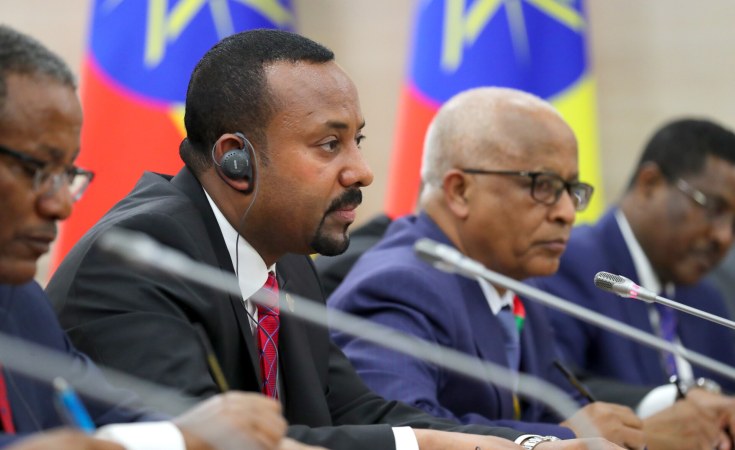
Source: ACAT-Switzerland

Berne, 26 January 2021

... Without losing face

The Ethiopia and Eritrea policy of the Swiss migration authorities has failed

Despite increased promises of financial assistance in case of a voluntary return, e.g. in the canton of Bern (February 2020), rejected Eritrean asylum seekers do not return to their home country, even though the State Secretariat for Migration (SEM) and the Federal Administrative court (FAC) consider that such a return is “possible, reasonable and admissible”.

And despite a readmission agreement concluded by the EU and Switzerland with Ethiopia, only a handful of people have been forcibly returned to that country since Prime Minister Abiy Ahmed came to power in April 2018.

The fear of the arbitrary rule of Eritrea’s dictator Afewerki and his unlimited military service, or of the unpredictable situation in Ethiopia, a multi-ethnic state already described by analysts as the future Yugoslavia, appears to be stronger than the despair at the idea of having to vegetate under the emergency aid system in Switzerland for an unpredictable number of years or to live under unimaginable conditions in a neighboring country in hopes for a passage to the United Kingdom.

While the human rights situation in Eritrea remained unchangingly dire despite the peace agreement with Ethiopia, even the sweeping reforms in the latter, Eritrea's large neighbor, did not bring about what the SEM and the FAC had hoped for.

War is now raging in the north of the country – temporarily limited and strictly targeted though, according to Prime Minister Abiy – but is led with the involvement of the dictator from Asmara, who carries out attacks against the renegade Tigray militias from the north.

These attacks are led by Eritrean youths, some of them only 14 or 15 years old, having been hastily rounded up and loaded on trucks in nationwide raids and who are now being driven towards the border as cannon fodder in front of the Ethiopian troops or mixed with Ethiopian soldiers.

Because of this ill-fated pact with Eritrea, Prime Minister Abiy’s assertions of a quick and clean war have lost all credibility.

On the one hand, the Tigray militias will most likely retreat to the surrounding mountains after the capture of the provincial capital Mekele, in order to wage guerrilla warfare from there, possibly for months or years; on the other hand, an estimated number of 100,000 Eritrean refugees are now being trapped between the fronts.

Initial reports about abductions from the UNHCR refugee camps in the Tigray area by Eritrean soldiers have already been published.

Moreover, this institution has had no news of these refugees since the beginning of the Ethiopian offensive and  has not been able to supply them. The United Nations still does not have access to Tigray, despite an agreement reached with Ethiopia in early December.

What will Prime Minister Abiy do with these refugees?

He has already banned all Eritrean opposition groups from Ethiopia, as dictator Isaias Afewerki has demanded.

In a further step, will Abiy now go so far to hand him the Eritrean refugees over at his disposal – maybe as a gesture of gratitude for his cooperation against the Tigray troops?

How does the winner of the Nobel Peace Prize intend to get out of this dilemma?

And how will the other ethnic groups position themselves in the multi-ethnic state of Ethiopia?

Have their demands for autonomy and self-determination fallen silent now that their leaders are imprisoned or under house arrest for the sake of unity?

Or will Prime Minister Abiy, in a not distant future, become dependent on Isaias' half-starved troops, in order for instance, to bring Oromo insurgents under control in the south of the country?

And how does Switzerland position itself in this opaque game for power and influence at the Horn of Africa?

Its migration authorities, including the FAC, act as if nothing has happened.

Still, asylum complaints of Ethiopian Oromos – even if they assert their political persecution with strong evidence – are dismissed as not credible.

Hardship applications by Eritreans are informally written off without further justification despite promises of employment.

And for the many rejected asylum seekers, who are living in the woods around Calais and Dunkerque and are regularly shelled with tear gas by the French police special task forces (CRS), no one wouldn't want to take on any responsibility.

How much longer does Switzerland intend to hide its head in the sand and thereby ruin the future of countless young and healthy people?

Wouldn't it be now the time to finally regularise the residence status of these people who had come to Switzerland from Ethiopia and Eritrea during 2014 to 2016 and reconsidering their case, admitting that a return to their country is currently not reasonable?

Now is the time to act before they are completely ruined mentally and physically!

The stabilisation of the "steam pan" Ethiopia, with its dozens of ethnic groups, forcibly held together under emperors and military regimes, will take a long time – if it succeeds at all.

The human rights' situation and disastrous living conditions in Eritrea will not improve as long as dictator Afewerki remains in power.

Switzerland may continue to wait and see, while those affected remain trapped in the emergency aid system under inhumane conditions. Or it can face the facts and finally act proactively, admitting that democratisation takes time – time which is irreversibly slipping through the fingers of those rejected and caught in the humiliating trap of the Swiss emergency aid system.

Now is the time to legalise their status, without the SEM and the Federal Administrative Court losing face!

The escalation of violence in northern Ethiopia has become completely unpredictable, which is an absolutely convincing argument for such a step.

Hardly anyone would bother to come up with sources that might seriously challenge this assessment.

No. No one needs to lose face if, in an act of humanity, countless young people are finally given the chance to complete their vocational trainings and build their futures in Switzerland, all by means of a reality-based legal adjustment of practice.

For a change, we Swiss Citizens could be again rightly proud of our much-praised humanitarian tradition, which has been lately set aside!

ACAT - Switzerland

Speichergasse 29, CH-3001 Bern

http://www.acat.ch

This email address is being protected from spambots. You need JavaScript enabled to view it.

+41 (0)31 312 20 44

Co-signatories: and experts

Aktionsgruppe Nothilfe

Alternative Liste Zürich

Association «Alle Menschen / tous les êtres humains» Biel/Bienne

Association Be a Robin

Association Dachstock

Association Kontakt- und Beratungsstelle für Sans-Papiers Luzern

Association Miteinander Valzeina

Association Netzwerk Asyl Aargau

Association Suisse Erythréenne Pour l'Entraide (ASEPE)

Association voCHabular

Barbara Durrer, teacher, Berne

Barbara Feichtinger, theologian, St. Gallen

Bistro Interculturel Nidwalden

Comité de soutien aux érythréen.ne.s

CPRSI - Commission protestante romande Suisses-Immigrés

Demokratische Jurist_innen der Schweiz DJS

Denise Plattner, supporter of various NGO

Derya Dursun, trade unionist at Unia Neuchâtel Region/IG Migrants

Deutsch zentral - free German courses for migrants

Dr. Chika Uzor, refugee and chaplain, St. Gallen

Dr. Nicole Hirt, political scientist and Horn of Africa expert

Droit de Rester Neuchâtel

Eritreischer Medienbund Schweiz

ExilAktion

Fachstelle Migration der Reformierten Kirchen Bern-Jura-Solothurn

Give a Hand.ch

HelloWelcome, Luzern

Human Rights Concern-Eritrea (HRCE)

Ines Buhofer, theologian, Lucerne

Jesuit refugee service Switzerland

Jürg R. Schweri, voluntary support for many refugees, Zollikofen

L'AMAR

Luzerner Asylnetz

Maria Ocaña, parish employee, Bellmund

MAXIM Theater

Network migrationscharta.ch

Raphael Strauss, specialist for asylum social assistance, Bern

Riggi-Asyl

Roman Rieger, theologian and city chaplaincy director, Mörschwil

Samson Yemane, student of political science, collaborator of the Swiss Refugee Council, Eritrea

human rights activist

Sans-Papiers Anlaufstelle Zürich SPAZ

Solidaritätsnetz Ostschweiz

Solidarité Tattes, Geneva

Solinetz Zürich

solinetze.ch

Swiss Peace Council, Zürich

Women for Peace Switzerland

Ethiopia Sets Pre-Condition for Dialogue With Sudan

Thursday, 28 January 2021 00:09 Written by

Ethiopia's Prime Minister Abiy Ahmed, second left, during a meeting with Russia's President Vladimir Putin on the sidelines of the 2019 Russia-Africa Summit (file photo).
26 JANUARY 2021
 

Ethiopia on Tuesday set a pre-condition outlining what it wants if it is to engage in negotiations with Sudan over their border dispute.

According to State media reports, the government will only begin talks when the Sudanese side goes back to the status quo ante, an Ethiopian news agency quoting Ministry of Foreign Affairs Spokesperson Dina Mufti, said today.

"Our precondition to carry out the negotiations with the Sudanese side is return to the status quo ante. Then we will discuss the border issue," he said.

Mr Dina stressed that there won't be any dialogue with Sudan unless the latter pulls its forces out of occupied Ethiopian territories.

While commending the initiative of actors who have been trying to settle the dispute through dialogue, Mr Dina stated that Ethiopia "is always ready to settle border issues through normal mechanisms that have already been schemed out".

Source=Ethiopia Sets Pre-Condition for Dialogue With Sudan - allAfrica.com

Four retired US ambassadors to Ethiopia write an open letter to Prime Minister Abiy Ahmed (PhD) stating their concerns about recent political developments in the country.

The letter sent exclusively to The Reporter is signed by Ambassadors David Shinn, Aurelia Brazeal, Vicki Huddleston, and Patricia Haslach.

The full content of the letter is presented below.

Open Letter to Prime Minister Abiy Ahmed from retired U.S. Ambassadors to Ethiopia

January 21, 2021

Dear Mr. Prime Minister:

We are former ambassadors who have served in Ethiopia during various political crossroads, and each of us are forever inspired by the resilience and principles of the Ethiopian people. At present, we are deeply concerned about the stability and future of Ethiopia, and so have taken the liberty to write to you about our concerns.

We have watched the conflict in Tigray with grave unease as, according to the United Nations, nearly 60,000 refugees have fled to Sudan, 2.2 million people have been displaced, and 4.5 million people need emergency assistance, many of whom are without adequate food. We are also worried about the reported presence of Eritrean troops in Tigray, which could jeopardize Ethiopia’s territorial integrity.

We are concerned about the worsening ethnic tensions throughout the country, reflected in the proliferation of hate speech and rising ethnic and religious violence. Based on our time in your country, this growing violence seems to us to be contrary to Ethiopia’s long-standing tradition of tolerance for diverse religions and ethnicities. 

It is our hope, Mr. Prime Minister, that your government will ensure the protection of civilians, the independent investigation of human rights violations, and unrestricted access for the United Nations and other relief agencies. We would like to repeat the advice we often heard during each of our tenures in your country: Ethiopia needs a national dialogue designed to bring together all sectors of society. We wish you and every Ethiopian the very best.

Sincerely,

Hon. David H. Shinn
Ambassador: July 1996-August 1999

Hon. Aurelia E. Brazeal
Ambassador: November 2002-September 2005

Hon. Vicki J. Huddleston
Chargé d’Affaires: September 2005-November 2006

Hon. Patricia M. Haslach
Ambassador: September 2013-August 2016 

Source=Retired US Ambassadors to Ethiopia write an open letter to Prime Minister Abiy | The Reporter Ethiopia English

JANUARY 25, 2021  ETHIOPIANEWS

Source: Union of Catholic Asian News

Prime Minister Abiy Ahmed launches military action against the Tigray People’s Liberation Front

Fredrick Nzwili, Catholic News Service

Updated: January 23, 2021 07:54 AM GMT

Ethiopian Bishop Tesfaselassie Medhin of Adigrat. (Photo: Amecea News Blog)

Massive damage and looting has occurred in Adigrat, a diocese in Ethiopia’s semi-autonomous region of Tigray, where the government launched a military offensive nearly two months ago, reported a delegation from the Ethiopian bishops’ conference.

Cardinal Berhaneyesus Souraphiel, conference president, sent the delegation to the diocese in mid-January, with instructions to visit and physically see Bishop Tefaselassie Medhin of Adigrat.

Father Teshome Fikre Woldetensae, secretary-general of the bishops’ conference who led the delegation, said the bishop is safe and in good health, but his diocese is reeling from destruction that will take a long time and cost the church millions to repair.

Fighting in Tigray started Nov. 4 after Ethiopian Prime Minister Abiy Ahmed Ali sent the federal army to fight the Tigray People’s Liberation Front, which he accused of attacking an army base in the capital, Mekele. On Nov. 28, the government recaptured Mekele.

Bishop Medhin’s safety had become an issue of concern after he was cut off from the rest of the church due to fighting.

The delegation reported a church compound in the diocese was used as a military command center, even when the parish priests and the Daughters of St. Ann were staying there. The priests and the nuns witnessed heavy fighting.

“Adigrat minor seminary building and water tanker (are) partly damaged by the shelling fragments of the explosives, chapel at the cemetery is partly damaged, and windows … of the high school are damaged and broken,” said the report of the delegation. It also spoke of damage to a nearby Orthodox church and mosque as well as damages to church buildings.

The Catholic Church report comes amid international media reports that churches and mosques in northern Tigray were attacked, with sacred treasures, including ancient manuscripts, damaged or looted.

The team also said the administration offices and classroom buildings at Wukro St. Mary’s Catholic College were broken and looted, with laptops and computers stolen. Trees in the college were dying, the report indicated, after the solar panel, which provides power to supply the college with water, was stolen.

Delegation members spoke to officials of the U.S.-based Catholic Relief services, which had reached 50,000 people with food in Mekele. More people were targeted for food distribution.

At a meeting with the interim administration, government officials said 4.5 million people needed emergency support all over Tigray.

JANUARY 25, 2021  ETHIOPIANEWS

Questions by Lord Alton, Vice-Chair of the All Party Parliamentary Group for Eritrea in the UK Parliament and responses from the British Government

Lord Ahmad of Wimbledon, the Foreign, Commonwealth and Development Office, has provided the following answer to your written parliamentary question (HL12040):

Question:
To ask Her Majesty’s Government what assessment they have made of reports of a mass killing on 15 December 2020 at the Mariam of Zion church in Aksum, Ethiopia. (HL12040)

Tabled on: 12 January 2021

Answer:
Lord Ahmad of Wimbledon:

We are shocked and saddened by further reports from Tigray of massacres of civilians, sexual violence, and attacks on humanitarian facilities and places of worship. An ongoing lack of access to the Tigray region for humanitarian agencies, means that it remains difficult to fully corroborate these reports, but we will continue to try to do so. We have however made clear our concerns with Ethiopian Ministers, and underlined the overriding need to protect civilians and adhere to international law and international human rights law. We continue to call for independent, international, investigations into allegations of human right abuses and violations, and that the perpetrators of those incidents that are proven are held to account, whoever they may be. The UK continues to call for sustained, free and unfettered humanitarian access across Tigray

Date and time of answer: 25 Jan 2021 at 12:17.   

Lord Ahmad of Wimbledon, the Foreign, Commonwealth and Development Office, has provided the following answer to your written parliamentary question (HL11957):

Question:
To ask Her Majesty’s Government what action they are taking to end the forced repatriation of refugees to Eritrea from refugee camps in Tigray; and what assessment they have made of (1) reports of armed attacks on those refugee camps; and (2) of the humanitarian needs of the refugees in those camps. (HL11957)

Tabled on: 11 January 2021

Answer:
Lord Ahmad of Wimbledon:

We are concerned at reports that Eritrean troops have entered Ethiopian refugee camps in Tigray and forced a number of refugees to return to Eritrea. Due to the lack of access to northern refugee camps in Tigray for humanitarian agencies, including the UN High Commission for Refugees (UNHCR), it has not yet been possible to fully corroborate these reports. We have however, raised our concerns with Ministers in both governments, making clear the overriding need to protect civilians and adhere to international law and international human rights law. We continue to call for independent, international, investigations into allegations of human right abuses and violations, and that the perpetrators of those incidents that are proven are held to account, whoever they may be.

The UK continues to call for sustained, free and unfettered humanitarian access across Tigray, so that the UNHCR can uphold its mandate towards refugees. It is the responsibility of the host state to ensure refugees are protected and are not subjected to forcible return.

Date and time of answer: 25 Jan 2021 at 12:18.

JANUARY 25, 2021  ETHIOPIANEWS

Eritrean soldiers went house-to-house seeking out and killing Tigrayan men and boys, some as young as 7, then didn't allow their burials."

Source: AP

Witnesses: Eritrean soldiers loot, kill in Ethiopia's Tigray

Huge unknowns remain in the deadly conflict in Ethiopia's Tigray region

25 January 2021, 07:59

NAIROBI, Kenya -- The Eritrean soldiers' pockets clinked with stolen jewelry. Warily, Zenebu watched them try on dresses and other clothing looted from homes in a town in Ethiopia's embattled Tigray region.“They were focused on trying to take everything of value,” even diapers, said Zenebu, who arrived home in Colorado this month after weeks trapped in Tigray, where she had gone to visit her mother. On the road, she said, trucks were full of boxes addressed to places in Eritrea for the looted goods to be delivered.

Heartbreakingly worse, she said, Eritrean soldiers went house-to-house seeking out and killing Tigrayan men and boys, some as young as 7, then didn't allow their burials. “They would kill you for trying, or even crying,” Zenebu told The Associated Press, using only her first name because relatives remain in Tigray.

Huge unknowns persist in the deadly conflict, but details of the involvement of neighboring Eritrea, one of the world’s most secretive countries, are emerging with witness accounts by survivors and others. Estimated in the thousands, the Eritrean soldiers have fought on the side of Ethiopian forces. They are accused of targeting thousands of vulnerable refugees from their own country, raping and intimidating locals — and now, some worry, refusing to go home.

Eritrea and Ethiopia recently made peace under Ethiopian Prime Minister Abiy Ahmed, who was awarded the Nobel Peace Prize in 2019 for his efforts. But Eritrea remains an enemy of the Tigray leaders who dominated Ethiopia’s government for nearly 30 years and are now fugitives since fighting began between Ethiopian and Tigray forces in November, the result of growing tensions over power.

Ethiopia’s government denies the Eritreans are in Tigray, a stance contradicted by an Ethiopian military commander who confirmed their presence last month. The U.S. has called Eritrea's involvement a “grave development," citing credible reports. Eritrean officials don't respond to questions.

Despite the denials, the Eritrean soldiers aren't hiding. They have even attended meetings in which humanitarian workers negotiated access with Ethiopian authorities.

Now millions of Tigray residents, still largely cut off from the world, live in fear of the soldiers, who inspire memories of the countries' two-decade border war. The recent peace revived cultural and family ties with Tigray, but Eritrea soon closed border crossings.

“If Eritrea refuses to leave, the U.N. should give us protection before we perish as a people,” a former Ethiopian defense minister, Seye Abraha, said in comments posted Sunday by a Tigray media outlet.

A spokeswoman for Ethiopia's prime minister, Billene Seyoum, did not respond to a request to discuss the Eritrean forces.

With almost all journalists blocked from Tigray and humanitarian access and communications links limited, witness accounts give the clearest picture yet of the Eritreans’ presence.

They were first reported in northwestern Tigray, which saw some of the earliest fighting. The Ethiopian Human Rights Commission cites residents of the border town of Humera as saying the Eritreans participated in widespread looting that “emptied food and grain storages.” That has contributed to growing hunger among survivors.

The account by Zenebu, a 48-year-old health care worker, is one of the most detailed to emerge — and it came from central Tigray, an area little heard from so far.

She first saw the Eritrean soldiers in mid-December. She had fled with others into the mountains as fighting approached, leaving her mother, too frail for the journey, behind. Twelve days later she returned to the town of Hawzen, needing to know whether her mother had survived.

In the darkness, she said, she stumbled over bodies, including around 70 she later realized she knew as they were identified. The ground was strewn with beer bottles, cigarettes and other trash, and “I couldn’t tell the difference between human and animal bodies.” The stench of death was strong.

A neighborhood boy, just 12, had been recruited by soldiers to do errands and then killed.

“I saw his body,” Zenebu said. “They just, like, threw him away.”

Her mother had survived, her home stripped of possessions.

People had been killed for having photos of Tigray leaders, even long-ago ones, Zenebu said, and the photos were set on fire. While she said some atrocities were carried out by Ethiopian forces and allied fighters from the neighboring Amhara region, she recognized the Eritreans by markings on their cheeks and their dialect of the Tigrinya language.

“I was more heartbroken and surprised to see the Eritreans doing that because I felt a connection, speaking the same language,” Zenebu said. “I felt we shared more of the same struggle,” while others “don’t know us like the Eritreans do.”

Residents tried to survive as food supplies dwindled. Electricity for grinding grains was gone, and medical supplies ran out. “People are starving to death,” Zenebu said.

It was worse, she said, than in the 1980s, when famine and conflict swept through Tigray and images of starving people in Ethiopia brought global alarm and she fled to Sudan.

Then, “there wasn’t house-to-house looting of civilians, weaponizing hunger, the merciless killing," she said. "It’s worse than before.”

Zenubu eventually managed to leave Hawzen and reach the Tigray capital, Mekele, after pretending she was a resident and blending in with others traveling there. She called her family in the U.S., crying hysterically.

“I just wanted to say I was alive,” she said. Now she is unable to reach her mother.

Her account, like many, cannot be verified until communication links with Tigray are fully restored — and even then, people in Ethiopia worry that phone calls are monitored.

But another person who escaped Hawzen and arrived in the U.S. this month told the AP that Eritrean soldiers were “everywhere” and confirmed their killing and looting. He also identified them by their dialect.

“Same blood, same language,” he said, noting the close ties with Tigrayans. “I don't know why they killed.” He spoke on condition of anonymity out of fear for his relatives.

“We are investigating credible reports of a whole range of abuses by the Eritrean forces in central Tigray, including extrajudicial executions of civilians, widespread looting and damage of public and private property, including hospitals,” Human Rights Watch researcher Laetitia Bader said, urging “immediate international scrutiny” and a U.N.-led investigation.

Other accounts come from the nearly 60,000 refugees who fled to Sudan.

“My five brothers and mother are in Axum” near the Eritrean border, a doctor among the refugees, Tewodros Tefera, told the AP. “People from Axum said Eritrean forces killed many young men.”

“I don’t know if my brothers are alive,” he said of his brothers, who are 25 to 35. His phone calls don't go through.

A woman now in the U.S. after managing to leave Axum, who gave only her first name, Woinshet, wept as she told the AP she believes she survived because she showed Eritrean soldiers her U.S. passport instead of a local ID.

“There's no (military) camp in Axum, just monasteries,” she said, recalling bodies left in the streets. “Why are they there?”

Other survivors have fled the Eritrean soldiers to remote areas in Tigray and called to say they have been living for weeks on leaves and dried fruit.

"I don’t know how people are staying alive,” Tewodros said.

JANUARY 21, 2021  ETHIOPIAHORN OF AFRICANEWS

A rebel region is being starved into submission

Source: Economist

Ethiopia suffered famines in the past. Many foreigners know this; in 1985 about one-third of the world’s population watched a pop concert to raise money for starving Ethiopians. What is less well understood is that poor harvests lead to famine only when malign rulers allow it.

It was not the weather that killed perhaps 1m people in 1983-85. It was the policies of a Marxist dictator, Mengistu Haile Mariam, who forced peasants at gunpoint onto collective farms. Mengistu also tried to crush an insurgency in the northern region of Tigray by burning crops, destroying grain stores and slaughtering livestock.

When the head of his own government’s humanitarian agency begged him for cash to feed the starving, he dismissed him with a memorably callous phrase: “Don’t let these petty human problems…consume you.”

Things were supposed to be different under Abiy Ahmed, the Ethiopian prime minister who was hailed as a reformer when he took charge in 2018, and who won the Nobel peace prize the following year.

Yet once again it looks as if hunger is being used as a weapon in Africa’s second-most-populous nation. And once again the scene of the horror is Tigray. Since fighting broke out in November between federal forces and those of Tigray’s rebellious former ruling party, perhaps 2m out of 6m Tigrayans are thought to have fled their homes.

Many could now starve because the government has let so little food into the region

JANUARY 20, 2021  ETHIOPIANEWS

Source: Devex

pic


 Pekka Haavisto, Finnish minister for foreign affairs. Photo by: European Union

The European Union is preparing to send Finnish foreign minister Pekka Haavisto to negotiate with the Ethiopian government as it pushes for unfettered access for humanitarians in the conflict-torn Tigray region.

EU foreign affairs chief Josep Borrell raised the possible visit on a Jan. 9 phone call with Ethiopia’s Deputy Prime Minister Demeke Mekonnen, a spokesperson for the European External Action Service told Devex Monday, adding that the idea was “welcomed.”

The move comes after the EU announced its decision Friday to halt budget support for Ethiopia over the lack of humanitarian access in Tigray.

Haavisto is an experienced Greens politician and former development minister who has acted as a special representative and adviser in Africa for Finland, the EU, and United Nations, notably in Darfur. An EU official, speaking on condition of anonymity, said that Borrell accepted Haavisto’s offer to act on his behalf in talks with the Ethiopian government due to his high-level contacts and experience in the region.

“We have told the Ethiopians that we stand ready to negotiate something different, but what is now on the table is not working.”

— EU official

Haavisto’s precise mandate and mission will be finalized in the coming days, the official said, with the current plan for him to travel to Ethiopia in time to report back to a Feb. 22 meeting of EU foreign ministers. Haavisto’s office declined to comment.

Last Friday, Borrell outlined the EU’s decision to stop sending development assistance directly to the Ethiopian government, citing restricted humanitarian access amid “reports of ethnic-targeted violence, killings, massive looting, rapes, forceful returns of refugees and possible war crimes.”

“In the absence of full humanitarian access to all areas of the conflict, we have no alternative but to postpone the planned disbursement of €88 million [$106.7 million] in budget support,” Borrell wrote in a blog post.

The figure includes the suspension of three planned payments: €60 million for regional connectivity, €17.5 million for a health sector transformation plan, and €11 million for job creation.

“We were under circumstances under which by no means we could give a single euro of the EU budget to this government, because of what’s going on,” the EU official told Devex.

A spokesperson for the European Commission’s development department said Ethiopia will have to comply with the following conditions before the EU will disburse future budget support:

  • “Granting full humanitarian access for relief actors to reach people in need in all affected areas, in line with International Humanitarian Law.
  • Civilians must be able to seek refuge in neighboring countries.
  • Ethnically targeted measures and hate speech must stop.
  • Mechanisms to monitor human rights violations must be put in place to investigate allegations of breach of Human Rights.
  • Communication lines and media access to Tigray should be fully re-established.”

The move only affects budget support, which goes directly to the government. Other development modalities, such as funding channeled through NGOs, and humanitarian programs will continue. Last month, the EU increased its emergency aid to the region by €23.7 million.

The spokesperson did not respond to questions on how the suspension would affect the EU’s 2021-2027 development work in Ethiopia, which is currently being programmed.

Ethiopia is one of the top recipients of official development assistance from the EU. It was allocated €815 million for the 2014-2020 budgetary period, plus more than €400 million from the EU Trust Fund for Africa.

JANUARY 21, 2021  ETHIOPIANEWS

Antony Blinken, the nominee to be President Biden’s Secretary of State (Foreign Minister) had a nomination hearing in the US Senate on Tuesday.

He is a long-serving government official and diplomat. Blinken served as Deputy National Security Advisor from 2013 to 2015 and Deputy Secretary of State from 2015 to 2017 under President Barack Obama.

Speaking at this hearing he made his views clear on several issues, including the Horn of Africa.

Horn of Africa

The U.S. needs to be more actively involved in the horn of Africa and “not be AWOL as problems emerge” like in the Tigray region of Ethiopia, Blinken said.

We must use the diplomatic weight with the government of Ethiopia, he said.

“Eritrean refugees are on the receiving end of atrocities. We have Eritrea possibly getting there and we have other states that are now affected. The potential for this to spill over is a real concern,” Blinken told the Senators.

There needs to be greater access to the region, more accountability, a restoration of communication and humanitarian assistance, and an effort to put dialogue in place to address key issues, he said.

Otherwise, Blinken said, he worries that the violence has the potential to destabilize the region. He also said he would consider appointing a special envoy in the region.

Blinken was favourably received at the hearing. Several Senators supported him.

This was the assessment of the Washington Post.

There was every indication that Blinken would be confirmed with a strong bipartisan vote, although Sen. Robert Menendez (D-N.J.), the incoming chairman, said earlier in the day that a panel vote was unlikely until at least Monday. After that, floor votes will have to vie for Senate time with President Trump’s impeachment trial.

One sign of the committee’s direction came from Sen. Lindsey O. Graham (R-S.C.), a strong Trump partisan who opposed Blinken the last time he appeared before it, for confirmation as deputy secretary of state six years ago.

“I think you’re an outstanding choice, and I intend to vote for you,” Graham said this time around.


JANUARY 19, 2021  ETHIOPIANEWS

Source: UNHCR

UNHCR finds dire need in Eritrean refugee camps cut off in Tigray conflict

This is a summary of what was said by UNHCR spokesperson Babar Baloch  to whom quoted text may be attributed  at today’s press briefing at the Palais des Nations in Geneva.

Children are playing in a street of Adi Harush refugee camp.  © UNHCR/Chris Melzer

UNHCR, the UN Refugee Agency, regained access to two refugee camps in Tigray and found Eritrean refugees in desperate need of supplies and services two months after conflict forced humanitarian workers to withdraw from the region.

UNHCR led the first humanitarian mission to Mai Aini and Adi Harush refugee camps since the start of the conflict in November, after being granted one-time access by the Ethiopian authorities to conduct a needs assessment.

The assessment, which concluded last week, found help is urgently needed for the tens of thousands of Eritrean refugees in northern Ethiopia. Refugees were cut off from any supplies and services for more than two months. Wells were not functional without fuel for the pumps – leaving refugees to use water from a nearby creek for washing, cooking and drinking, resulting in diarrhea like illnesses.

The only assistance refugees received since the start of the conflict was a one-time food distribution conducted by the World Food Programme (WFP) almost a month ago. Plans are underway for a second distribution.

Thankfully, teams found that in both Mai Aini and Adi Harush camps, buildings and structures remain intact, including refugee homes, schools and clinics, with little damage observed.

However, refugees told our staff that while they were not impacted directly from the fighting, they were threatened and harassed by various armed groups. The refugees told us they continue to have safety concerns, reporting that armed gangs roam the camps at night stealing and looting.

UNHCR is working with the government and partners to re-establish a regular presence at the camps and launch a response based on the information collected. We have called on the government to strengthen security in both camps.

Further north in Tigray, we have not had any access to the Shimelba and Hitsats refugee camps since November. As highlighted in the High Commissioner’s statement last week, we continue to receive a number of reports of significant damage to those camps and indications that many refugees have fled in search of safety and food. We remain deeply concerned about them.

Some 5,000 Eritrean refugees have made their way to the town of Shire and are living in dire conditions, many sleeping in an open field on the outskirts of the town, with no water and no food.

UNHCR reiterates the UN wide call for full and unimpeded access to all refugees in the Tigray region and remains committed to work with the Ethiopian government to seek solutions together. We stress again that swift action to restore safe access are needed now to save thousands of lives at risk.

EPDP Magazines